Get Your Manuscript Editor-Ready Before You Hit Send
There's a moment every writer hits where the draft feels "done enough," and the urge to fire it off to an editor becomes almost physical. I get it. This manuscript has been living inside you for months—maybe years—and you want someone, anyone, to take it off your hands for a while. Or at least tell you if you have a book.
But how you hand it off matters far more than most writers realize. As a nonfiction editor, I can tell you that the manuscripts arriving prepared get more out of the same editing dollar than the ones that show up raw. Same editor, same hours, wildly different return. If I’m spending time getting the manuscript into a consistent format or trying to reconcile whether you want just this one paragraph to be in present tense, while the rest of the book is in past tense, that's time I'm not spending on your prose to help align what’s on the page with your vision and make it sound more like your voice.
So before you submit to an editor, here's how to prepare your manuscript so you get the biggest bang for your buck.
Finish the Whole Draft First
This one sounds obvious until you're staring at a half-finished Chapter Nine, wondering if you can just send the first eight and "see what she thinks."
Resist that. A partial manuscript forces an editor to assess a structure that isn't finished forming. I might flag a pacing problem in chapter three that your unwritten chapter eleven would have solved—and now we've both wasted effort. Get to the end, however rough that ending is. A complete draft, even a messy one, gives an editor something real to work with. And honestly, if you have an entire manuscript and you just haven’t written the Conclusion, it’s just a matter of pulling it out of you. Go back to the beginning when you stated your thesis/promise. Reiterate that in the Conclusion and restate the proof/takeaways, and how it affected your life, how it could benefit the reader, etc.
Do a Self-Edit Pass Before You Submit to an Editor
You don't need to polish every sentence to a shine. But a single read-through on your part catches the low-hanging fruit and frees your editor to focus on the work only an editor can do.
Read the manuscript start to finish and look for the patterns nearly every nonfiction writer falls into: overwriting, vague language, weak transitions, and a tendency to bury your best points under too much setup. Reading aloud helps enormously here—your ear catches what your eye glides past. The goal is to clear out the obvious so we can get to the interesting problems faster. (If you want the full method, my post on self-editing your manuscript walks through it step by step.)
Figure Out What Kind of Editing You Need
This is where I see writers waste money. They request line editing when they mean proofreading, or they pay for a polish on a manuscript that needs structural surgery—and end up paying twice.
Here's the short version of the different types of editing.
Developmental editing looks at the architecture: structure, argument, and whether the book holds together.
Line editing works at the sentence level, sharpening voice and rhythm.
Copy editing handles grammar, consistency, and mechanics.
Proofreading is the final pass before publication.
These services run from broadest to finest, and order matters—there's no sense polishing sentences in a chapter that might get cut.
If you're genuinely unsure which one you need, that's fine. A good editor can usually tell within a few chapters, and many of us offer a manuscript evaluation for exactly this reason. Knowing and naming what you need is half the battle when you prepare a manuscript for editing.
Get the Basic Formatting Right
What may seem like a few small things to you makes a real difference to how quickly an editor can get down to working on the meat and potatoes of your manuscript.
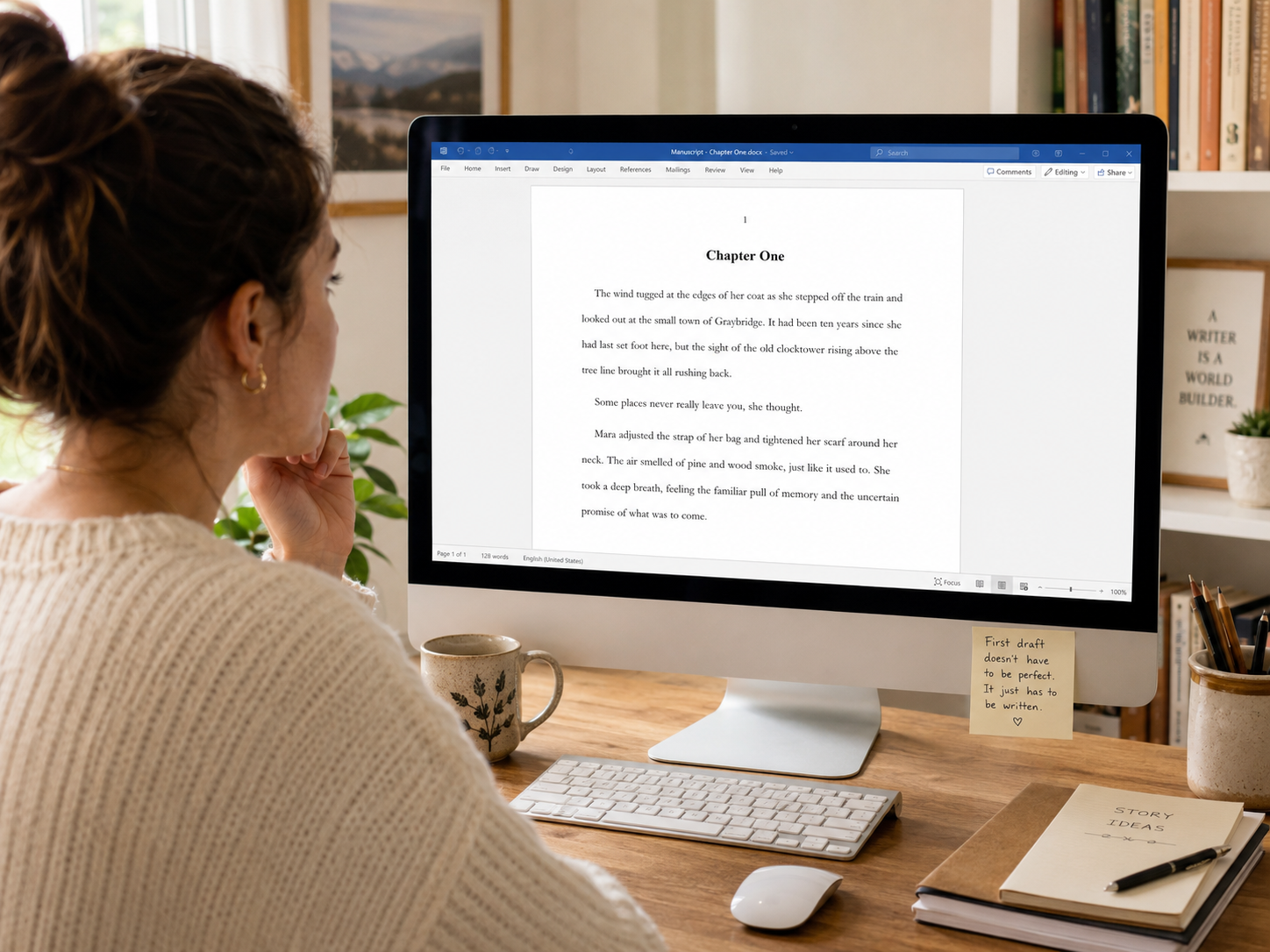
Here’s a standard setup that would make me do a happy dance if I received a manuscript with the following:
Use a common font like Times New Roman or Calibri
Use 12-point font
Set the paragraph to be double-spaced
Set the margins at one inch
Use standard page numbers
Use consistent chapter headings. By that, I mean if you applied a heading to Chapter One and just bolded Chapter Two, and you mix them up across 20 chapters, the time it takes to correct those adds up.
Submit a clean Word document unless your editor tells you otherwise, since that's where most of us work with tracked changes and comments. You don't need anything fancy. You just need it tidy enough that your editor spends time on your writing, not on reformatting your file.
Tell Your Editor What You're Trying to Do
This is the step where I will drag the answer out of you. I would never take on a project without knowing why you wrote the book and what you’re trying to achieve. Other editors may not bother. So, when you submit to an editor, include a short note—even a few paragraphs—that answers the following questions:
Who is this book for?
What do you want a reader to feel, understand, or do by the end?
Are there stylistic choices you've made on purpose—an unconventional structure, invented words, a deliberately conversational tone—that you don't want "corrected"?
Where do you feel you need the most help?
I once worked with an author who wrote a 147,000-word book full of invented words and multiple languages. If he hadn't told me those were intentional, I might have spent hours flagging them as errors. Instead, he gave me the context up front, and I could focus on serving his vision rather than second-guessing it.
If you're using a specific style guide—Chicago, AP, or a custom style sheet—say so. If certain spellings or character details are deliberate, note them. A page of context saves both of us a dozen rounds of queries.
Get in the Right Mindset for the Feedback
The last thing to prepare isn't on the page. It's in your mindset.
Editing is a collaboration, not an assessment of your writing prowess. I’ll tell you, those Tracked Changes look way worse than they are. Consider those markups as a conversation between you and the editor about a suggested roadmap for your book. Every writer I've worked with, including ones who've published in a big way, has had a moment of staring at tracked changes and wondering if they're any good at this. They are. The marks just mean the work is getting better.
When you process the edits, come at them willing to engage, push back where you disagree, and pause to sit with suggestions before reacting. The writers who get the most from editing treat it as a conversation about their work, not a referendum on their worth.
One thing I want to share from the bottom of my heart is that editors like me feel honored to collaborate in this way. Putting your thoughts out there, no matter the genre, is an incredibly brave act.
Ready to Take the Next Step?
If you've worked through these steps and your manuscript is ready for a professional set of eyes—or if you're still not sure what kind of editing it needs—feel free to reach out. No pressure. Just a chat about where you are and how to get your book where you want it to go. You can find me here.