
Blog
Whether you’re outlining your first chapter or polishing your final draft, you’ll find practical guidance, editorial insight, and a steady nudge forward.
Browse by Topic
-
Editing & Revision
- Jul 28, 2026 A Realistic Timeline for Writing and Editing a Nonfiction Book Jul 28, 2026
- Jul 23, 2026 Why Great Editing Preserves Your Voice (Instead of Editing It Out) Jul 23, 2026
- Jun 27, 2026 What Is Copyediting, and When Do You Need It? Jun 27, 2026
- Jun 27, 2026 What Is Proofreading? Your Manuscript's Last Line of Defense Jun 27, 2026
- Jun 27, 2026 What Is Line Editing? The Service That Sharpens Your Voice Without Replacing It Jun 27, 2026
- Jun 20, 2026 Developmental Editing for Nonfiction: What It Is and When You Need It Jun 20, 2026
-
Editing Tips
- May 21, 2026 What Type of Editing Does Your Manuscript Need? May 21, 2026
- May 19, 2026 How to Self-Edit Your Nonfiction Manuscript May 19, 2026
-
Getting Started
- May 12, 2026 How to Outline a Nonfiction Book (With Templates and Examples) May 12, 2026
- May 8, 2026 How to Turn Your Expertise Into a Compelling Book May 8, 2026
- May 8, 2026 How to Start Writing a Nonfiction Book (When You Don’t Know Where to Start) May 8, 2026
-
Memoir/Personal Narrative
- Jun 30, 2026 How to Write a Memoir That Doesn't Read Like a Diary Jun 30, 2026
-
Reader Engagement
- Jun 25, 2026 The Psychology of Reader Engagement in Nonfiction Jun 25, 2026
- Jun 23, 2026 How to Build Credibility and Trust as a Nonfiction Author Jun 23, 2026
- Jun 9, 2026 Using Research In Your Writing Without Boring Readers Jun 9, 2026
- Jun 4, 2026 The Art of Clarity: How to Write Complex Ideas Simply Jun 4, 2026
-
Storytelling
- Jun 23, 2026 Storytelling in Nonfiction Writing Jun 23, 2026
-
Structure
- Jun 20, 2026 Developmental Editing for Nonfiction: What It Is and When You Need It Jun 20, 2026
- Jun 11, 2026 How to Craft a Strong Central Argument for Your Nonfiction Book Jun 11, 2026
- Jun 4, 2026 The Art of Clarity: How to Write Complex Ideas Simply Jun 4, 2026
- May 14, 2026 How to Structure a Nonfiction Book for Maximum Clarity and Impact May 14, 2026
- May 12, 2026 How to Outline a Nonfiction Book (With Templates and Examples) May 12, 2026
-
Writer Editor Collaboration
- Jul 21, 2026 Red Flags When Choosing a Nonfiction Editor (and What to Look For Instead) Jul 21, 2026
-
Writer-Editor Collaboration
- Jul 16, 2026 Writing Coach vs. Editor: Which One Do You Need? Jul 16, 2026
- Jul 14, 2026 Signs Your Nonfiction Manuscript Is Ready for Editing (or Not Quite Yet) Jul 14, 2026
- Jul 9, 2026 What to Expect When Working With a Nonfiction Editor Jul 9, 2026
- Jul 2, 2026 The Writer–Editor Relationship: What Collaboration Should Look Like Jul 2, 2026
-
Writing Mindset
- Jul 16, 2026 Writing Coach vs. Editor: Which One Do You Need? Jul 16, 2026
- Jul 14, 2026 Signs Your Nonfiction Manuscript Is Ready for Editing (or Not Quite Yet) Jul 14, 2026
- Jul 9, 2026 What to Expect When Working With a Nonfiction Editor Jul 9, 2026
- Jul 2, 2026 The Writer–Editor Relationship: What Collaboration Should Look Like Jul 2, 2026
- Jun 25, 2026 The Psychology of Reader Engagement in Nonfiction Jun 25, 2026
- Jun 23, 2026 The Mindset Shift Every Writer Needs Jun 23, 2026
- Jun 23, 2026 How to Build Credibility and Trust as a Nonfiction Author Jun 23, 2026
- May 28, 2026 The 7 Habits of Great Writers May 28, 2026
-
Writing Process
- Jul 28, 2026 A Realistic Timeline for Writing and Editing a Nonfiction Book Jul 28, 2026
-
Writing Tips
- Jun 23, 2026 The Mindset Shift Every Writer Needs Jun 23, 2026
- Jun 23, 2026 Storytelling in Nonfiction Writing Jun 23, 2026
- Jun 11, 2026 How to Craft a Strong Central Argument for Your Nonfiction Book Jun 11, 2026
- Jun 9, 2026 Using Research In Your Writing Without Boring Readers Jun 9, 2026
- Jun 4, 2026 The Art of Clarity: How to Write Complex Ideas Simply Jun 4, 2026
- May 28, 2026 The 7 Habits of Great Writers May 28, 2026
- May 26, 2026 The 5 Most Common Mistakes Writers Make (And the Simple Fixes) May 26, 2026
- May 14, 2026 How to Structure a Nonfiction Book for Maximum Clarity and Impact May 14, 2026
- May 12, 2026 How to Outline a Nonfiction Book (With Templates and Examples) May 12, 2026
- May 8, 2026 How to Turn Your Expertise Into a Compelling Book May 8, 2026
- May 8, 2026 How to Start Writing a Nonfiction Book (When You Don’t Know Where to Start) May 8, 2026
A Realistic Timeline for Writing and Editing a Nonfiction Book
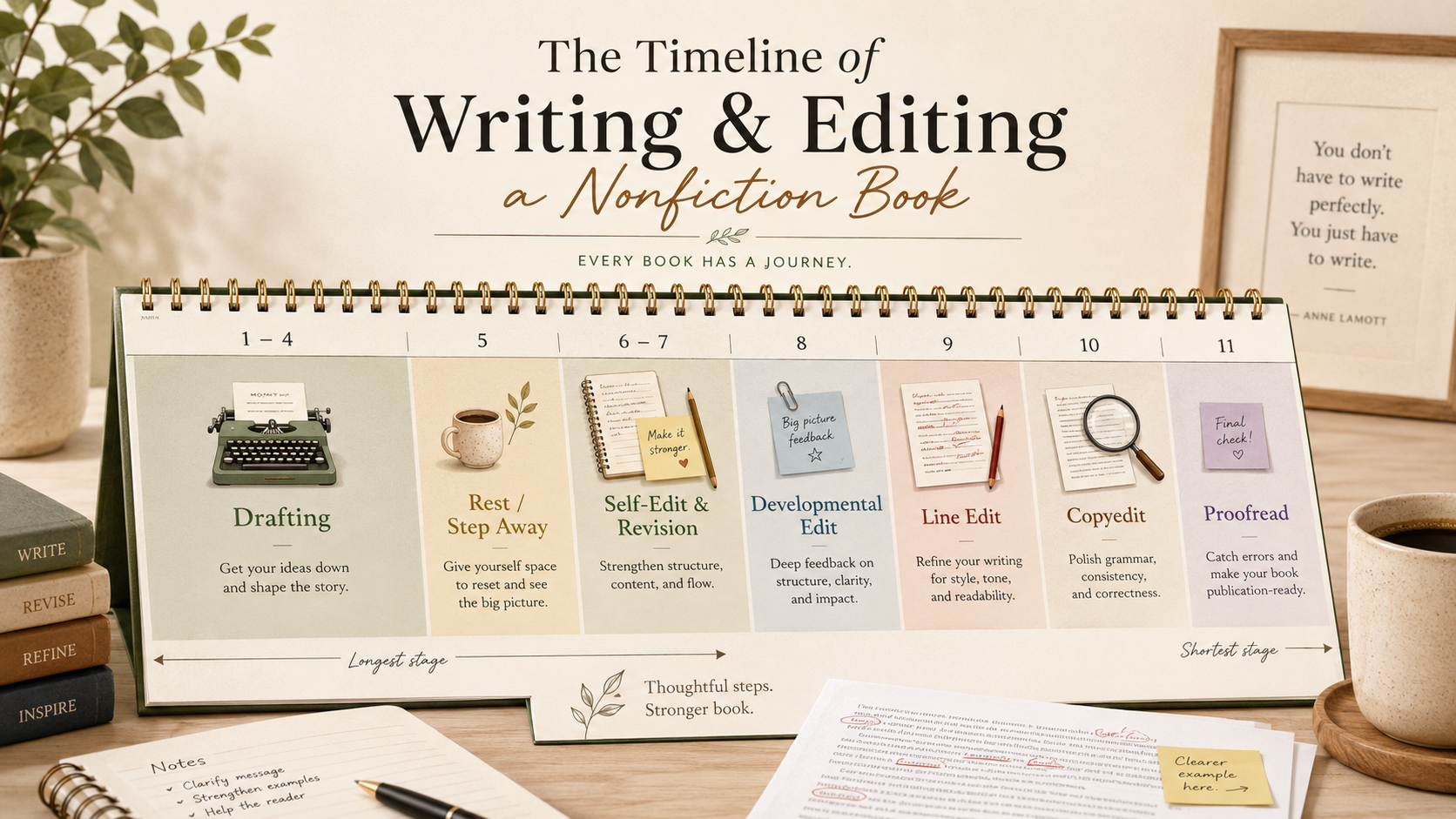
The question comes up before some writers have typed a single word: How long is this whole thing going to take? It's reasonable to want to know. You're about to pour a meaningful chunk of your life into a book, and you'd like some sense of whether you're signing up for months or years.
Here's the honest answer, and I promise to do better than stopping here: it depends. A 30,000-word business book written by someone with an open calendar moves at a wildly different pace than a 90,000-word memoir squeezed into the margins of a full-time job and a houseful of kids. So rather than give you one magic number to make it nice and neat, let me walk you through a realistic nonfiction writing timeline, stage by stage, so you can build one that fits your day-to-day life.
Consider what follows a planning tool, not numbers set in stone. The ranges are real, but your mileage will vary—and that's perfectly on par.
The Drafting Stage: Slower Than You Hope, Faster Than You Fear
Most writers underestimate how long a first draft takes, then beat themselves up for falling behind a schedule that was never realistic to begin with. Let's not do that to you.
A typical nonfiction book runs somewhere between 40,000 and 80,000 words. If you write 500 words on the days you genuinely sit down—and we both know you won't sit down every day, because you have a life—you're looking at several months of drafting. Many of the writers I work with take six months to a year to get a complete first draft down. Some move faster. Others move more slowly, especially when the book leans on research, interviews, or excavating old journals to reconstruct what happened.
Many writers are surprised when I tell them that the biggest variable here isn't talent, and it’s not even the hours on your calendar. It's consistency. A writer who produces 300 words four mornings a week will almost always finish ahead of the one holding out for a free weekend and a thunderbolt of inspiration. Stephen King writes daily for a reason: momentum is far easier to maintain than to rebuild from a cold start.
When you map your own drafting timeline, be generous. Pick a word count you can hit on an ordinary Tuesday, do the multiplication, and then pad it for the weeks when life decides to get chaotic.
Self-Editing and Revision: The Stage Everyone Wants to Skip
Once you've got a complete draft, the urge to fire it off to an editor while it's still warm is almost physical. Resist it for a week or two. Literally step away. That distance is what lets you come back and read what's on the page instead of what you meant to put there. Do you get what I’m saying by that? When we’re too close to the writing, our brains tend to fill in any gaps on the page (this is especially true for those of you who are subject matter experts!), and we don’t process the content in the same way a reader with fresh eyes would. We already know what we mean when we read a sentence. That’s why you need that space and time to pivot your attention and let that manuscript rest.
Next is revision, which is where a lot of the real writing happens. Budget a few weeks to a couple of months here, depending on how much reshaping the draft needs. A self-editing pass—hunting for the patterns nearly every nonfiction writer falls into, like overwriting and weak transitions—does double duty. It sharpens the book, and it means you'll eventually pay your editor to refine your prose rather than untangle the basics.
This stage is unglamorous and easy to rush past. Take. Your. Time. The weeks you invest here tend to pay for themselves later, in both time and money.
What Moves the Needle
Before we get to the editing calendar, it helps to know what truly stretches or shrinks these ranges, because two writers with the same word count can finish a year apart.
Length. A 35,000-word guide is a different animal from a sprawling family saga.
Complexity. A book heavy with research, citations, or interwoven timelines asks more of every stage.
Available time. The writer with two protected hours a day will lap the one stealing 15 minutes between meetings.
Condition of your draft when it reaches an editor. Writers wildly underestimate this. A clean, self-edited manuscript moves through editing faster than a rough one, simply because there's less to wade through before the meaningful work begins.
The Editing Stages: Broad to Fine, in Order
Here's where the editing timeline takes on its own rhythm, and where sequence earns its keep. Editing happens in stages—a progression that runs from the big-picture architecture down to the last stray comma—and tackling them out of order is how writers end up paying for the same work twice. I've covered the different types of editing in depth elsewhere, but here's how each one tends to sit on a calendar.
Developmental editing comes first, and it's the heaviest lift. This is the architectural work: structure, argument, pacing, and whether the book delivers on its promise. For a full manuscript, the edit itself often runs several weeks, and the revision it sets in motion can take you weeks or even months, since a developmental pass frequently means reordering chapters or writing fresh material. It's the stage most likely to send your timeline sideways, which is exactly why you want it early, before you've buffed sentences that may not survive the cut.
Line editing arrives once your structure holds. Working at the sentence and paragraph level—voice, rhythm, clarity—a line edit on a full-length manuscript generally takes a few weeks, plus your own time to work through the suggestions.
Copyediting follows, handling grammar, consistency, and mechanics. The edit lands in a similar ballpark, though your turnaround on the changes is usually quicker, since you're reviewing corrections rather than rebuilding paragraphs.
Proofreading is the final pass, and the speediest by a comfortable margin. On a clean, formatted file, it's often a matter of days to a couple of weeks.
One factor writers almost never build in: the queue. Sought-after editors are frequently booked weeks, sometimes months, ahead. The edit might take three weeks, but if your editor can't start until spring, that wait belongs on your timeline too. Reach out earlier than feels necessary.
Putting It Together: A Sample Timeline
Let me make this concrete with a plausible scenario: Our writer has a full-time day job, and this is their first book at 60,000 words. That means the bulk of the writing will be done on weekends with occasional sessions during weekday evenings. You can easily decrease the following times by half if, say, you’ve got a part-time job. Your numbers will land differently, but this will give you an idea.
Drafting. Around eight or nine months at a sustainable pace.
Revision and a self-edit pass. Two months.
Developmental editing. Two to three months once you fold in scheduling.
Line editing. Six to eight weeks.
Copyediting. Roughly a month.
Proofreading. A week or two.
Stack those up, leave breathing room between stages for the life interruptions that will absolutely arrive, and you're somewhere in the neighborhood of 18 months to two years from blank page to publication-ready manuscript.
If that number made you wince, take a breath. Many books move faster—shorter ones, second books, writers who can give the project real daily time. And not every manuscript needs every stage; a writer with a strong structural instinct or a chapter flow that is inherently logical might skip developmental editing altogether. The principle behind these timeframes is that a book of substance takes real time, and knowing that up front spares you that nagging sense of feeling perpetually behind.
Why a Realistic Timeline Is a Gift
The writers who finish are the ones who kept going when the work took longer than they'd hoped—and it almost always takes longer than they'd hoped. With as many manuscripts as I’ve handled, you’d think I’d be able to look one over and give the writer an accurate estimate of how long the editing process will take. And let me say here that I’m a bit of a workhorse because I have the flexibility in my life to do so (and it’s just how my brain works). But I can never understand the depth or breadth of what changes are needed in a manuscript by a cursory look. Remember, we are talking about the real work of editing that includes more than corrections to spelling, grammar, and punctuation. We usually sail through that stuff.
So, giving yourself a realistic writing timeline for your nonfiction book does something powerful: it turns "I'm so far behind" into "I'm right on schedule." When you know drafting eats most of a year, you stop spiraling in month four. When you know a developmental edit can reshuffle your entire second half, you build in the room ahead of time instead of resenting it later. Most of the discouragement I see in writers traces back to measuring an honest pace against a fantasy schedule that never existed in the first place. That unrealistic schedule is only because the writer didn’t know better.
So plan for the long haul, pad your estimates, and treat the timeline as directional, not an endpoint set in stone. Your book will take as long as it takes. Your job is to keep showing up for it.
The difference between published and non-published writers is persistence.
The Last Word
A nonfiction book is a serious undertaking, and pretending otherwise only sets you up to feel like a failure when you're simply somewhere in the middle. Give the writing its months. Give the revision its weeks. And let each editing stage take its turn in line. Do that, and the timeline stops being a source of frustration and turns into a reasonable plan you can follow.
Now, hurry up and write your book already! 🙂 If you’re having trouble getting started, writers have found the content in this post helpful.
Why Great Editing Preserves Your Voice (Instead of Editing It Out)
There's a particular fear I hear from writers before we've even started working together. They'll send me a few chapters, then add a nervous note: "Please don't make it sound like someone else wrote it."
I get it. You've spent months—maybe years—getting your words to sound like you. The last thing you want is to hand your manuscript to a stranger and get back something polished, coherent, and completely unrecognizable.
So let me put this to rest right away. The whole point of good editing is to preserve author voice, not bury it. A skilled editor isn't trying to turn your prose into theirs. They're trying to help you sound more like yourself, not less.
That distinction—editing without losing voice—is the heart of what I do. Let me show you how it works.
What Is Your Voice Anyway?
Voice is slippery to define, but you know it when you read it. It's the rhythm of your sentences and the words you reach for when you're not overthinking. It's the way your personality flows onto the page, intentionally or not. Two writers can describe the same event and sound nothing alike, and that gap is voice.
The first thing to know is that voice isn't the same as polish. A manuscript can be riddled with comma splices, yet crackle with personality. It can also be technically flawless and read like a chemistry textbook. The mechanics and the music are separate things—and a seasoned editor treats them that way.
That separation is why editing and rewriting aren't the same job.
Editing and Rewriting: Not the Same Job
When someone rewrites your prose, they replace your choices with theirs. Your sentence becomes their sentence. You read it back and think, "That's... fine, I guess," because you can't argue with it—but it isn't how you'd have said it. Something got swapped out.
Editing works differently. A good edit first questions before even considering any alternatives: what were you reaching for here, and is the sentence getting you there? The goal is to help you land it while still sounding like you.
I tell clients this constantly: I'm not here to make you sound like me. I'm here to make you sound like the best version of yourself on the page. If you've read my breakdown of the different types of editing your manuscript needs, you know line editing in particular is built around this idea. A line edit amplifies your voice. It doesn't overwrite it.
How an Editor Keeps the Writer’s Voice Intact
So what does this look like when a manuscript is actually in front of me?
For one, I work in tracked changes with comments—it’s all transparent.. You see every suggestion, and you get to accept it, reject it, or counter with something better. The manuscript stays yours the entire time. I'm a collaborator, not a teacher correcting your paper.
Before I edit anything, I pay attention to patterns, not only on the page, but also in our exchanged messages. I read enough, for example, to learn how you build a paragraph, where your humor lives, and how you handle a hard transition. Once I understand your natural moves, I can tell the difference between a quirk worth protecting and a habit worth fixing. And everybody gets into some kind of a pattern of writing that we need to discontinue. It could be switching verb tenses from one paragraph to the next, using a particular word too frequently, or using filler words that amount to “throat clearing” before launching into a critical idea.
That’s it. That's the whole game. An adverb you lean on for rhythm is a different animal from an adverb propping up a weak verb, and a good editor learns to hear which is which.
When I do suggest a change, I explain why. A comment like "tightening this so the punchline lands harder" tells you what I'm protecting: your joke, your point, your effect. You're never left guessing whether I understood what you were going for.
When Your Voice Isn't Actually the Problem
Here's the honest part. Sometimes what feels like "losing your voice" in an edit is something else entirely.
I once worked with an author who came to me convinced editing meant getting sanded down, because a previous editor had left his book sounding like a press release. When we dug in, the issue wasn't that he had too much voice. It was that he'd been hiding it—writing in the stiff, over-formal register he assumed a "serious" book required. The flattening hadn't started with his old editor. It started with him trying to sound like someone he wasn't.
We worked to clear away the borrowed formality so the personality already there could finally come through. That's a pattern I see all the time, and it's one of the traps I get into in my post on the mistakes I see in nearly every manuscript. Sometimes, the most voice-preserving thing an editor can do is give you permission to sound like yourself.
Trust Is Paramount
You're handing an editor something you made. That takes trust, and trust gets earned by how an editor treats your words—not how confidently they replace them.
The right editor reads you closely enough to protect what makes your writing yours. The wrong one imposes a house style and calls it improvement. If you've done the work of self-editing your manuscript and you still love how it sounds, a good editor should love that too, then build on it instead of overriding it.
Your voice is the reason someone will want to read your book instead of the thousand others on the same shelf. No editor worth hiring would take that from you. The job is to make it sharper, clearer, and more unmistakably yours.
If you've been holding off on hiring an editor because you're afraid of being rewritten, I'd love to change your mind. Reach out and tell me about your project. Let's talk about how to make your manuscript sound exactly like you—only better.
Red Flags When Choosing a Nonfiction Editor (and What to Look For Instead)

You’ve put everything you have into completing your nonfiction manuscript. Your colleagues and friends have given it a thumbs-up, and many of them reinforced what you already know: you need an editor to get it publish-ready. Unless you’ve written a book and have gone through the publishing process before—and even if you have—this is a vulnerable time for writers. Choosing a nonfiction editor means handing a near-stranger months or years of your work, and not every editor deserves that trust.
Pre-pandemic, I wouldn’t have written an entire blog post on this. But throughout the pandemic era through today, I can say with confidence that freelancers who have little to no editing experience are labeling themselves as such and charging below market rates. Just know that it takes years of hands-on experience with many different writers to hone one’s editing skills.
What I’m about to share with you does not make me rub my hands together in glee. But writers have found me after having had bad experiences with so-called editors”
Editors who suddenly go silent mid-project.
An editor delivered line edits as comments in the margins.
Several editors obviously let AI edit the manuscript.
An editor who thought development editing was prompting the writer to add more content to the manuscript.
A big-name publishing house editor line-edited my client’s voice out of his first book.
Those editing disasters are completely avoidable when you know what to look for before agreeing to anything.
Let's get started by walking through the editor behaviors that should raise a red flag—and the signs you're looking at a good one. (Like when you look at my photo!)
Raise the Red Flag When:
They guarantee you'll get published
Red Flag: We’re starting with the big one. If an editor promises their work will land you an agent, a book deal, or a spot on a list, walk away.
No honest editor can promise that. Publishing depends on the market, timing, your platform, and a long list of things no editor controls. An editor's job is to make your manuscript as strong as it can be, not to sell you a fantasy. When someone leads with guarantees, they're really selling hope—and hope tends to be overpriced.
Green Flag: Look for an editor who's candid about what editing can and can't do. The good ones set realistic expectations and are upfront about the limits of the work.
They can't tell you what kind of editing you need
Red Flag: A nonfiction manuscript might need developmental editing, line editing, copy editing, or proofreading. Those are genuinely different services at genuinely different price points. (I break it all down in my post on what type of editing your manuscript actually needs.)
A warning sign is the editor who lumps it all into one fuzzy package, or who quotes a "full edit" without asking where you are in the process. Worse is the one who happily agrees to a copy edit when your book has structural problems that no amount of comma-fixing will solve.
Green Flag: What you want instead is someone who asks questions before quoting. A good editor wants to know whether you've finished revising, what feedback you've gotten so far, and what you're trying to accomplish. Often, they'll point you toward the service you actually need—even when it costs less than the one you asked for.
The price feels too good to be true
Red Flag: We all want a deal. But editing is skilled, labor-intensive work, and rates that fall dramatically below the norm usually signal inexperience or a rushed job. The Editorial Freelancers Association publishes rate ranges that give you a realistic feel for the market. If a quote comes in at a small fraction of that, it's worth asking why.
The flip side is its own red flag. An editor who's vague about money—who won't put scope, price, and timeline in writing—is one you can't hold to anything later.
Green Flag: Look for clear, written terms: a real scope-of-work document that spells out:
What you're getting
What it doesn’t include (like if you add more content during the process)
When you’re getting it
What it costs
They want to make your book sound like them
Red Flag: This is the one that genuinely bothers me, because it's so hard to undo. Some editors, often well-meaning ones, revise until your voice disappears and theirs takes over. You get back clean, competent prose that no longer sounds like you wrote it.
In nonfiction, especially, your voice is the reason readers trust you. It's what makes a memoir feel intimate and a business book feel like real advice from a real person. Many of these subject matter experts appear online in videos. Imagine a major mismatch between their authentic voice and how they sound on the page. There’s a real risk of losing credibility, like maybe the SME really didn’t write it. An editor who edits out a writer’s voice is doing damage, even when every individual sentence is technically improved.
Green Flag: A prospective editor will proactively tell you how they handle voice. The answer is some version of this: my job is to make you sound more like yourself, not more like me. That distinction is the whole game.
They say yes to everything
Red Flag: Here's a counterintuitive one. An editor who never pushes back, never tells you anything you don't want to hear, and agrees with everything you say has zero editing prowess.
Green Flag: I've declined projects that weren't the right fit, and I've told writers their manuscript needed another revision pass before I could be useful to them. That isn't rejection—it's respect, both for the work and for their budget. Honest pushback during a sample edit or a first conversation is one of the better signs you're dealing with a professional who has standards rather than just an open calendar.
They can't show you anything
Red Flag: Before you commit, you should be able to see how an editor works and get a sense of what it’s like to collaborate with them. A short sample edit shows you their judgment on your actual pages, not a generic pitch. Testimonials and references tell you whether they deliver what they say they will. Why would you let someone have access to your manuscript who gives you nothing to earn your trust?
Green Flag: A willingness to do a brief paid sample edit is a green flag worth paying attention to. So is a roster of clients who'll vouch for the experience, not just the result.
Indicators of a Good Editor
Pull these threads together, and the same picture keeps emerging.
Signs of a good editor:
Curious about your book
Honest about the work
Protective of your voice
Ask more than they promise.
Undersells and over-delivers
Treats the collaboration as a partnership
If you're trying to choose a nonfiction editor and you're not sure who to trust, I'd be glad to talk it through. No pressure, no pitch. Reach out and tell me where you are with your book. The right fit matters far more than any number on a price sheet.
Writing Coach vs. Editor: Which One Do You Need?
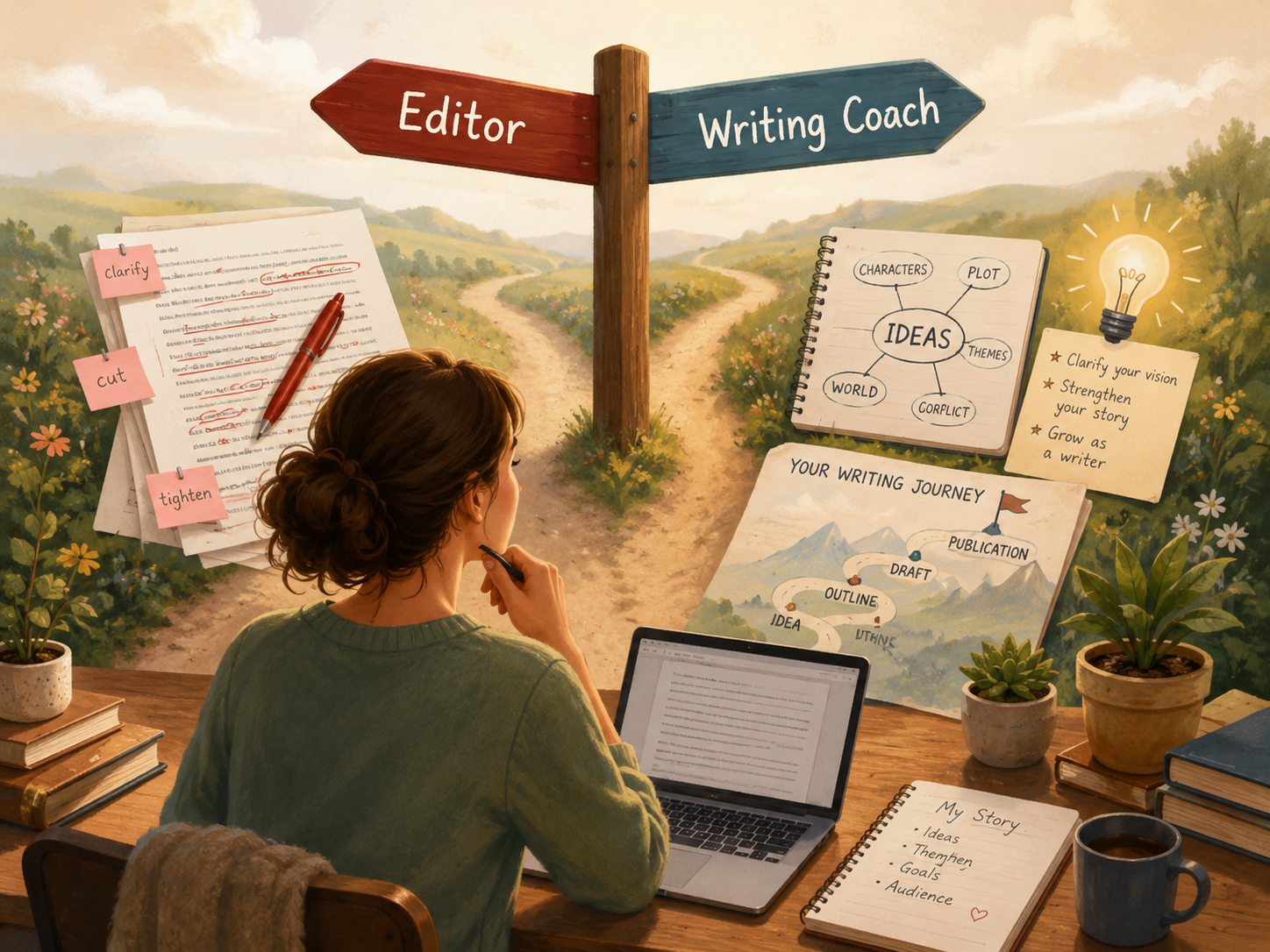
You know your nonfiction book needs help. What you're less sure about is what kind. "Writing coach" and "editor" tend to get tossed around like they're the same service, and plenty of people in the industry blur the line themselves. But a writing coach and an editor do genuinely different jobs, at different stages, for different problems. One helps you produce a manuscript. The other helps you refine one. Hiring the wrong one at the wrong time is an expensive mistake. So let's settle the writing coach vs. editor question for nonfiction writers, so your money is spent on elevating your book and moving it forward.
What a Writing Coach Does
A writing coach works with you while you're writing. You’ve got someone in your corner through the messy, uncertain middle part of a project—the stretch where most books quietly die.
Coaches help with momentum, accountability, and the day-to-day discipline of getting words on the page. A good one helps you set realistic goals, talks through structure before you've committed 40,000 words to the wrong one, and helps you troubleshoot when you're stuck. Some coaches teach craft directly. Others act more like a strategic partner who asks the right questions until you find your own way through.
What a coach generally won't do is take your finished pages and mark them up line by line. Their work is about you—your process, your habits, your confidence. The manuscript gets better as a byproduct of you getting better.
What an Editor Does
An editor works on the page, not the process. You hand over your writing, and they provide suggestions directly on the page to improve it. You can accept or reject those suggestions.
Beyond that, there are several types of editing, depending on what the manuscript needs.
Developmental editing tackles structure and argument.
Line editing works at the sentence level—voice, rhythm, flow.
Copy editing handles grammar and consistency.
Proofreading is the last polish before you publish.
But the common thread is this: editors respond to writing that already exists. They are product-focused, not process-focused. You hire an editor to elevate what you've already written.
The Real Difference: Where You Are in the Process
The cleanest way to tell these two apart is to forget the job titles and ask where you are.
If you're still writing—the draft isn't done, you keep stalling, you're not even sure the thing holds together—you're in coaching territory. A coach helps you produce the manuscript.
If you have a draft—rough is fine, but it needs to be a real, complete one—you're in editing territory. An editor helps you refine it.
Signs You Need a Writing Coach
You haven't finished a draft, and some part of you suspects you won't.
You start strong and lose steam around the middle, every single time.
You have the expertise or the story, but no idea how to shape it into a book.
You need accountability—someone expecting pages from you on a schedule.
This is your first book, and you’re overwhelmed.
If a few of those land, your money is better spent on coaching (or a structured writing program) than on editing. There's no sense paying someone to polish a manuscript that doesn't exist yet.
Signs You Need an Editor
You have a finished draft and know it needs work—you just can't always name what.
You've taken it as far as you can on your own, including self-editing, and need fresh, professional eyes.
You're getting ready to query agents or self-publish and want the writing as sharp as possible.
Beta readers keep flagging the same issues, and you want an expert read on what's really going on.
If you're nodding along, you're ready for editing. The only thing left is figuring out which type—and that hinges on whether your manuscript needs structural work or sentence-level refinement.
Where the Two Overlap
Here's where the line blurs, because it isn't always clean.
Developmental editing, in particular, shares DNA with coaching. A developmental editor diagnoses big-picture problems—structure, argument, pacing—and guides your revision without rewriting the book for you. That guiding role can feel coach-adjacent. The difference is timing and form: a developmental edit responds to a complete draft and arrives as a defined deliverable, usually an editorial letter plus margin comments. Coaching is ongoing and forward-looking. Developmental editing is a high-level assessment of the work you've already done.
Some professionals offer both, and the roles hand off naturally—a coach gets you to a finished draft, an editor helps you make it publishable. They aren't rivals. They're tools for different stages. For example, I offer both and, more often than not, incorporate a small degree of coaching into my editing services, as all of my clients turn out to be better writers by the end of our collaboration (and hopefully, have learned a thing or two they can use moving forward).
So, Which One Do You Need?
Let’s just strip it down to a single question: Do you have a complete draft?
If the answer is no, you need a coach—or build the writing habits that do a coach's job. If the answer is yes, you're ready for an editor, and the only thing left to sort out is which kind.
If you've got a draft and aren't sure what it needs—or whether it's even ready for editing yet—reach out. Sometimes a short conversation is all it takes to figure out where you are and what will actually help.
Signs Your Nonfiction Manuscript Is Ready for Editing (or Not Quite Yet)
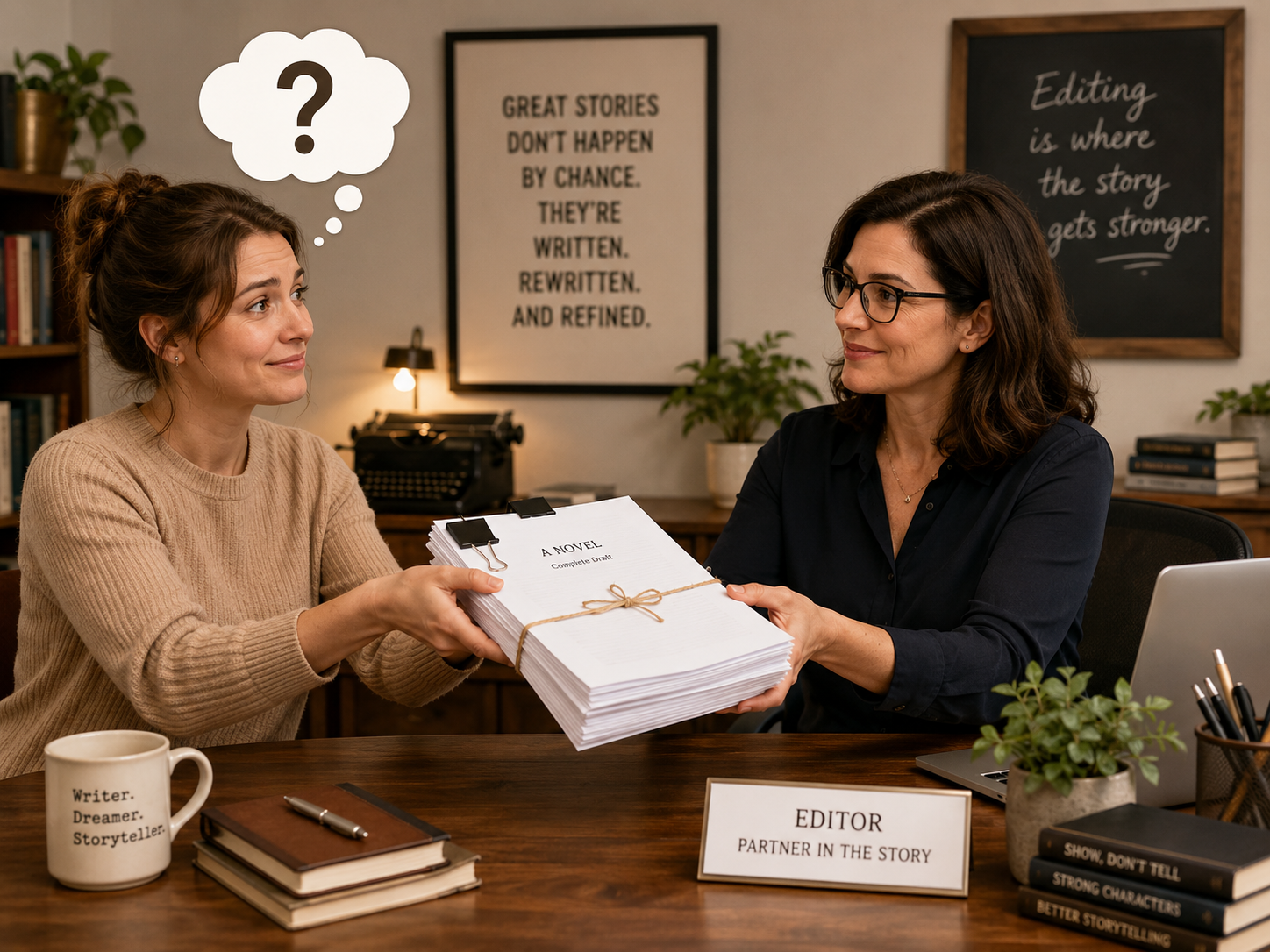
Every writer hits the same crossroads eventually. You've poured months—sometimes years—into your manuscript, and now you're staring at it, wondering whether it's time to bring in a professional or whether you'd just be handing over a draft that isn't there yet.
It's a fair question, and knowing when to hire an editor matters more than most writers realize. Bring one in too early, and you risk paying someone to point out problems you or a beta reader could have caught—or worse, paying for careful work on material you end up cutting anyway. Wait too long, and you can spend months spinning your wheels, polishing a manuscript that needs an outside set of eyes to move forward.
After years of editing nonfiction, I've gotten pretty good at reading the signals on both sides. And almost every writer I work with says the same thing afterward: they wish they'd known the signs sooner. Here's how to figure out where you stand.
You've Finished a Complete Draft
This is the big one. Before you hire an editor, you need a finished draft—beginning, middle, and end. It just has to be complete, not polished.
I can't tell you how many writers reach out when they're a third of the way in, hoping an editor can help them figure out where the book is going. I understand the impulse. But editing a partial manuscript is like asking a contractor to inspect a house with no roof and half the walls still missing. There's not enough there to assess. Finish the draft first, however rough it turns out. A messy, complete manuscript gives an editor something real to work with.
If you are absolutely stuck in the last third of your book but you are clear on its trajectory, then you would need a writing coach—not an editor—to help you get to the end.
You've Already Revised at Least Once
A first draft fresh off the keyboard is not going to be ready for professional editing—unless you’re Stephen King. Countless successful writers say that writing is revision, revision, revision. I just took David Sedaris’s MasterClass, and he said he will rewrite the opening of a short story 14 times before he is convinced he has the right version. Sedaris is a prolific, seasoned writer. You’d think it would come to him, maybe by the third try. But 14 times! In the class, he showed some of the opening rewrites that didn’t make the cut, and even though they were beautifully written, they didn’t create the setup that he was going for. That’s why writing is truly a craft.
If you’re feeling urgency, this next thing may be hard to do, but it works. Step away from the manuscript for a week or two, then come back and revise with fresh eyes. That distance lets you catch the rambling sections, the point you accidentally made twice, the place where you buried your real insight under three paragraphs of throat-clearing.
And if you haven't done a self-editing pass yet, that's your next move, not hiring an editor. (I walk through exactly how to approach this in my post on self-editing your manuscript). Handing over a draft you've already tightened means you're paying for refinement instead of cleanup.
You've Taken It As Far As You Can
You've read the manuscript so many times, you can no longer tell what's working. You've revised it, reorganized it, gone back and tinkered some more, and now you're just moving commas around. Something feels off, but you can't name it.
You’ve just hit the wall of self-editing. You know your material so well that you've lost the ability to read it as a stranger would, which is exactly the perspective a book needs before it goes out into the world. When you hit that wall, it's a strong sign you're ready for an outside reader.
You Know What You're Asking For—Or You're Ready to Find Out What You Need
You don't need to walk in with a perfect diagnosis. But it helps to have a sense of whether you're after big-picture structural feedback, sentence-level polish, or a final proofread. These are different services at different price points, and matching the right one to your manuscript's actual stage saves you real money. If you're unsure which you need, that's a conversation worth having before any work begins. (My breakdown of the different editing types is a good place to start sorting that out.)
So those are the green lights. Now for the other side.
You're Still Making Major Changes
If you're rethinking your structure, cutting whole chapters, or debating what the book is even about, you're not ready—and that's completely fine. Questions like these are worth resolving before line-level work begins, because there's no sense in perfecting prose that might not survive the next round of revision. Sometimes a developmental editor is the right partner for this stage. But if you're still in the process of shaping the book, give yourself room to do that work first.
You're Looking for Reassurance More Than Feedback
Be honest with yourself here. Are you hiring an editor because your manuscript needs sharpening, or because you want someone to tell you it's good? I say that with affection, because every writer feels the pull. Editing is a process of making your work better, which means it involves hearing what isn't landing yet. If you're not in a headspace to receive that, a little more time might serve you better than a little more money.
You're Hoping the Editor Will Do the Hard Part
A good editor diagnoses and guides. They don't write your book for you. If part of you is hoping to hand off a thin draft and get back a finished manuscript, that expectation will disappoint everyone involved. The revision is yours. An editor helps you see it more clearly so you can do it well.
When You're Somewhere in Between
Most writers don't land cleanly in one camp. You've finished a draft and revised it once, but you're still uneasy about the structure. You've taken it as far as you can, but you're not sure it's far enough. That uncertainty is common, and it's exactly where a conversation helps to clarify where you are and what you need. You don't have to figure that out alone.
Not Sure Where You Stand?
If you've read this far and you're still uncertain whether your manuscript is ready for editing, that uncertainty is worth talking through. Reach out, and let's figure out where you are in the process and what kind of support would move your work forward.
What to Expect When Working With a Nonfiction Editor

Handing your manuscript to an editor for the first time feels a little like handing someone your journal and asking them to mark it up in red pen. You've lived with these pages for months, maybe years. You know every soft spot, every paragraph you wrestled with at 2 a.m. and never quite fixed. And now a stranger is going to read all of it.
I get it. As an editor, I've watched plenty of writers approach that first handoff with their shoulders up around their ears. I don’t blame them. It’s an incredibly brave thing to do.
But let me pull back the curtain for a minute. Most of the anxiety around the nonfiction editing process comes from not knowing what happens once you hit "send." When you understand what goes on during the editing process, that anxiety dissipates quite a bit. Here's a behind-the-scenes look at what working with an editor looks like, from first contact to final file.
Conversation First
Before a single word is edited, a professional editor wants to understand your vision. What triggered you to write the book? Where are you in the process? Who are your readers? What's keeping you up at night about it?
That first conversation is about determining what kind of editing service your manuscript needs. Sometimes a writer asks me for a line edit when their manuscript has a structural problem that has to be solved first. Catching that early saves you money and spares you the frustration of polishing sentences that may be cut.
Many editors will also do a short sample edit of a few manuscript pages so you can see how they work before you commit. It also helps determine whether you and the editor will be a good fit. Some editors charge for an editing sample; others don’t. Either way, it’s a valuable test drive that will either reassure you as you move forward or help to refine what you do and don’t want in an editor.
The Writer-Editor Relationship: A Strategic Partnership
Savvy editors are not teachers who are going to mark up your manuscript in red to get you to comply with their agenda. We don’t judge the quality of your writing. And good editors do not rewrite your prose to sound more like they think you should sound. A nonfiction editor's job is to help you sound like the clearest, sharpest version of yourself on the page.
The best editing is invisible. When it works, readers don't notice the edits—they just feel like the writing flows, the argument holds, and the story lands. But the only way to achieve that is to have a meeting of the minds. You articulate high-level goals for your book. And that vision informs how the editor applies best practices, experience, and a style guide.
I once worked with an author who'd recorded dozens of videos for his audience before he ever wrote a word of his book. I watched them, read his social posts, listened to how he actually talked. The point wasn't to impose a style—he had that in spades, bowtie and all. The point was to honor and protect his voice so that it remained intact throughout the edits. That's the spirit of the writer-editor collaboration: your editor is in your corner, working to realize the book you intended.
What You'll Actually Receive
This part varies by the type of editing and editor, but the deliverables are more concrete than you may think. Here’s what I provide:
Developmental editing.
An editorial letter that walks through what's working, what isn't, and how to strengthen the structure and argument. It's a chapter-by-chapter roadmap for your revision, not a list of failures.
You’ll also get comments on the manuscript itself, referring to suggested high-level changes. These comments may point to redundant/repetitive content, inconsistencies, or a gap in logic.
As of this writing, I just did a developmental edit where I also included a “Heading Map” by chapter, so the writer could more easily understand the content included in each chapter. This heading map was needed because the edit required a complete overhaul of the original manuscript.
Line, copy editing, and proofreading.
Your manuscript typically comes back as a tracked-changes document. You'll see every suggested edit right in the text, alongside margin comments that explain the reasoning.
You'll also get queries: questions only you can answer. "You mention this study in Chapter Two, but a different figure here—which is correct?"
I also provide insights that may help with clarity or make the prose more compelling.
You Are in the Driver's Seat
Tracked changes can look alarming when you first open the file. A page lit up with revisions feels like a verdict. It isn't.
Every single change is a suggestion you can accept, reject, or modify. The manuscript is still yours, and so is the final call on every comma. A good editor expects pushback and welcomes it, because the back-and-forth is where the real refinement happens. If a suggested edit changes your meaning or flattens a line you love, say so. You won't hurt anyone's feelings. You'll make the book better.
This is what people mean when they call editing a partnership rather than a service. You bring the expertise and the vision. Your editor brings the outside eyes and the craft. Neither of you could produce the finished book alone.
Timelines, Cost, and Communication
Editing takes time, and the deeper the edit, the longer it runs. Developmental work on a full manuscript can take several weeks; a proofread of a finished, formatted file moves much faster. Your editor should give you a clear timeline up front, along with how they prefer to communicate along the way—email check-ins, a mid-project call, or a single handoff at the end.
Cost tracks with depth, too. Developmental and line editing are more labor-intensive and priced accordingly, while proofreading sits at the lighter end. Reputable editors base their rates on industry benchmarks rather than pulling numbers from thin air, so don't be shy about asking how a quote was built. Clarity here protects both of you.
One thing worth knowing: the cleaner your draft is going in, the less time an editor spends untangling basics, and the more of your budget goes toward elevating your prose. Self-editing before you hire pays for itself.
The Last Word
Working with an editor is not about handing over custody of your manuscript. You are always in control. You gain a strategic collaborator whose entire job is to help your words land exactly the way you meant them to.
Get Your Manuscript Editor-Ready Before You Hit Send
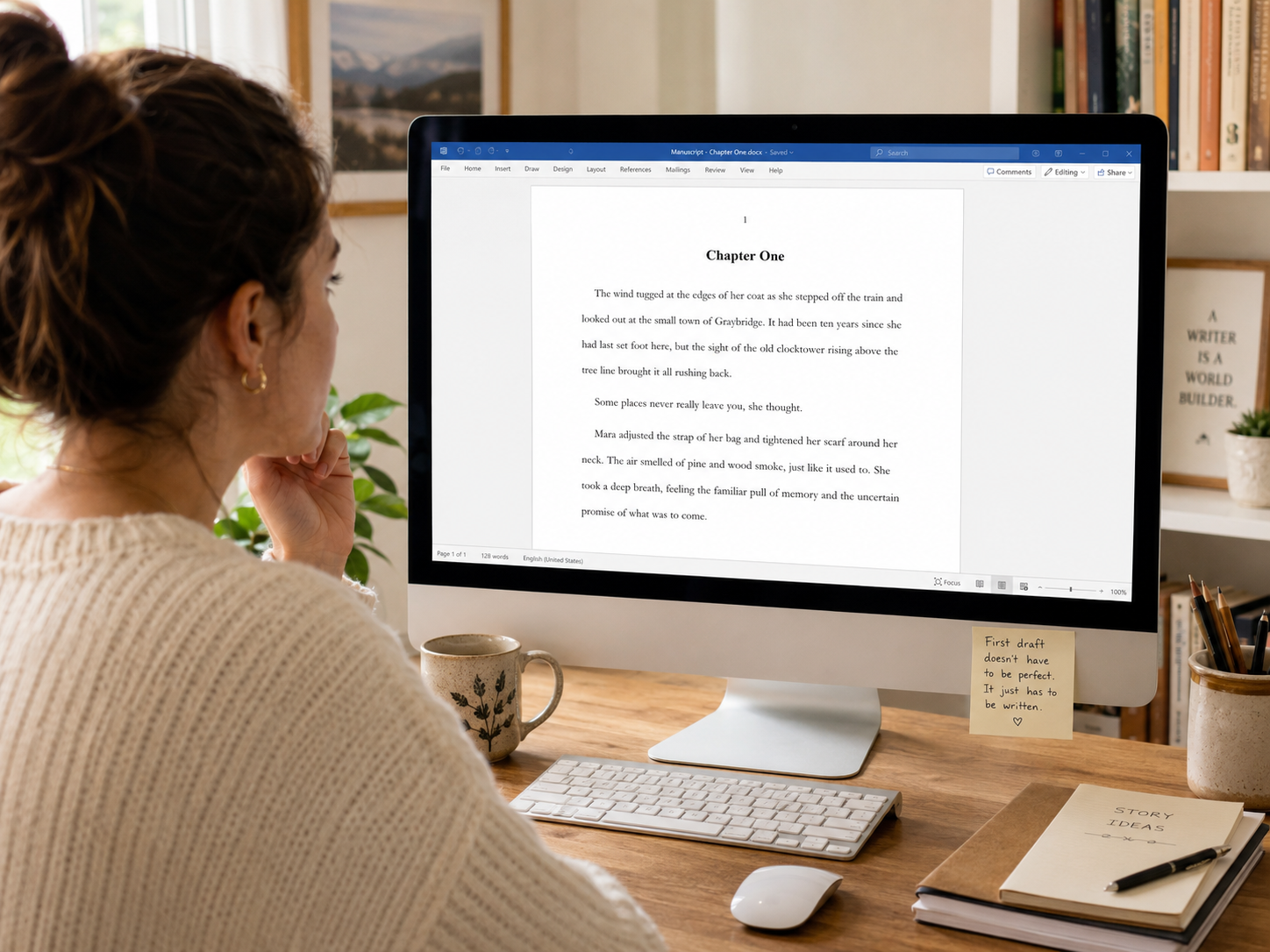
There's a moment every writer hits where the draft feels "done enough," and the urge to fire it off to an editor becomes almost physical. I get it. This manuscript has been living inside you for months—maybe years—and you want someone, anyone, to take it off your hands for a while. Or at least tell you if you have a book.
But how you hand it off matters far more than most writers realize. As a nonfiction editor, I can tell you that the manuscripts arriving prepared get more out of the same editing dollar than the ones that show up raw. Same editor, same hours, wildly different return. If I’m spending time getting the manuscript into a consistent format or trying to reconcile whether you want just this one paragraph to be in present tense, while the rest of the book is in past tense, that's time I'm not spending on your prose to help align what’s on the page with your vision and make it sound more like your voice.
So before you submit to an editor, here's how to prepare your manuscript so you get the biggest bang for your buck.
Finish the Whole Draft First
This one sounds obvious until you're staring at a half-finished Chapter Nine, wondering if you can just send the first eight and "see what she thinks."
Resist that. A partial manuscript forces an editor to assess a structure that isn't finished forming. I might flag a pacing problem in chapter three that your unwritten chapter eleven would have solved—and now we've both wasted effort. Get to the end, however rough that ending is. A complete draft, even a messy one, gives an editor something real to work with. And honestly, if you have an entire manuscript and you just haven’t written the Conclusion, it’s just a matter of pulling it out of you. Go back to the beginning when you stated your thesis/promise. Reiterate that in the Conclusion and restate the proof/takeaways, and how it affected your life, how it could benefit the reader, etc.
Do a Self-Edit Pass Before You Submit to an Editor
You don't need to polish every sentence to a shine. But a single read-through on your part catches the low-hanging fruit and frees your editor to focus on the work only an editor can do.
Read the manuscript start to finish and look for the patterns nearly every nonfiction writer falls into: overwriting, vague language, weak transitions, and a tendency to bury your best points under too much setup. Reading aloud helps enormously here—your ear catches what your eye glides past. The goal is to clear out the obvious so we can get to the interesting problems faster. (If you want the full method, my post on self-editing your manuscript walks through it step by step.)
Figure Out What Kind of Editing You Need
This is where I see writers waste money. They request line editing when they mean proofreading, or they pay for a polish on a manuscript that needs structural surgery—and end up paying twice.
Here's the short version of the different types of editing.
Developmental editing looks at the architecture: structure, argument, and whether the book holds together.
Line editing works at the sentence level, sharpening voice and rhythm.
Copy editing handles grammar, consistency, and mechanics.
Proofreading is the final pass before publication.
These services run from broadest to finest, and order matters—there's no sense polishing sentences in a chapter that might get cut.
If you're genuinely unsure which one you need, that's fine. A good editor can usually tell within a few chapters, and many of us offer a manuscript evaluation for exactly this reason. Knowing and naming what you need is half the battle when you prepare a manuscript for editing.
Get the Basic Formatting Right
What may seem like a few small things to you makes a real difference to how quickly an editor can get down to working on the meat and potatoes of your manuscript.
Here’s a standard setup that would make me do a happy dance if I received a manuscript with the following:
Use a common font like Times New Roman or Calibri
Use 12-point font
Set the paragraph to be double-spaced
Set the margins at one inch
Use standard page numbers
Use consistent chapter headings. By that, I mean if you applied a heading to Chapter One and just bolded Chapter Two, and you mix them up across 20 chapters, the time it takes to correct those adds up.
Submit a clean Word document unless your editor tells you otherwise, since that's where most of us work with tracked changes and comments. You don't need anything fancy. You just need it tidy enough that your editor spends time on your writing, not on reformatting your file.
Tell Your Editor What You're Trying to Do
This is the step where I will drag the answer out of you. I would never take on a project without knowing why you wrote the book and what you’re trying to achieve. Other editors may not bother. So, when you submit to an editor, include a short note—even a few paragraphs—that answers the following questions:
Who is this book for?
What do you want a reader to feel, understand, or do by the end?
Are there stylistic choices you've made on purpose—an unconventional structure, invented words, a deliberately conversational tone—that you don't want "corrected"?
Where do you feel you need the most help?
I once worked with an author who wrote a 147,000-word book full of invented words and multiple languages. If he hadn't told me those were intentional, I might have spent hours flagging them as errors. Instead, he gave me the context up front, and I could focus on serving his vision rather than second-guessing it.
If you're using a specific style guide—Chicago, AP, or a custom style sheet—say so. If certain spellings or character details are deliberate, note them. A page of context saves both of us a dozen rounds of queries.
Get in the Right Mindset for the Feedback
The last thing to prepare isn't on the page. It's in your mindset.
Editing is a collaboration, not an assessment of your writing prowess. I’ll tell you, those Tracked Changes look way worse than they are. Consider those markups as a conversation between you and the editor about a suggested roadmap for your book. Every writer I've worked with, including ones who've published in a big way, has had a moment of staring at tracked changes and wondering if they're any good at this. They are. The marks just mean the work is getting better.
When you process the edits, come at them willing to engage, push back where you disagree, and pause to sit with suggestions before reacting. The writers who get the most from editing treat it as a conversation about their work, not a referendum on their worth.
One thing I want to share from the bottom of my heart is that editors like me feel honored to collaborate in this way. Putting your thoughts out there, no matter the genre, is an incredibly brave act.
Ready to Take the Next Step?
If you've worked through these steps and your manuscript is ready for a professional set of eyes—or if you're still not sure what kind of editing it needs—feel free to reach out. No pressure. Just a chat about where you are and how to get your book where you want it to go. You can find me here.
The Writer–Editor Relationship: What Collaboration Should Look Like
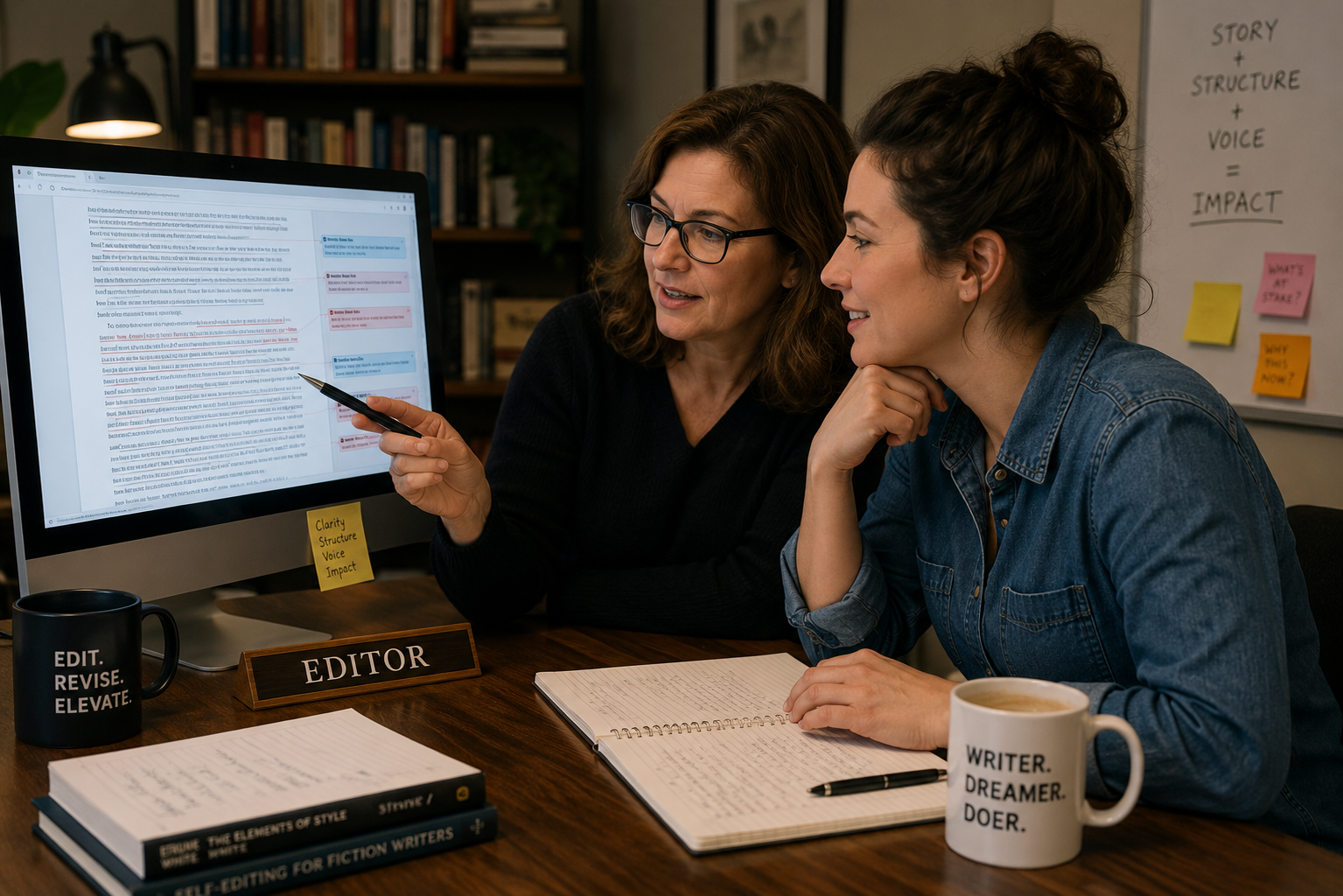
The first time you hand your manuscript to an editor, it can feel like handing over a child. You've lived with these words for months, maybe years. And now some stranger is going to mark them up, point out the flaws, and—you secretly fear—tell you the whole thing was a mistake.
I get it. I've watched that fear show up in writers who've published before and writers who've never put a word out in public. So let me put one worry to rest right away: working with an editor isn't about someone taking a red pen to your work and handing it back covered in corrections you're expected to obey. At least, that's not how I do it, and it's not how good editing works.
What actually happens is closer to a partnership. And the writers who get the most out of the process are the ones who expect that going in.
It Starts With Your Voice, Not My Preferences
Before I change a single sentence, my job is to understand how you sound. Everyone has a natural rhythm on the page—the words you reach for, the way you build an argument, the jokes you can't help making. That's your voice, and it's the most valuable thing in your manuscript.
A while back, I was tasked with taking a bunch of blog posts and papers written by my client and structuring all that content into a book. He also had a website and a YouTube presence, which I studied. We may have Zoomed one time, but we did a lot of messaging back and forth and shared a couple of relevant personal details. Throughout the process, I not only had a grasp of his voice, but I also understood how he thought. When we were wrapping up, he said that it felt like I was in his head.
That's the heart of writer-editor collaboration. A good editor doesn't impose a house style on you. They learn your voice well enough to help you sound more like yourself, not less.
You're Still the Author
Here's something that surprises a lot of first-time clients: when I send back a line edit, every change is a suggestion. You can accept it, reject it, or rewrite it your own way. The tracked-changes document isn't a verdict—it's a starting point for a conversation.
I'll often leave comments explaining why I suggested something: "this paragraph repeats the point you made two pages back," or "I think you're burying your strongest line at the bottom here." But you know things about your book that I don't. You know what you're trying to say, who you're saying it to, and what you're willing to cut. When a writer pushes back on an edit with a good reason, that's the process working exactly as it should.
The authority stays with you. I'm there to give you the clearest possible picture of how your words land so that you can make better decisions about them.
The Back-and-Forth Is the Point
People sometimes imagine editing as a single hand-off: you send the file, I fix it, you publish. Real collaboration is messier and a lot more useful than that.
A developmental edit, for instance, usually comes back as an editorial letter—a few pages walking through what's working, what isn't, and why. Then you sit with it. You decide what to change. You might reorganize chapters, cut a section you loved, or write something new to fill a gap I flagged. After that, we often talk it through. Questions come up. You explain what you were going for, and suddenly the fix becomes obvious to both of us.
One client I worked with on a business book had reorganized his chapters more times than he could count and still wasn't confident. He didn't need me to rewrite anything. He needed a fresh set of eyes to tell him which version actually served his reader. We figured it out together, and he finished ahead of his deadline—on a book he'd called me, a little panicked, to ask whether he even had a book.
What I Need From You
Collaboration runs both directions, so here's my side of the bargain and yours.
Be honest about where you are and what you want. Maybe you're querying agents. Maybe you're self-publishing, or writing something for a narrow professional audience. You could be writing a book that you’ll use more like a business card and a marketing tool to establish credibility and attract clients.
Do you know what kind of editing you need? Deep structural feedback? A final polish before it goes out the door? The more I understand your goals, the more useful my edits become. I'd rather you tell me up front that you're attached to a certain chapter than spend hours suggesting you cut it.
Most writers don't expect how much I lean on context. The history matters—if an editor took your manuscript partway and then walked, that alone tells me a lot about the seams I'm noticing. But so does everything surrounding the writing itself: how long you've been carrying this book, what your experience on the page has been, even how the people in your life feel about you spending your evenings on it. None of that is small talk to me. It all informs the work.
I need access to you. That means when I have a question during the editing process, your answer may inform my edits on subsequent material. I’ve found the most successful collaborations have a real-time feel with solid momentum.
Why So Demanding?
The reason I'm so particular about all of this is simple: the relationship determines the result.
I've had writers tell me, after the fact, about editors who flattened their personality or rewrote them into someone else—who handed back a marked-up file with no explanation and no conversation. They felt managed, not helped. A few of them nearly gave up on their books because of it. One client was convinced that the editor ran her manuscript through an AI platform that marked it up. She had paid professional rates.
That's the opposite of what editing should be. When the collaboration works, you don't come away feeling like your book was taken from you and returned in someone else's handwriting. You come away with a manuscript that's unmistakably yours, just sharper and more assured than the version you handed over.
That's the whole goal. Not to make you sound like me—to help you say exactly what you mean.
The Last Word
If you're thinking about working with an editor and you're not sure what the process would actually look like for your project, reach out. I'm always happy to talk through where you are, what you're trying to accomplish, and whether we'd be a good fit. No pressure, no judgment—just a conversation about your writing.
How to Write a Memoir That Doesn't Read Like a Diary

Several years ago, I came across the diary I got for my tenth birthday. Its cover, white with gold embossed letters, announces “My Diary” and features a gold lock. I immediately set out to digitally capture this treasure trove of life as a ten-year-old girl in suburban Pennsylvania during the seventies. I saw that I had written most days for an entire year. Wouldn’t that make the best Christmas gift for my three daughters?
Not really.
Here’s what most entries sound like: “I played with Sandy, Bev, and Fritzi. Bev was mean. She’s not my friend anymore.” “Today, Bev is my best friend.” “We played street hockey. My team lost.” “Same as yesterday.” “I like Timmy. We played tents and servants.” (Whatever that was!) “We had pizza at the mall. Steve was a bully.”
Granted, I was ten, and I’m grateful that I have that diary now (so many years later), but most entries were transactional and didn’t capture how I thought and functioned in my pre-teen world. Fast-forward to my adult journal entries, and they are interior monologues without much context. Turns out a diary at ten and a journal at forty share the same flaw—they record, but they don't reflect all the dynamics that bring those entries to life in a way that resonates with the reader.
The Diary Trap
A lot of memoir drafts have the same problem my diary did. The events are all there, faithfully recorded—but the meaning isn't.
Most memoir manuscripts that land on my desk open the same way: the writer's birth, or somewhere close to it. Then they march forward year by year, recording what happened in the order it happened. First this, then this, then this. By chapter four, I'm reading a very detailed account of someone's life, but there’s nothing for me to grab onto like a theme or a lesson learned.
That's the diary trap. After close to a decade editing memoir, I can tell you it's the single most common thing standing between a memoir writer and a book a stranger would want to read.
A diary records. A memoir makes meaning out of what it records. Learning the difference is most of the work, so let's get into how to write a memoir that earns a reader’s time instead of just documenting yours.
Figure Out the Meaning Behind Your Memoir
Here's the question I ask every memoir client early on: What is this book about? Almost everyone answers by describing what happened to them. "It's about my divorce." "It's about caring for my mother through her illness." "It's about the year I spent abroad."
Those are subjects, not themes. The events are what happened. We got pizza at the mall. The theme is what those events mean. We got pizza at the mall today, and it’s Wednesday night! What was Dad going to have for dinner? I wonder if we’re going to have pizza on Friday night, too. Maybe Dad is going to be mad because Mom is spending too much money again. Mom doesn’t have a job, so it’s her job to have a real dinner on the table. But first, Dad needs to sit down and have his cocktail hour. When he wiggles the glass, the ice clinks, and even if Mom isn’t in the room, she'd better drop what she’s doing and get him another one. I don’t think I want to be a wife when I grow up. I hope it doesn’t thunderstorm on the way to the mall. Mom just learned how to drive, and she yells at us if we talk or laugh. That's what turns a pile of memories into a story.
Your divorce memoir might really be about learning to trust your own judgment again. The caregiving memoir might be about a mother and daughter finally understanding each other when it was almost too late. Until you can name that deeper thread, you're just transcribing. Once you can, you've got a filter for every decision that follows.
Be Ruthless About What You Leave Out
A diary includes everything because everything happened. A memoir keeps only what serves the story you're telling. This is the hardest of all memoir writing tips to follow, because the material is your real life, and cutting it can feel like pretending it didn't happen.
But you're not writing your life. You're writing a shaped version of one piece of it. If a beautifully written chapter about your college years doesn't move your theme forward, it has to go—no matter how much you love it. Toni Morrison said she was most impressed with herself when she could say more with less, and memoir is where that discipline matters most.
I once worked with a writer on a memoir she'd dictated rather than typed—she had unmanaged ADHD and dyslexia but could tell a story better than almost anyone I've edited. Our biggest job wasn't adding. It was choosing, deciding which of her thousand vivid moments belonged in this book.
Reflect, Don't Just Report
This is the piece that separates memoir from a transcript more than anything else.
When something happened to you, you only knew what you knew in that moment. But you're writing about it now, with distance and understanding the younger you didn't have. That gap—between the person who lived it and the person telling it—is where memoir actually lives.
A diary entry says what happened. A memoir lets the older, wiser narrator step in and make sense of it. Why did you stay so long? What were you protecting yourself from seeing back then? Readers don't come to memoir for a record of events. They come for the meaning you've made of them.
You’re handing the reader your hard-won insight at pivotal moments, then getting out of the way.
Put Readers Inside the Moment
Diaries summarize: "Had a rough conversation with Dad." A memoir takes that same moment and lets us live it—the kitchen, the coffee going cold, the thing he said that you've never repeated to anyone.
Scene is how you do that. Instead of telling readers a relationship was strained, show the dinner where nobody spoke. Instead of stating you were terrified, put us in the car outside the building you couldn't make yourself walk into.
You won't write every moment in scene—that would be exhausting, and the book would never end. Summary still has its place for moving through time. But the moments carrying your theme deserve to be rendered fully, so the reader feels them instead of being told about them.
Treat Yourself Like a Character
In your diary, you're the writer. In your memoir, you're also a character on the page—and that version of you has to be drawn as honestly as anyone else in the book. Easier said than done.
That means showing your flaws, your bad calls, the moments you weren't the hero. The most compelling memoir narrators are the ones willing to be seen clearly, mistakes and all. A reader will trust a narrator who tells the truth about themself, even when it isn't flattering.
A Quick Gut Check
Once you've got a draft, read it with one question in mind: if you swapped your name for a stranger's, would this still be worth reading? If the answer is "only because it's true," you've probably drifted toward a diary. If a reader who's never met you would still feel something, you're writing memoir.
That's the bar—not whether it happened, but whether it means something to someone who wasn't there.
Where This Goes Next
Writing a memoir that rises above the diary is a structural and reflective challenge long before it's a sentence-level one. It comes down to knowing your theme, cutting hard for it, and reflecting honestly on what your experience actually meant.
That's also the kind of work that's nearly impossible to see in your own pages, because you’re so close to it. Sometimes a fresh set of eyes is what helps you find the book hiding inside the diary. If you've got a memoir draft and you're not sure if it's landing, reach out—I'd love to help you say exactly what you mean.
What Is Copyediting, and When Do You Need It?
A reader is moving happily through your chapter, nodding along, fully with you—and then they hit a snag. You cited a study from 2019 back in Chapter Three, and here in Chapter Nine, you talk about the same study as being in 2020. It's a tiny thing. That may be a millisecond snag, but it might be enough for the reader to stop trusting that you've got the wheel.
That inconsistency is exactly what thorough copyediting prevents. It's the service most people picture when they hear "editing"—and, as it happens, it's also what a lot of writers mean when they say "proofreading," even though the two aren't the same job. The mechanical layer of a manuscript that copyediting addresses does load-bearing work in the background. Get it right, and nobody notices. Get it wrong, and your reader notices everything. So let's talk about what copyediting is, what it isn't, and when your manuscript is ready for it.
What Copyediting Is
Copyediting is about rules and mechanics—grammar, punctuation, spelling, consistency. My attention is on the engine room of your prose rather than its melody.
In practice, that means I'm making sure your timeline holds together, so the wedding that happens "two years later" actually lands two years later. I'm checking that a term you capitalized early on stays capitalized throughout. I'm catching the homophones—your/you're, their/there/they're—and the comma splices that slipped past you at 2 a.m. And I'm applying a style guide so your formatting, hyphenation, and capitalization stay uniform from the first page to the last. Did you write "e-mail" on page four and "email" on page forty? That's mine to reconcile.
A quick word on style guides, since writers ask. Chicago is the standard for most books. AP turns up more in journalism and business writing. Some projects run on a custom style sheet—a running document of the specific choices your manuscript makes, especially if you've invented terms or made deliberate exceptions. If you have a preference, tell me. If you don't, I'll recommend one and build the style sheet as I go.
Copyediting vs. Line Editing
These two get conflated all the time, and it's a costly mix-up, because they solve different problems.
Line editing works at the level of voice and rhythm—does this sentence land the way you intended, is this paragraph carrying too much? Copyediting works at the level of correctness—is the grammar sound, is the spelling consistent, does the style hold throughout?
The shorthand I give clients: line editing asks whether your writing is effective; copyediting asks whether it's right. Both matter. They're just different stages, and the order matters, which brings me to the part writers most often get backward.
What Copyediting Isn't
copyediting is not developmental editing or line editing. I'm not restructuring your chapters, reworking your argument, or rewriting your sentences for style and flow. I'm working with prose that's already doing what you want it to do, and my job is to make sure it's mechanically clean and internally consistent. If your manuscript still needs big-picture or sentence-level work, we should handle that first. There's no sense perfecting the punctuation in a sentence that a line edit might restructure, or a paragraph that a developmental pass might cut entirely.
Copyediting also isn't proofreading. They feel like cousins, and people use the words interchangeably, but a proofread comes later—it's the final quality-control pass after your manuscript has been formatted for publication. Copyediting happens after line editing, and proofreading is the last look before the book goes out the door.
This is why copyediting should happen when you're confident you won't be making major revisions. I'll say it plainly because it saves writers real money: there's no point in perfecting the mechanics of sentences that may be deleted.
What I Need From You
A copyedit goes faster and lands better when you bring a few things to the table:
A manuscript that's content-complete, with no major revisions still pending.
Your preferred style guide, if you have one.
A style sheet, if you've been tracking specific choices—character names, invented terms, intentional decisions you don't want "corrected."
Any house preferences or exceptions I should know about.
That last one matters more than writers expect. I once worked with an author whose manuscript was full of deliberately invented words. Had he not flagged them up front, I might have spent hours dutifully marking them as errors—billable hours, his hours. A page of context spares both of us a dozen rounds of needless queries.
What You'll Receive
When I finish, your manuscript comes back with tracked changes where every correction is visible. Those are yours to accept, reject, or modify. Alongside the edits, you'll get queries—the questions only you can answer. "You mention Sarah's birthday is in March here, but it was June in Chapter Two. Which is correct?" I will never guess about something like that on your behalf and hope I got it right; I will always ask.
You'll also get a style sheet documenting the choices made throughout your manuscript: spellings, hyphenations, capitalization calls, the treatment of numbers and terms, etc. Keep it. It's a reference for you, for any future editor, and for the next book. Consider it a record of how your manuscript handles the thousand small decisions a reader feels but never consciously registers.
The Last Word
Copyediting is the layer nobody compliments, and everybody notices when it's missing. It's the difference between a manuscript that reads as careful and one that quietly leaks the reader's confidence, one small inconsistency at a time. You've done the work to get your content and your prose where you want them. This is the step that makes sure nothing small undermines all of it.
If your manuscript is content-complete and you're confident the big revisions are behind you, it may be ready for a copyedit. Reach out, and let's chat about where you’re having challenges with your manuscript.
What Is Proofreading? Your Manuscript's Last Line of Defense
You've been through it all. The structure holds, the sentences sing, the mechanics are clean. Your manuscript has survived round after round of revision, and you're so close to being done you can taste it. Then a friend reads the formatted version and emails you: "Loved it—but there's a typo on the dedication page." The dedication page. The first thing anyone reads.
That sinking feeling is exactly what proofreading spares you. It's the final quality-control pass on a manuscript that's otherwise finished—the last set of eyes before your book goes out into the world. I can tell you that proofreading is the least glamorous service I offer and, at the very end, one of the most important. So let's talk about what proofreading is, what it isn't, and when your manuscript is genuinely ready for it.
What Proofreading Is
Proofreading is your last line of defense. By the time a manuscript reaches me for a proofread, the real editing is done—I'm not rewriting sentences or second-guessing your word choices. I'm catching the small things that slipped through everything that came before: the lingering typo, the missing period, a book title that should be italicized, not in quotation marks.
Picture it as the final polish before your work goes public. At this stage, I'm watching for the typos and spelling errors that survived earlier rounds, the missing or misplaced punctuation, and style inconsistencies. I'm also doing a light read for any glaring errors that somehow made it this far. (They always do. Really, it’s no wonder when you consider that a book is tens of thousands of words. Something always hides.)
What you get back is a clean, publication-ready manuscript.
Proofreading vs. Copyediting (The Costly Mix-up)
Here's the confusion I run into most: writers say "proofreading" when they mean copyediting. The two get used interchangeably all the time, and it's an easy mistake—but they're different jobs at different stages, and conflating them can cost you real money.
Copyediting is about rules and mechanics—grammar, punctuation, spelling, consistency. It happens while your words are still being shaped, often before the manuscript is formatted, and it's substantial work: applying a style guide, reconciling inconsistencies, and querying you about things only you can answer. Proofreading comes after line editing and copyediting, so the changes are minimal by comparison. Copyediting assumes your manuscript still has open questions. Proofreading assumes those questions are settled, and you just need a final, careful read. If you hand me a raw draft and ask for a proofread, I'll tell you honestly that you're not there yet—and that paying proofreading rates for copy-edit-level work would shortchange you.
What Proofreading Isn't
Proofreading is not editing, full stop. I'm not rewriting awkward sentences, tightening your prose, or addressing anything structural. If I spot something significant, I'll flag it—but proofreading assumes your manuscript has already moved through developmental editing, line editing, and copy editing as your project needed. This is a final read-through, not a revision.
That sequence matters, and it's worth saying plainly because writers get it backward and pay for it. Developmental editing handles the architecture. Line editing sharpens voice and rhythm at the sentence level. Copyediting cleans up the mechanics. Proofreading is the last pass, after the rest is done and the file is formatted. There's no sense in proofreading a manuscript you're still revising—you'd just be polishing words that might not survive the next round.
What I Need From You
A proofread goes smoothly when a few things are in place. A final, formatted document—ideally the exact version headed to print or publication. Confirmation that all your content revisions and edits are genuinely complete, so we're not reopening doors that should be closed. And a style sheet from your copyedit or your own house preferences.
That last one saves us both time. If you've already got a style sheet documenting how your manuscript handles numbers, hyphenation, and the like, hand it over. A proofreader working from your established choices is far more useful than one guessing at them.
What You'll Receive
You'll get a clean manuscript with corrections made—or flagged, depending on your preference. Some writers want the changes done directly; others want every catch marked so they can make the call themselves. Either way works, and we'll sort out which you prefer before I start.
What you won't get at this stage is an editorial letter or pages of margin comments. Because by the time you need proofreading, your manuscript is ready to publish. The deliverable is short on commentary and long on polish, which is exactly what you want this late in the game.
A Word on Timeline
Proofreading has the fastest turnaround of any service I offer, simply because the changes are minimal. It's not a deep edit—it's a careful final read. I'll give you a specific timeframe based on your manuscript's length and where it falls in my schedule, but of all the stages, this is the one that moves quickest.
The Last Word
Proofreading happens at the very end—after all the other editing, after you've poured months or years into getting every word right. It's the final read-through before your book goes out into the world, and its whole job is to make sure nothing small undermines all the big work you've done. You've earned the clean copy. Let's make sure you—not stray typos—get the last word.
If your manuscript is fully edited, formatted, and ready for that final pass, it may be ready for a proofread. Reach out and let's chat about where your book stands and what might move it forward.
What Is Line Editing? The Service That Sharpens Your Voice Without Replacing It
You've got a sentence that's nagging at you. It says what you mean—technically—but sounds more like a restatement than a revelation. You've rearranged it four or five times, and it still feels slightly off. You can't name the problem, which means you can't fix it either.
That space between a sentence that's correct and a sentence that's right is exactly where line editing does its work. I've come to think of line editing as the most misunderstood service I offer—and the one that does the most for a finished draft. It's the work that takes prose that's already functional and makes it unmistakably yours and compelling for your readers.
Let’s get into what line editing is, what it isn't, and how to tell whether it's what your manuscript needs.
What Line Editing Is
Line editing happens at the level of the sentence and the paragraph. Your voice, your rhythm, your word choices, the way one thought hands off to the next—that's my territory. I'm not hunting for typos or stray commas, though I'll certainly notice them as I go. My attention is on clarity, style, and impact.
Here's the part writers don't always expect: a good line edit doesn't impose a new voice on your work. It amplifies the one you already have. I read closely enough to learn how you build a sentence, where your humor tends to surface, and how you handle a hard turn in your argument. Once I understand the cadence and rhythm of your voice—and even how you think—that knowledge informs how I edit your prose. That’s how I help you sound like the best version of yourself on the page. What I think about here is if you happen to meet somebody in person who has read your book, they’d say, “Wow, you sound exactly like your book.”
Line Editing vs. Copyediting (The Confusion Worth Clearing Up)
These two get mixed up constantly, and it's an expensive thing to get wrong, because they solve different problems.
Copyediting is about rules and mechanics—grammar, punctuation, spelling, consistency. A copyeditor catches the comma splice, the stat you cited two different ways, the term you capitalized in Chapter Three and lowercased in Chapter Nine. Line editing is about how you're saying it. Does this sentence land the way you intended? A line editor is also the one who notices when a paragraph is straining under too much work, or when you've told the reader something you already showed them two pages back.
The shorthand I give clients: copyediting asks whether your writing is correct. Line editing asks whether it's effective. Both matter, and most manuscripts eventually need both. But they're different stages with different goals, and the order matters—there's little sense tightening a comma in a sentence a line edit might still rewrite.
Let me show you the difference with a real line. Here's a sentence the way a writer might first put it down:
"It was at that particular point in time that I came to the realization that leaving had perhaps been a mistake."
Nothing in there is technically wrong. A copyeditor would wave it through. But it's wearing about a dozen words it doesn't need, and the weight of the moment gets buried under all that padding. Here's a decent line edit:
"That was the moment I knew leaving had been a mistake."
Same meaning, same voice, roughly half the words—and a lot more punch. (For what it's worth, I cut sentences like the first one out of my own drafts all the time. The padding sneaks in when you're thinking out loud on the page.) In the margin, I'd leave a note explaining what I trimmed and why, so you can catch the pattern yourself next time.
What Line Editing Isn't
Line editing isn't developmental editing. I won't be restructuring your chapters, reworking your central argument, or solving pacing problems at the level of the whole book. If your manuscript needs that kind of architectural work, sentence-level polish is premature, and we'd want to talk about whether developmental editing makes more sense as a first step. Polishing prose in a chapter that might get cut is a heartbreak nobody needs.
It's also not proofreading. I'll catch errors as I move through your pages, but a final proofread—the last pass after you've accepted revisions and formatted the file—is its own separate service. Think of all of this as a sequence that runs from the biggest questions about your book down to the smallest. Line editing sits in the middle, where the writing stops being merely clear and starts being compelling.
What You'll Receive
When I finish a line edit, your manuscript comes back as a Word document with tracked changes and margin comments. Every suggestion is visible, and every one is yours to accept, reject, or rewrite your own way. The file stays yours from the first page to the last.
The comments are explanations. "Tightening this so your punchline lands harder." "You've got a strong line buried at the bottom of this paragraph; what if it opened instead?" The reasoning matters because once you understand why a change works, you start making that move on your own, in this book and the next one. That's the bonus of a good line edit: you come out of it a stronger writer than you went in.
The Last Word
You did the hard part. You got your ideas out of your head and onto the page, in your own words, in an order that makes sense. Line editing is the work of helping those ideas land exactly the way you meant them to—clearly, powerfully, and in a voice that's recognizably yours.
If you've got a draft that's structurally sound but isn't quite singing yet, that's precisely the manuscript a line edit was built for. Reach out, and let’s chat about your manuscript.
The Psychology of Reader Engagement in Nonfiction

Every nonfiction writer is competing for the same thing: a reader’s attention. It’s far too easy for a reader’s mind to drift to wondering about what’s for dinner or quickly glancing at their phone. You may think, well, my material is interesting, so my readers aren’t going to do that. But interesting material loses readers all the time. What holds them is something more mechanical, more psychological, and far more learnable than most writers assume.
If you want to engage readers, nonfiction asks you to understand what's really happening in a reader's mind as they move down the page—what pulls attention forward and what loses it. The craft of reader engagement in writing is, essentially, applied psychology. Let’s look at how that works.
Curiosity Is a Gap, Not a Topic
You may want to consider how you think about your reader’s curiosity. Psychologist George Loewenstein argued that curiosity arises from a gap between what we know and what we want to know (Loewenstein 1994). What sparks it, then, is the reader's awareness that something is missing—not the topic itself.
This is the secret sauce and a major reframe for many writers. If you think a reader’s curiosity lives in the topic, you’ll naturally front-load information, explaining thoroughly and answering questions the reader hasn't yet thought to ask. But you’ll do the opposite once you understand the gap: you open a small space of not-knowing and let the reader feel it before they fill it. Malcolm Gladwell opens Outliers with Roseto, a Pennsylvania town whose residents had an impossibly low rate of heart disease, and he describes the mystery in vivid detail for pages before explaining it (Gladwell, 2008). The withholding is the point. The reader leans in not because the topic compels them but because Gladwell opened a gap and hasn’t closed it yet.
Strong nonfiction poses the question before the answer. It names a problem and lets you sit in it for a sentence or two. It tells you something surprising is coming before telling you what. Each move opens a gap, and an open gap is a kind of mild, productive tension the reader wants resolved. That tension is the engine. Close every gap immediately, and you've turned off the motor.
The Power of the Unfinished
A close cousin of the curiosity gap is the Zeigarnik effect, named for the psychologist who observed that people remember interrupted or incomplete tasks more readily than completed ones (Zeigarnik 1927). An open loop occupies the mind. The brain keeps a low background hum running until the loop closes.
This is why a chapter that ends mid-tension pulls you into the next one, and why a chapter that ties everything into a neat bow can give the reader permission to stop. It's why a well-placed "but there was a problem I hadn't anticipated" at the end of a section is worth more than another paragraph of explanation. You're not manipulating anyone. You're working with the way attention naturally behaves.
I think a lot about pacing for exactly this reason—where to close a loop, where to leave one humming. It's some of the most consequential work in shaping a manuscript, and the reader doesn’t even realize it when it's done well.
Transportation and Why Stories Outperform Arguments
Melanie Green and Timothy Brock studied what they called “narrative transportation”—the state of being absorbed into a story—and found that the more transported a reader is, the more their beliefs shift in line with the narrative, and the less they counterargue (Green and Brock 2000).
Sit with that second part. A transported reader stops arguing back. When we read a dry claim, our critical thinking is in full operating mode, generating objections. When we're absorbed in a concrete scene, those faculties quiet down. This is why a single well-told example often persuades more than a page of evidence. The example doesn't just illustrate the point—it lowers the reader's resistance to it.
I’m not saying we should bombard our nonfiction manuscripts with stories. The point is that concreteness and scene are load-bearing. Abstraction invites scrutiny; specificity invites belief. A reader who can picture what you're describing is a reader who has, for that moment, stopped holding you at arm's length.
Cognitive Ease: The Friction You Can't See
Another dynamic that influences engagement works below conscious notice. Daniel Kahneman describes cognitive ease—the sense of mental fluency we feel when information is easy to process—and its strange consequence: things that are easy to read feel more true, more familiar, and more agreeable (Kahneman 2011).
Every source of friction taxes this ease. A tangled sentence, an unexplained term, a paragraph that makes the reader backtrack to figure out who "it" refers to—each one is a tiny cost. Readers rarely notice the cost consciously. They just have this vague sense that reading the text takes effort, and effort erodes engagement. So, they drift.
This is the unglamorous, foundational layer of holding attention, and it's where line editing earns its keep. Smoothing rhythm, cutting the word that makes a reader stumble, ordering a sentence so the reader never has to reread it—this is engagement work, even though it looks like mere tidying, even nitpicking. You're removing the small frictions that, in aggregate, decide whether a reader stays in the dream or wakes up.
Variation Keeps the System Awake
This last mechanism is often overlooked. Attention habituates. A reader who encounters the same sentence length, the same paragraph shape, and the same rhetorical move for too long will start to glaze, because the pattern has become predictable, and the mind stops registering the predictable. The reader’s perceptual system is on autopilot, and their attention fades.
This is the role rhythm plays. A short sentence after three long ones snaps a reader back. A sudden direct address—you—re-establishes contact. A shift from explanation to scene wakes the system up. Skilled nonfiction writers vary their texture because variation is how you keep attention from settling into autopilot. Sameness is comfortable, and comfort is where readers close your book.
None of This Is a Gift
Hopefully, you’re seeing that reader engagement isn't a mysterious gift some writers have. It's the product of understanding how attention, curiosity, and belief operate, and then taking those mechanisms into account when writing.
Remember to:
Open gaps.
Leave a few loops humming.
Trade abstraction for scene.
Remove invisible friction.
Vary your rhythm so the reader never settles.
Master those, and you're no longer hoping readers stay. You're giving their minds reasons they can't quite articulate but always feel.
Sources
Gladwell, Malcolm. Outliers: The Story of Success. Little, Brown and Company, 2008.
Green, Melanie C., and Timothy C. Brock. "The Role of Transportation in the Persuasiveness of Public Narratives." Journal of Personality and Social Psychology, vol. 79, no. 5, 2000, pp. 701–721.
Kahneman, Daniel. Thinking, Fast and Slow. Farrar, Straus and Giroux, 2011.
Loewenstein, George. "The Psychology of Curiosity: A Review and Reinterpretation." Psychological Bulletin, vol. 116, no. 1, 1994, pp. 75–98.
Zeigarnik, Bluma. "Über das Behalten von erledigten und unerledigten Handlungen" ["On Finished and Unfinished Tasks"]. Psychologische Forschung, 1927.
The Mindset Shift Every Writer Needs
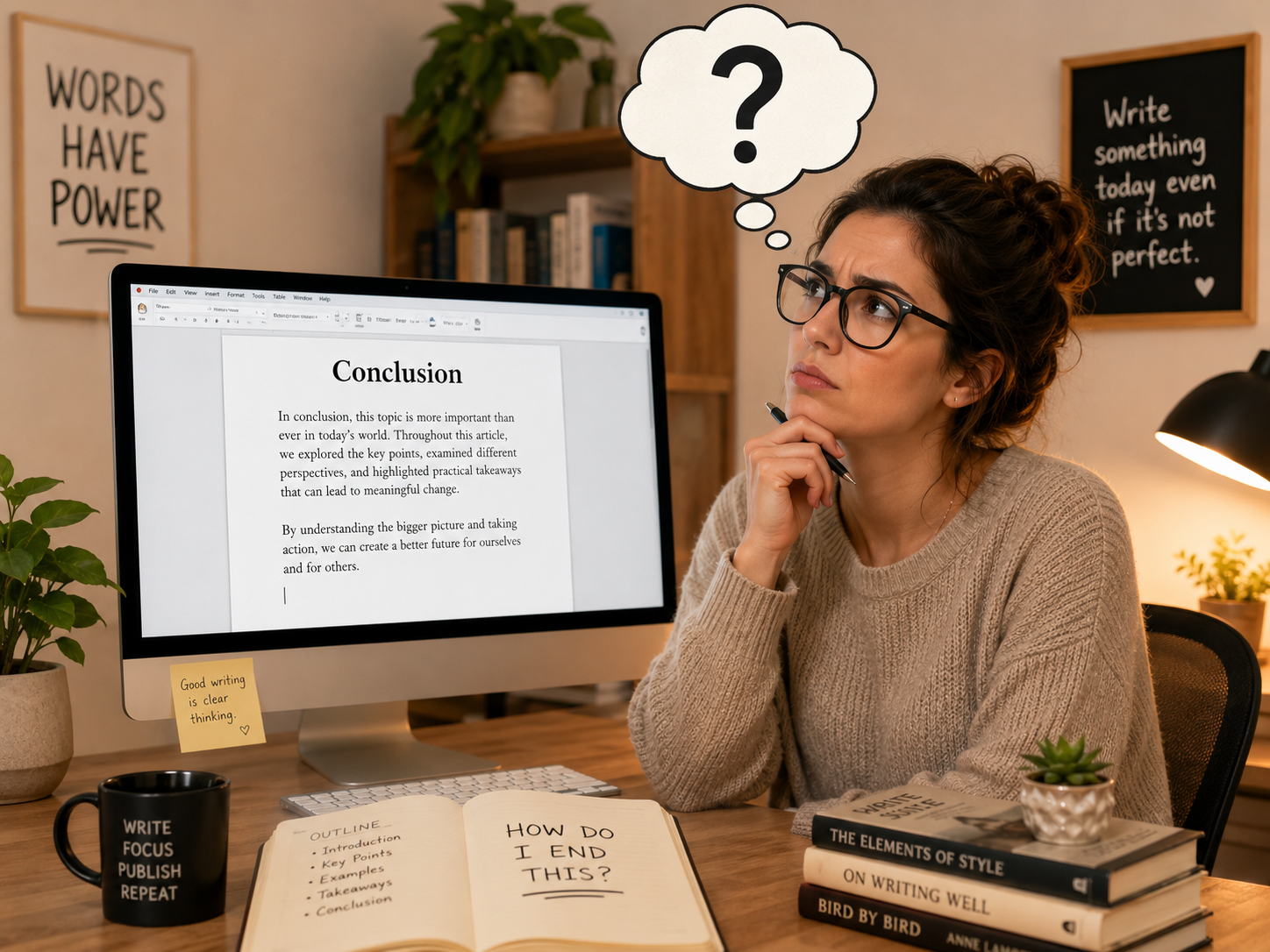
You're stuck.
Maybe you're three chapters from the end and suddenly convinced the whole thing is garbage. Maybe you haven't opened your manuscript in weeks because the thought of facing it makes your stomach clench. Or maybe you keep finding "urgent" tasks—laundry, emails, reorganizing your sock drawer—anything to avoid sitting down with your words.
I feel you. And I have some news that might surprise you: this is completely, frustratingly normal.
The Lie Your Brain Keeps Telling You
Here's what I've learned after years of working with writers: almost everyone, at some point in their manuscript, becomes convinced they're uniquely terrible at this. That they're the only ones struggling while everyone else sails through their drafts with coffee in hand and inspiration flowing like an open faucet.
Psychologists have a name for this feeling. It's called imposter phenomenon, first described by researchers Pauline Rose Clance and Suzanne Imes in 1978. It's that persistent sense of being a fraud—of waiting for someone to discover you have no idea what you're doing—despite evidence that you're actually capable. Research shows that about 70% of professionals experience this at some point in their lives, and writers are certainly no exception.
The cruel irony? The more you care about your work, the more vulnerable you are to this kind of self-doubt. Your inner critic isn't a sign that you're failing. It's a sign that you're invested.
The Mindset That Changes Everything
Stanford psychologist Carol Dweck's research on mindset has revolutionized how we understand achievement and struggle. Her work shows that people tend to operate from one of two belief systems. Some people believe their abilities are fixed—you either have talent or you don't, and no amount of effort will change that. Others believe their abilities can be developed through practice, feedback, and persistence.
That second belief? That's a growth mindset. Along with persistence, it's one of the most important things you can cultivate as a writer.
When you operate from a growth mindset, failure stops being a statement about who you are. It becomes information about what to try next. Dweck's research found that people with a growth mindset are more likely to embrace challenges, persist through setbacks, and ultimately achieve at higher levels—not because they're more talented, but because they're more willing to keep going.
Think about what this means for your manuscript. That chapter that isn't working is in no way proof that you can't write. It's a puzzle to solve. That critical voice that taunts you when you sit down to write has zero credibility. Remember—that inner critic is merely composed of thoughts, which means you can choose not to let them run the show. They’re not the boss of you. You got the wheel here.
Practical Reframes for the Stuck Writer
Let's get specific and get to work. Here are some mindset shifts that can actually get you back to the page.
Replace "I can't do this" with "I haven't figured this out yet." That single word, “yet,” is magic. It acknowledges the struggle without making it permanent. You're not a writer who can't finish. You're a writer in the middle of learning how. It’s true.
Understand that your first draft is just about getting it all down, nothing more. Anne Lamott gave us permission decades ago to write what she calls "shitty first drafts." The purpose of a first draft is to exist. In fact, celebrate that you now have something to work with. You can fix garbage. You cannot fix nothing. (I explore this more in my piece on The 7 Habits of Great Writers—it's habit number three, and it might just save your creative life.)
Separate your identity from your output. A bad writing day doesn't make you a bad writer. A messy chapter doesn't mean you don't have what it takes. Your worth as a creative person isn't determined by how smoothly the words come.
Remember that everyone's process looks different. Some writers draft quickly and revise slowly. Others labor over every sentence. Some write linearly; others jump around. There's no correct way to finish a manuscript—there's only your way.
The Surprising Power of Being Kind to Yourself
Here's something that might feel counterintuitive: being gentle with yourself isn't weakness. It's a sound strategy.
Kristin Neff, a psychologist at the University of Texas, has spent over two decades researching self-compassion. Her findings consistently show that self-compassion is actually a more effective motivator than self-criticism. When we beat ourselves up, we activate the threat-defense system in our brains. We become anxious, avoidant, and less creative. But when we treat ourselves with kindness—the same kindness we'd show a friend in the same situation—we create the psychological safety needed to take risks and keep going.
Neff identifies three core components of self-compassion: kindness toward yourself instead of harsh judgment, recognition that struggle is part of the shared human experience rather than something isolating, and mindful awareness of your emotions without drowning in them.
Applied to writing, this might look like acknowledging that the work is hard today without making it mean something terrible about you. Don’t fall into the trap of thinking a bad writing day means you’re just no good at this, and then chewing on that thought like caramel. Let it go. It’s just a bad session. It might look like remembering that every author whose book you love has sat exactly where you're sitting, wondering if they could pull it off. It might look like noticing your frustration or fear without letting it drive you away from the work.
The Truth About Finishing
Here's what I know to be true after working with hundreds of manuscripts: the writers who finish aren't the ones who never doubt themselves. They're the ones who doubt themselves and keep going anyway. Listen, as of this writing, my writer has before him a completed manuscript (ahead of deadline) ready to be sent to the publisher. But it was only a couple of months ago when he wanted to Zoom to ask me if he really had a book. And he’s already published in a big way. Obviously, we kept going, and here we are with a “real” book.
It’s okay to be filled with uncertainty about your manuscript. But it’s not okay to let your inner critic prevent you from putting butt in chair and writing something, even if it’s terrible. Take it from an editor who knows—terrible can be revised. Nothing cannot.
You may never be able to fully silence the inner critic, but you can change how you meet that voice. Instead of treating it as the final authority on your abilities, treat it as background noise. You can hear it, acknowledge it, and then get back to work.
Your Invitation
If doubt has rendered you too anxious to write—I want to offer you this: you are not broken, and you are not alone. You are experiencing the hard work of writing. That struggle is a sign that you’re a writer, and knowing that is how you move forward.
So close your browser tabs. Silence your phone. Open your manuscript.
And remember: the only way out is through.
Stuck on where to go next with your draft? Sometimes a fresh set of eyes can help you see what's working—and what's keeping you from the finish line. Reach out to me here to talk about how editing support might help you get unstuck.
Sources
Bravata, D. M., et al. "Prevalence, Predictors, and Treatment of Imposter Syndrome: A Systematic Review." Journal of General Internal Medicine, vol. 35, no. 4, 2020, pp. 1252-1275.
Clance, P. R., and S. Imes. "The Imposter Phenomenon in High Achieving Women: Dynamics and Therapeutic Intervention." Psychotherapy: Theory, Research & Practice, vol. 15, no. 3, 1978, pp. 241-247.
Dweck, C. S. Mindset: The New Psychology of Success. Ballantine Books, 2006.
Dweck, C. S., and D. S. Yeager. "Mindsets: A View From Two Eras." Perspectives on Psychological Science, vol. 14, no. 3, 2019, pp. 481-496.
Neff, K. D. "Self-Compassion: Theory, Method, Research, and Intervention." Annual Review of Psychology, vol. 74, 2023, pp. 193-218.
Neff, K. D., et al. "Self-Compassion and Its Link to Adaptive Psychological Functioning." Journal of Research in Personality, vol. 41, no. 1, 2007, pp. 139-154.
Workplace Strategies for Mental Health. "Self-Doubt and Impostor Syndrome." Centre for Applied Research in Mental Health and Addiction, 2022.
How to Build Credibility and Trust as a Nonfiction Author

It might surprise you to know that readers decide whether to trust you long before you deliver your main message. It can happen in the first paragraph or when they come across a sentence that overpromises. It’s like those few precious seconds of a first impression: everything that follows is seen through that lens.
Author credibility can be fluid as the reader gets to know you and your work. It can ebb and flow on the page itself, line by line. And the good news is that nonfiction authority has far less to do with credentials than most writers assume. I've edited published experts who undercut themselves on every page, and I've edited first-time authors whose work radiated trustworthiness. The difference came down to a handful of choices any writer can learn to make.
So let's talk about how you go about building that trust.
Know Exactly Who You're Writing For
Trust starts with relevance. When a reader feels like you understand their situation—what they already know, where they're stuck, what they're afraid the book won't deliver—they relax into your hands. When the book feels aimed at "anyone interested in this topic," that trust never forms.
This is why I push writers so hard on audience before they draft a word. Picture one reader and write to that person. The more precisely you understand who you're talking to, the more your expertise lands as authority rather than noise. A book that knows its reader feels like it was written for them, and readers reward that recognition with their attention.
Show Your Expertise—Don't Announce It
Here's a mistake I see constantly: writers try to establish authority by telling readers how qualified they are. They stack credentials in the introduction and remind you, repeatedly, that they know what they're talking about.
If that’s how you function professionally, please don’t do that on the page. Authority you claim outright reads as insecurity, but authority you demonstrate reads as confidence.
And you demonstrate your authority through specifics, not broad strokes. Writing "I've helped countless clients improve their leadership” tells the reader nothing and is yawn-inducing. But that’s exactly how a lot of experts write. Far fewer of them will tell you about the specific executive who couldn't stop interrupting his team until one uncomfortable meeting changed everything. The concrete example proves what the claim merely asserts. Vague language drains your credibility, because readers sense when you're gesturing at expertise instead of showing it. (I dig into this in my post on the five most common mistakes I see in nonfiction manuscripts.)
Structure Is an Authority Signal
This one surprises people. They think credibility lives in the sentences, but a disorganized book erodes trust no matter how polished the prose. When readers can't tell where they are, why a chapter matters, and where it’s all going, they start to suspect the author doesn't fully know either.
A clear structure does the opposite. It signals that you've thought this through, that there's a foundation of logic supporting the material, and that you're a reliable guide who knows the terrain. Each chapter builds on the last, creating necessary context for subsequent chapters. Concepts unfold in the order that will make most sense to your reader.
That's the architecture work, and it happens before sentence-level polishing—which is exactly what developmental editing addresses. If you want the longer version of how structure holds a book together, I've written about that separately.
Back Up What You Claim
Nonfiction makes promises. Most often, it tells readers that something is true and goes about proving it. Credibility depends on whether you can support that promise.
That means your claims should rest on something a reader can trust: research, documented experience, a real example, a source they can check. When you assert that a technique works, show it working. When you cite a statistic, make sure it's accurate and attributed. Robert Cialdini's work on persuasion describes authority as one of the core drivers of how people decide whom to believe (Cialdini 2006). But borrowed authority only works when it's honest—one inflated or unverifiable claim, and a skeptical reader starts doubting all the others.
Also, don’t underestimate the power of addressing what you don't know. Writers fear that admitting limits will weaken their authority. In my experience, the opposite is true. A writer who says "the evidence here is mixed" or "this won't work for everyone" sounds more trustworthy, not less, because they're clearly more interested in being accurate than in being impressive.
Let Your Voice Do the Work
Readers trust people, not personas. When a writer adopts a stiff, inflated "author voice" because they think that's how serious nonfiction or an expert is supposed to sound, something subtle goes wrong. The prose doesn’t feel authentic, which widens the distance between reader and writer. And trust thrives on closeness.
Your natural voice—the way you'd actually explain this to a smart friend—is one of your strongest credibility tools. It makes you sound like a real person who knows their subject, rather than someone performing expertise. This is the foundation of what the ancient rhetorician Aristotle called ethos: the credibility a speaker establishes through character and how they come across (Aristotle, Rhetoric). Thousands of years later, it still holds. We believe people who sound genuine.
Clean Pages Protect Everything Else
I'll end with the least glamorous point, because it matters more than writers want to believe. Errors erode trust. A typo here, a misused word there, a fact that doesn't quite check out—each one is small, but they accumulate. By the third or fourth, a reader has started to wonder what else you missed.
You've done the hard work of building authority through everything above. Don't let preventable mistakes chip away at it. This is what copy editing and proofreading exist to protect—not your ego, but the reader's confidence in you. A clean manuscript tells your reader you cared enough to get the details right, and that care reads as respect.
The Last Word
Nonfiction authority isn't conferred by a title or a bio. It's built through clarity, specificity, honesty, and respect for your reader—choices you make on every page. The writers readers trust most aren't necessarily the most credentialed. They're the ones who write in their own voice, know their reader, and fulfill their promise to the reader in a way that makes sense.
If you're working on a manuscript and want a professional read on whether it's building the trust you intend—or undermining it—reach out. I'd be glad to talk through where you are and what kind of support would serve your book best.
Sources
Aristotle. Rhetoric. Translated by W. Rhys Roberts, Dover Publications, 2004.
Cialdini, Robert B. Influence: The Psychology of Persuasion. Revised ed., Harper Business, 2006.
Zinsser, William. On Writing Well: The Classic Guide to Writing Nonfiction. Harper Perennial, 2006.
Storytelling in Nonfiction Writing

Since you’re writing nonfiction, you might be thinking that storytelling belongs to novelists. That if you're writing a memoir, a business book, a self-help guide, or a deeply reported piece of journalism, your job is to deliver information clearly and let the narrative prose stay out of the way.
It makes sense where this nonfiction writing myth comes from. Nonfiction is supposed to be true, and "story" can feel synonymous with "made up." But here's the reality after nearly a decade of editing memoirs, business books, white papers, and everything in between: the nonfiction that lands with readers—the kind people finish, recommend, and return to—uses the same techniques novelists use. Scene. Character. Tension. Voice. Specificity.
Information alone doesn't move people. Story does. And the good news is that storytelling in nonfiction isn't about inventing anything. It's about shaping what's already true so a reader can feel it.
Let's get into how you can make that happen.
Trade Summary for Scene
A big shift happens when you stop telling readers what happened and start putting them inside what happened. Here’s what I mean. Telling or summary sounds like "My dad and I had an almost nonexistent relationship throughout my childhood." Scene sounds like "My father was reading the newspaper in his recliner, a cigarette between his print-smudged fingers, when I told him I was moving to California with my boyfriend. He lowered the paper, narrowed his eyes, and took a hard pull on his cigarette, then snapped the paper back up. Smoke drifted from behind it.
Both versions are accurate, but only one of them lets the reader feel the weight of the moment.
Known as the godfather of creative nonfiction, Lee Gutkind built a framework around a "scene-by-scene construction" of nonfiction. His point is simple: scenes are the basic building blocks of a story, and nonfiction writers who lean on summary are essentially writing reports. Readers don’t just want to be informed. They wanted to be transported.
But that doesn’t mean you never summarize. Transitions, context, and reflection all require a summary. What you don’t want to do is string together a series of summarized events bound by analysis. Your manuscript is going to read like a textbook.
Treat Real People Like Characters
Your subjects—including yourself, if you're writing memoir—are characters in your book. That means rendering them with the same care a novelist gives to a protagonist, which means specificity. We’re not talking about eye color, height, and weight. What does this person look like when they're nervous? What's their tell? When do they laugh, and when do they refuse to? What's the contradiction at the heart of them—the thing that makes them three-dimensional?
Without these details, even real people in your manuscript will come across as generic people. "My mother was a hardworking woman who valued discipline” doesn’t set the writer’s mother apart from mine. It tells me nothing. "My mother woke up before everybody else and made German pancakes or southern biscuits every single morning of my childhood. She served my father coffee the moment he sank into his chair—even on the days she had one of her debilitating migraines" tells me everything about her standards, her commitment, and maybe something about her self-care.
The same applies if you're writing business or expert nonfiction. The CEO you're profiling, the client whose case study illustrates your method, the historical figure you're tracing—they're characters, too. Find the detail that brings them to life. Skip the resume, find the human.
Use Sensory Detail (And Be Ruthless About Specificity)
Vague language is the enemy of story. I've written about this elsewhere, but it bears repeating in this context: when you describe something in general terms, your reader's imagination has nothing to grip. Make it sticky.
"The restaurant was busy" is a sentence. "Every table was full, and a couple at the bar was arguing in Spanish over a single plate of fries" is a scene.
Sensory detail is what turns abstract prose into something a reader can actually feel. What did the room smell like? What sound was coming from the next apartment? What was the texture of the chair you couldn't stop noticing because you didn't want to be in that meeting? These details are the evidence that you were really there—or that your subject was. They're how you earn the reader's trust.
Build Tension, Even When the Outcome Is Known
Here's a question I hear constantly from memoirists: "How do I create suspense when my reader already knows I survived?"
The answer is that tension in nonfiction doesn't come from wondering what will happen. It comes from wondering how it will happen and what it will cost. Readers don't pick up a memoir about addiction recovery to find out whether the author got sober. They pick it up to understand what it took.
Jon Franklin, who won the Pulitzer Prize for his narrative journalism, argued in Writing for Story that every nonfiction story worth telling has the same essential structure: a complication and a resolution, with a series of developments in between that build pressure on the protagonist. The reader's engagement comes from watching that pressure build.
Practically, this means you have to identify what's at stake in every section of your manuscript. Not just the global stakes ("Will I survive this?") but the local stakes ("Will I make it through this dinner without telling my sister the truth?"). When you articulate what your subject—or you—stands to lose or gain in any given scene, you have tension. When you don’t, you have a summary.
Find the Structure That Serves the Story
Chronological order is the obvious choice, but it isn't always the right one. Some of the most effective nonfiction opens in the middle of the action—a technique novelists call in medias res—and then circles back to fill in context. Some braid multiple timelines together. Some organize around theme rather than time.
The structure you choose should be in service of the experience you want the reader to have. If the most powerful moment in your story is the day you walked out, maybe that's where the book opens, and we spend the rest of the manuscript understanding how you got there. If your business book makes its strongest argument through contrast, maybe each chapter pairs a failure with a success.
This is bigger than the scope of a single post (I get into book structure more deeply in my piece on outlining nonfiction), but the point is that storytelling structure is a choice, not a default. Make it intentionally.
Trust Your Voice
Narrative nonfiction techniques can sound technical, but they only work when they're filtered through a voice that feels like yours. The minute your prose starts sounding like what you think a "real writer" would sound like, you’re not using your voice.
Think of voice as the difference between writing that informs and writing that connects. It's the rhythm of your sentences, the words that naturally surface, the moments when you’re funny or angry or uncertain on the page. Mary Karr puts it bluntly in The Art of Memoir: a memoir without voice is just a chronology. The same is true of any nonfiction.
So as you bring these techniques into your work—scene, character, sensory detail, tension, structure—don't lose yourself in the process. The goal is to use the tools of story to tell your truth in a way readers can feel.
The Last Word
Nonfiction lives or dies on storytelling. You can have the research, the credentials, the lived experience—but if you can't tell a story with it, your reader checks out. The writers who break through are the ones who know how to make a reader lean in.
Want a professional read on whether your storytelling is landing the way you intend? That's exactly the kind of work I do in a line edit. Reach out and let's talk about where your manuscript is and what kind of support might move it forward.
Sources
Franklin, Jon. Writing for Story: Craft Secrets of Dramatic Nonfiction. Plume, 1994.
Gutkind, Lee. You Can't Make This Stuff Up: The Complete Guide to Writing Creative Nonfiction—from Memoir to Literary Journalism and Everything in Between. Da Capo Lifelong Books, 2012.
Karr, Mary. The Art of Memoir. Harper Perennial, 2016.
Developmental Editing for Nonfiction: What It Is and When You Need It
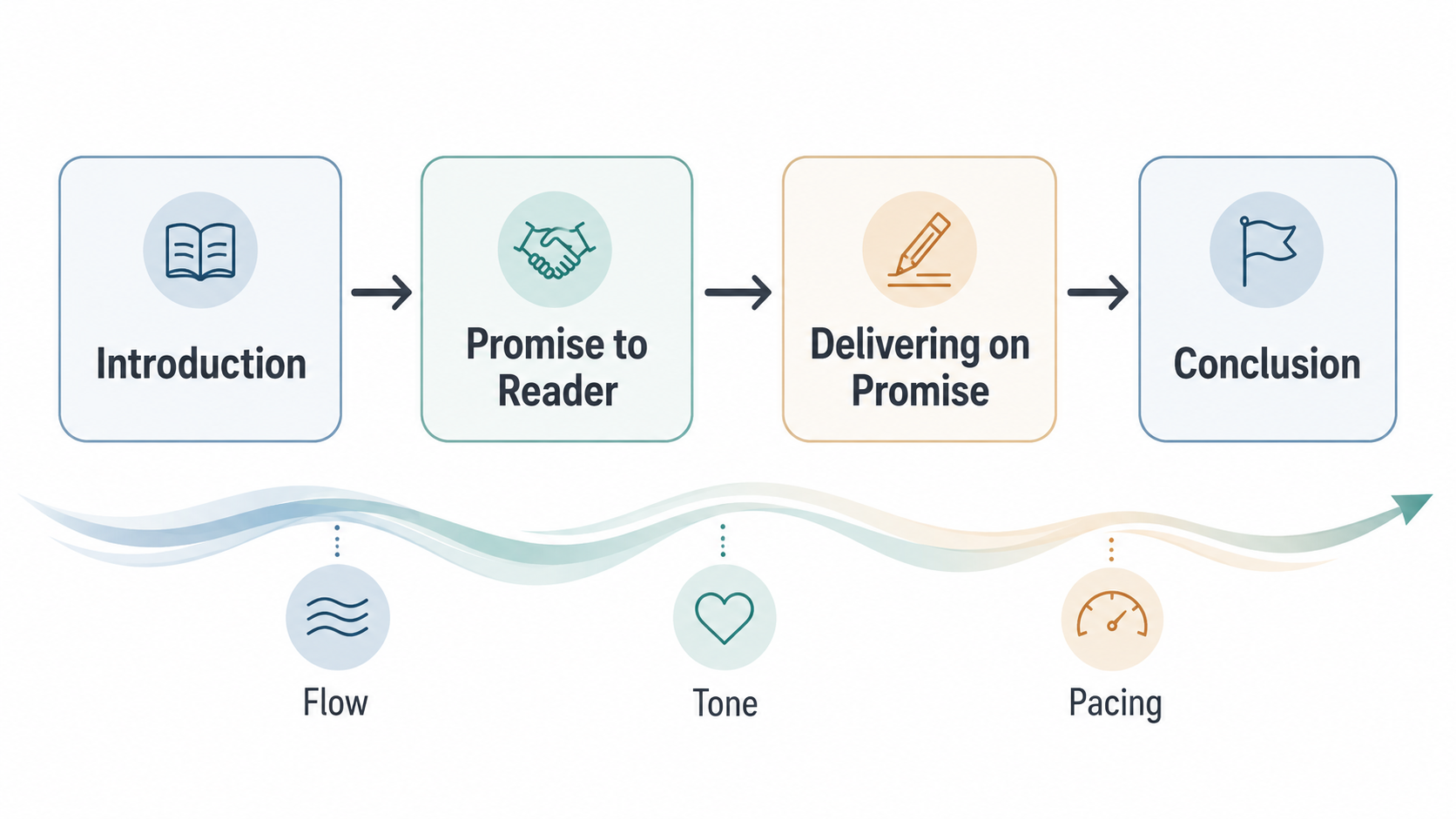
You've finished your draft—or at least a substantial chunk of it—and you know it needs work. But what kind of work, exactly? When you start researching editing services, you'll encounter terms like developmental editing, line editing, copyediting, and proofreading. They all sound like they involve making your writing better, so what's the difference?
If you're writing nonfiction—a memoir, a business book, a self-help guide, a narrative history—you need to understand the distinctions. Hiring the wrong type of editor at the wrong stage is one of the most common (and costly) mistakes writers make. And developmental editing, in particular, is often misunderstood.
You can see why writers get this one wrong: "developmental" sounds like the editor's job is to help you develop your ideas—feeding you questions and providing feedback until the book takes shape. That's not what it means.
So, let's clear that up.
What Developmental Editing Is
Developmental editing addresses the big-picture elements of your manuscript: structure, argument, pacing, clarity of purpose, and audience alignment. A developmental editor isn't looking at your sentences (that comes later). They're looking at your book as a whole and asking fundamental questions.
Does this structure serve the book's goals? Is the argument coherent and well-supported? Does the pacing keep readers engaged, or do certain sections drag? Is the intended audience clear, and does every chapter speak to that audience? Are there gaps in the logic, missing context, or sections that don't earn their place?
Think of it this way: if your book were a house, developmental editing is about the architecture. Are the rooms in the right places? Does the layout make sense? Is the foundation solid? Is there a staircase leading up to the second floor? You don't want to hang curtains and arrange furniture (line editing and copyediting) in a house that needs walls knocked down.
Scott Norton, author of Developmental Editing: A Handbook for Freelancers, Authors, and Publishers, describes the developmental editor's role as helping authors "discover and realize their intentions." A successful developmental edit clarifies and strengthens the vision you already have.
What a Developmental Editor Looks At
Every nonfiction book has its own challenges, but developmental editors typically focus on several core areas.
Structure and organization. Nonfiction books live or die by their structure. Your reader needs to feel oriented—to understand where they are, where they're going, and why each section matters. A developmental editor examines whether your chapters are in the right order, whether sections within chapters flow logically, and whether the overall arc of the book makes sense.
This is especially critical for books built around frameworks, methodologies, or arguments. If you're a consultant writing about your approach to leadership, for instance, your reader needs to understand each concept before you build on it. A developmental editor catches those moments where you've assumed knowledge your reader doesn't have yet, or where you've buried a key concept in the wrong chapter.
Argument and evidence. Nonfiction makes claims, and those claims need support. Whether you're drawing on research, case studies, personal experience, or client stories, a developmental editor evaluates whether your evidence actually supports your arguments—and whether your arguments are clear in the first place.
This isn't about fact-checking (though that matters too). It's about logical coherence. Does your conclusion follow from your premises? Have you addressed obvious counterarguments? Are there leaps in logic that will make skeptical readers disengage?
Audience alignment. One of the most common problems in nonfiction manuscripts is a mismatch between the book and its intended reader. Sometimes the author is writing for experts when the book is meant for beginners. Other times, the tone is too academic for a general audience, or too casual for a professional one.
A developmental editor helps you see your book through your reader's eyes. They ask: Who is this book for, and does every chapter serve that reader? Research on effective communication consistently shows that audience awareness is one of the strongest predictors of whether a message lands. As cognitive psychologist Daniel Willingham puts it, "the mind is not designed to think—it's designed to save you from thinking." Your reader won't do the work of figuring out why your book matters to them. You have to make it clear.
Pacing and engagement. Nonfiction doesn't get a pass on being engaging just because it's informational. Readers still need momentum. They need to feel like they're making progress, learning something new, moving toward a destination.
Developmental editors identify where your manuscript drags—where you've over-explained, repeated yourself, or lost the thread. They also spot where you've rushed, glossing over material that deserves more attention. Pacing problems often stem from structural problems, which is why this level of editing needs to happen before you start polishing sentences.
Signs You Might Need Developmental Editing
Not every manuscript needs developmental editing. But here are some indicators that yours might.
You're not sure if your structure is working.
You've organized your chapters in a way that makes sense to you, but you're uncertain whether a reader will follow. Or you've reorganized multiple times and still aren't confident.
Feedback has been confusing or contradictory.
Beta readers or writing group members have given you feedback, but it's all over the map. Some say the book is too long; others say it needs more detail. Some love Chapter 3; others find it boring. When feedback is inconsistent, it often signals a structural issue that readers sense but can't quite articulate.
You know something's off, but you can't put your finger on it.
The book doesn't feel right, but you've been too close to it for too long to see why. You need an outside perspective—someone who can read with fresh eyes and diagnostic expertise.
Your book has a complex argument or framework.
The more intricate your content, the more important structure becomes. If you're presenting a methodology, a theory, or a multi-part argument, developmental editing helps ensure that complexity serves your reader rather than overwhelming them.
You're writing your first book.
First-time authors often underestimate how different book-length writing is from articles, blog posts, or reports. The architecture of a book requires skills that take time to develop. Working with a developmental editor on your first project is an education in itself.
When You Might Not Need It
If your structure is solid, your argument is clear, and your feedback has been consistently positive on the big-picture elements, you might be ready to skip straight to line editing. Some writers—especially those who've written multiple books or who have backgrounds in journalism or academic writing—have internalized structural thinking. They've already done the developmental work themselves.
The key is honest self-assessment. If you're uncertain, a developmental editor can often tell within the first few chapters whether your manuscript needs deep structural work or just refinement at the sentence level. Many editors offer manuscript evaluations—a shorter, less intensive read-through that assesses what kind of editing your book actually needs.
What the Process Looks Like
Developmental editing is collaborative. It's not a situation where you hand off your manuscript and get back a "fixed" version. Instead, you typically receive a detailed editorial letter addressing the big-picture issues, along with comments throughout the manuscript pointing to specific passages where those issues show up.
Then comes the revision. You take the feedback, sit with it, and decide what you want to change. Sometimes that means reorganizing chapters. Sometimes it means cutting sections that aren't working or writing new material to fill gaps. The editor's job is to diagnose and guide; the revision work is yours.
This is why developmental editing often happens earlier in the process than people expect. Ideally, you want a developmental edit before you've polished every sentence to a shine—because polished sentences in a chapter that needs to be cut, moved, or substantially rewritten are wasted effort.
Finding the Right Editor
Not every editor offers developmental editing, and not every developmental editor works with nonfiction. When you're evaluating potential editors, ask about their experience with your genre and subject matter. Ask how they approach developmental feedback—do they provide an editorial letter, in-line comments, or both? Ask about their revision philosophy. You want someone who will push you to do your best work while respecting your voice and vision.
The right developmental editor doesn't rewrite your book. They help you see it more clearly so you can rewrite it yourself, with confidence.
Your Next Step
If you're wondering whether your nonfiction manuscript needs developmental editing—or if you're not sure what kind of editing it needs at all—I'm happy to talk it through. Sometimes, a short conversation is all it takes to get clarity on where you are in the process and what kind of support would actually help.
Sources
Norton, Scott. Developmental Editing: A Handbook for Freelancers, Authors, and Publishers. University of Chicago Press, 2009.
Willingham, Daniel T. Why Don't Students Like School?: A Cognitive Scientist Answers Questions About How the Mind Works and What It Means for the Classroom. Jossey-Bass, 2009.
How to Craft a Strong Central Argument for Your Nonfiction Book
Something's off with your manuscript, and you can't quite name it.
The chapters are solid on their own. The writing is decent. But when you read the whole thing through, it feels scattered—like a collection of related essays rather than a single, building case. You've reorganized it twice and it still doesn't cohere. You suspect the problem is structural, but every time you go looking for it, you end up rearranging chapters and hoping it sticks.
When a book feels structurally broken, many times the problem isn't the structure at all. It's that there's no clear central argument holding the structure together. You can't organize chapters around a throughline that doesn't exist yet.
Get the argument right, and the structure tends to fall into place on its own. Let's get to it.
The Real Source of Mushy Structure
Most structural problems are about purpose.
When writers come to me convinced their chapters are in the wrong sequence, many times, I find that the chapters don't agree on what the book is saying. Each one is pulling in a slightly different direction. Chapter three is making one case, chapter six is making a subtly different one, and the reader feels the drift even if they can't put their finger on it.
This can be a death sentence for author credibility. Readers don't consciously think "this book lacks a unifying argument." They just feel less convinced as they go, and they trust the author a little less with each chapter that doesn't connect. Structural confusion reads as muddled thinking, even when your thinking is perfectly sound. You just haven't pinned it down yet.
So before you move yet another chapter, don’t worry about structure right now. Ask yourself: What’s this book’s argument?
Topic vs. Argument
Okay—you’re going to read this distinction and say, “Julie, I know that already.” But what feels off with your book may be explained by the difference between a topic and an argument. A topic is what your book is about. An argument is what your book says.
"Productivity" is a topic. "Sustainable productivity comes from managing energy, not time" is an argument. The first gives you no way to decide what belongs in the book. The second tells you instantly: a chapter on energy management belongs; a chapter that drifts into general time-hacking does not, however interesting it is.
That's why this matters for structure. An argument is a filter. Once you can state in a single sentence what your book is claiming, every chapter becomes easy to evaluate—it either advances that claim or it doesn't. Without that filter, you're left organizing by instinct, which is exactly why you keep reshuffling without ever feeling settled.
Before you do anything else to your manuscript, finish this sentence:
By the end of this book, the reader will understand that ______.
If you can't fill that blank with something specific, that's your real problem—not the chapter order.
Make the Argument Carry Weight
A central argument that's too safe won't hold a book together. "Communication matters in relationships" is true, but it's so universally agreed upon that it gives your chapters nothing to build toward. There's no tension, no momentum, no push and pull.
A strong argument takes a position—this, not that. It makes a claim specific enough that someone could reasonably disagree. That specificity is what gives your book a spine. Each chapter’s job is to advance the claim, address an objection to it, or supply the evidence it needs. The argument creates the work, and the work creates the structure.
Nonfiction authority is not about how much you know—it’s about the clarity with which you make and defend a specific case. A sharp central argument, supported chapter by chapter, demonstrates rigorous thinking. That demonstration is what earns the reader's trust, and it's impossible without a claim worth defending in the first place.
Use the Argument to Diagnose Your Structure
Only now do you have a tool to fix the structure.
Here’s what you do:
Go through your manuscript chapter by chapter and ask one question of each: How does this advance my central argument?
Write the answer in a single sentence.
This is the most clarifying exercise I know, and it surfaces problems immediately:
If you can't write that sentence for a chapter, that’s great! You’ve just determined that the chapter isn't earning its place. Cut it or rewrite it to serve the argument.
If two chapters produce nearly identical sentences, you're making the same point twice and probably need to merge them.
If the sentences don't build on one another—if Chapter Five doesn't depend on anything Chapter Four established—your sequence is arbitrary, and you have just identified your ordering problem.
When I wear my developmental editor hat, your book is the house, the central argument is the load-bearing wall. Every chapter either supports it or it's just taking up space. Through that lens, once you can see which chapters carry weight and which ones merely sit nearby, the right structure stops being a guessing game.
Stop Rearranging, Start Arguing
If your manuscript feels scattered, resist the urge to keep rearranging. Shuffling chapters is treating a symptom. The cure is upstream: a central argument clear and specific enough that every chapter knows its job.
Do that work first, and the structure that frustrated you starts to take root. Chapters that don't belong become obvious. The right order reveals itself because order follows logic and logic follows the argument. And a clearly argued book reads like clear thinking, which fosters your credibility.
Figure out what you're really trying to say. Then let that argument tell you where everything goes.
Still can't see why your structure isn't working? That's exactly what a developmental edit is for—an outside set of eyes to find the throughline you're too close to see. Let's talk about the throughline you're trying to land—and how to get every chapter working toward it.
Using Research In Your Writing Without Boring Readers
You've done the due diligence. You've read the studies, interviewed the experts, filled a document with quotes, statistics, and citations you're proud of. Now comes the part you’re not going to be happy about: most of it can't go in the book.
That's the paradox of research in nonfiction writing. The more you gather, the harder it becomes to use well. I've watched skilled writers undermine strong arguments by burying them under data. No doubt, the information was relevant, but there was too much of it, and all of it was given equal weight, so the reader didn’t know where to focus.
You’re the expert with the research in hand. Finding it is not the problem. The bigger challenge is knowing what to leave out and how to weave in what stays so it enhances your message and serves the reader.
Let's get to work.
Research Is the Seasoning, Not the Meal
Here's the reframe that changes everything: your research exists to support your argument, not to be the argument.
When you've spent months immersed in a subject, every fact feels essential. You know the provenance of each statistic, the nuance behind each study, and the reason that one obscure source matters. But your reader doesn't share your investment, and they don't need to. They need just enough evidence to trust you and the information you’re providing—and to follow your thinking.
A good cook doesn’t use the salt so you can taste it in and of itself. The salt is used to enhance the taste of everything else. When readers notice your research as research—when they feel the seams, the data dumps, the parade of citations—you've over-salted. The evidence has lost its purpose and has started to detract from your prose. This is really just overwriting wearing a lab coat. Toni Morrison's line applies as much to evidence as to prose: "I have been more impressed with myself when I can say more with less." One well-chosen study lands harder than five mediocre ones.
The Litmus Test for Every Source
Before any piece of research earns its place, make it pass a single question: Does this change what the reader believes or does?
If a statistic confirms something you've already established, cut it. If a second study says the same thing as the first, you don't need both—you need the stronger one. If a quote is interesting but tangential, it belongs in your notes, not your manuscript.
While cutting it may feel like a waste, unused research isn't wasted—it helped to build a foundation that lets you write with authority even on the pages where it never appears. The reader feels the depth of your knowledge precisely because you're not dumping all of it on them.
These nonfiction research tips come down to a discipline of subtraction. The expertise that makes you a credible author is the same expertise that should make you ruthless about what stays.
Integrate, Don't Interrupt
Even the most compelling research can muddle up an otherwise excellent point if you’re not strategic about how and where to include it. The most common failure I see in manuscripts is the research interruption—a smooth passage of the author's own thinking that suddenly stops cold for a block quote, a string of figures, or a three-sentence study summary, then resumes as if nothing happened.
The reader feels that jolt. In this context, jolts are not a good thing. It's the same disorientation a weak transition creates: Wait—how did we get here?
The fix is to make your evidence move at the speed of your prose. A few techniques can help make that happen.
Paraphrase more than you quote. Direct quotes should be rare—reserved for language so precise or so memorable that rewording would diminish it. Most of the time, restating a finding in your own voice keeps the rhythm intact and keeps the reader inside your argument rather than someone else's phrasing.
Lead with your point, then support it. Don't open a paragraph with "A 2019 study found ..." and make the reader wait to learn why they should care. State your claim, then bring in the evidence that backs it. The research arrives as reinforcement, not a detour.
Attribute in passing, not in ceremony. "Researchers have found that ..." or "One study of remote teams showed ..." carries enough authority for most readers. Save the full citation for your sources section. You're writing a book, not defending a dissertation.
Trust the Reader to Connect the Dots
Expert writers often over-explain their evidence because they're afraid of being misunderstood. You present a statistic, then spend a paragraph telling the reader exactly what to conclude from it. But readers are smarter than we give them credit for, and spelling out every implication drains the life from the work.
This is where economy of language and respect for your audience meet. Present the evidence cleanly, point it in the right direction, and let the reader arrive at the conclusion themselves. That act of arrival—the small click of oh, I see—is what makes an argument stick. When you do the thinking for them, you rob them of it.
Restraint, here, is a form of confidence. You're trusting your research to do its job and your reader to meet you halfway.
The Last Word
Bringing research into your writing so that it enhances your point, your credibility, and the reader’s understanding is about how much you can leave out while keeping your argument airtight. The studies, the data, the quotes—they're in service to the reader's understanding, never to your need to prove you did the homework.
So when you revise, go through your evidence the way you'd go through your prose: asking what can be cut, what can be tightened, what's earning its place. Most of your research should stay invisible—beneath confident, clean writing rather than the clutter on top of it.
That's the difference between a manuscript that informs and one that overwhelms. And it's usually the last thing standing between a good nonfiction book and a great one.
Wrestling with whether your evidence is serving your argument or burying it? That's exactly the kind of thing a fresh set of professional eyes can spot. Reach out and let's talk about where your manuscript stands.
The Art of Clarity: How to Write Complex Ideas Simply

If you've ever read a business book or thought leadership piece and thought, I have no clue what I just read, you're not alone. And if you've ever written about a topic in depth that still came across as convoluted, you're definitely not alone.
I live in a town full of engineers and rocket scientists. At one point, Huntsville, Alabama, had the most PhDs per capita in the country. Here's a truth that you’ve likely experienced yourself: When people with deep subject expertise talk about it, they often forget that the listener doesn’t share that default knowledge. The same thing happens with their writing. It's not that they're bad writers. It's that the material is second-nature to them and they assume the reader is on the same level. These experts often live and breathe their subject and love to delve into nuance, and don’t want to be seen as simplistic. So they overcomplicate. They hedge. They reach for jargon when plain words would do. And that’s fine as long as they’re writing for their colleagues, and not a mainstream audience.
The result is writing that is clearly authoritative but doesn't reach the reader. And in business writing—where you're trying to build trust, establish expertise, or move someone to action—that's a problem.
Writing clearly doesn’t mean dumbing down your subject. You’re meeting the reader where they’re at. Let's talk about how to achieve it.
Clarity Is Not the Same as Simplicity
Before we go any further, let's clear up a misconception. When I tell writers that we need to work on clarity, some of them hear, “We’re going to make it less sophisticated." That's not what I mean.
Clear writing can address the most complex ideas in the world. The difference is that the complexity lives in the idea, not in the prose. Your job as a writer is to be the bridge between what you understand and what your reader needs to understand. The harder the concept, the more important it is that your sentences carry the reader across that bridge rather than letting them flounder in that understanding gap.
One way to do that is to get rid of unessential content—clutter. William Zinsser, in On Writing Well, called clutter "the disease of American writing." He was talking about prose that functions as filler and leaves no space for the idea to land.
Know Exactly What You're Trying to Say
Most unclear writing stems from a thinking problem.
When writers haven't fully worked out their thesis statement, their prose gets fuzzy. They circle the idea instead of stating it and use abstract language because it doesn't require commitment.
You address this before you write the first word. Ask yourself: If I had to explain this idea to one person, in one sentence, what would I say?
That sentence becomes your anchor. Everything else either supports it or gets cut. If you can't write that sentence, you're not ready to write the piece yet. Sit with the idea longer and talk it through. Once you can say it clearly out loud, you can write it clearly on the page.
Use Plain Words
There's a persistent belief in business writing that sophisticated ideas require sophisticated vocabulary. The opposite is true. The most respected thinkers in any field tend to write in remarkably plain language—because they understand their material well enough to translate it.
Compare these two sentences:
"To maximize organizational efficiency, leadership is focused on streamlining communication workflows and enhancing cross-departmental visibility to reduce friction points.”
"Leaders want teams to communicate more clearly and share information more easily so work doesn’t get slowed down."
The second sentence is not only clearer but also reflects how people (who aren’t using business lingo) really talk.
Jargon often functions as a kind of insider signaling—a way of saying I belong here. But your reader is more interested in whether you can help them understand something. Think of it like this: Every time you reach for a five-syllable word when a one-syllable word would do, you're choosing your ego over your reader.
But do use technical terms when appropriate. A neurosurgeon writing for other neurosurgeons should use the language of the field. But the moment your audience widens, your language has to widen with it.
Cut the Throat-Clearing
Open most business writing, and you'll find the first paragraph (or two, or three) doing nothing. Setting up. Contextualizing. Easing in. Throat-clearing.
Readers don't need a warm-up. They need to know why they should keep reading.
How many of your opening sentences say something like "In today's dynamic business landscape..." or "Now more than ever..." or "It's important to consider..."? These are placeholders, not ideas. Cut them. Start with the actual point. You can contextualize later, after you've earned the reader's attention.
The same applies to sentences inside the piece. Watch for phrases like "It is important to note that..." or "What is interesting here is that..." Just say the thing.
Use Concrete Examples
Abstract ideas are slick, but examples make them stick.
If you're explaining a concept—a framework, a principle, a methodology—stop and ask: Have I shown the reader what this looks like in practice? If not, find an example. A client story. A scenario. A specific case where the principle played out.
Many SMEs explain the theory beautifully but never show it in action. The reader nods along, then closes the book, having retained almost nothing. Examples are what convert understanding into memory.
This is also where storytelling techniques do their work in business writing. A two-sentence anecdote about a specific person facing a specific problem is worth ten sentences of abstract principle. You don't need to write narrative nonfiction to use a scene. You just need to give your reader something to hold onto.
Read for Rhythm
Clear prose has rhythm. Sentences vary in length. Short sentences punch. Longer sentences develop ideas, build context, and give the reader room to think. When every sentence runs the same length—particularly when they all run long—the reader's brain starts to slide off the page.
Read your work aloud. If reading a sentence makes you run out of breath, it’s too long. When the rhythm flattens, you've stacked too many similar structures. Break it up. Let some sentences be six words. Let others be twenty-five. Variation keeps the reader engaged.
Trust Your Reader
A lot of unclear writing comes from a place of anxiety—the writer worried that the reader won't get it, so they over-explain, over-qualify, over-justify. The irony is that this almost always makes the writing harder to follow, not easier.
Your reader is smart, so trust them to meet you halfway. One explanation for an idea—not three—will suffice. You don’t have to spell out every implication. And what I see so much of these days is this pattern of presenting counterarguments at the sentence level.
Say it once, clearly, and move on. If you've done your job, they'll get it.
This is one of the hardest shifts for thought leaders, specifically, because expertise comes with a deep awareness of nuance. You know all the exceptions. You know all the ways a sophisticated reader might push back. The temptation is to address every one of them in the body of your argument. Don't. Acknowledge nuance where it matters, then keep moving. Footnotes and appendices exist for a reason.
The One-Question Test
When you’ve completed your first draft, ask Would a smart person outside my field understand what I'm saying?
Someone capable, curious, and willing to read carefully—but without your specialized knowledge. If the answer is yes, your writing is doing its job. If the answer is no, you've got revision ahead of you.
Even better, give it to that person. Watch where they pause, where they reread, where they ask what you meant. Those are the spots where your clarity broke down. Fix them.
The Last Word
Writing clearly about complex ideas is harder than writing about them in dense, jargon-filled prose. It takes more thinking, more revision, and more willingness to be understood.
Wondering if your writing is landing the way you intend? A professional line edit catches the places where complexity is obscuring your message instead of communicating it. Reach out, and let's talk about your project.
Sources
Zinsser, William. On Writing Well: The Classic Guide to Writing Nonfiction. Harper Perennial, 2006.