
Blog
Whether you’re outlining your first chapter or polishing your final draft, you’ll find practical guidance, editorial insight, and a steady nudge forward.
Browse by Topic
-
Editing & Revision
- Jul 28, 2026 A Realistic Timeline for Writing and Editing a Nonfiction Book Jul 28, 2026
- Jul 23, 2026 Why Great Editing Preserves Your Voice (Instead of Editing It Out) Jul 23, 2026
- Jun 27, 2026 What Is Copyediting, and When Do You Need It? Jun 27, 2026
- Jun 27, 2026 What Is Proofreading? Your Manuscript's Last Line of Defense Jun 27, 2026
- Jun 27, 2026 What Is Line Editing? The Service That Sharpens Your Voice Without Replacing It Jun 27, 2026
- Jun 20, 2026 Developmental Editing for Nonfiction: What It Is and When You Need It Jun 20, 2026
-
Editing Tips
- May 21, 2026 What Type of Editing Does Your Manuscript Need? May 21, 2026
- May 19, 2026 How to Self-Edit Your Nonfiction Manuscript May 19, 2026
-
Getting Started
- May 12, 2026 How to Outline a Nonfiction Book (With Templates and Examples) May 12, 2026
- May 8, 2026 How to Turn Your Expertise Into a Compelling Book May 8, 2026
- May 8, 2026 How to Start Writing a Nonfiction Book (When You Don’t Know Where to Start) May 8, 2026
-
Memoir/Personal Narrative
- Jun 30, 2026 How to Write a Memoir That Doesn't Read Like a Diary Jun 30, 2026
-
Reader Engagement
- Jun 25, 2026 The Psychology of Reader Engagement in Nonfiction Jun 25, 2026
- Jun 23, 2026 How to Build Credibility and Trust as a Nonfiction Author Jun 23, 2026
- Jun 9, 2026 Using Research In Your Writing Without Boring Readers Jun 9, 2026
- Jun 4, 2026 The Art of Clarity: How to Write Complex Ideas Simply Jun 4, 2026
-
Storytelling
- Jun 23, 2026 Storytelling in Nonfiction Writing Jun 23, 2026
-
Structure
- Jun 20, 2026 Developmental Editing for Nonfiction: What It Is and When You Need It Jun 20, 2026
- Jun 11, 2026 How to Craft a Strong Central Argument for Your Nonfiction Book Jun 11, 2026
- Jun 4, 2026 The Art of Clarity: How to Write Complex Ideas Simply Jun 4, 2026
- May 14, 2026 How to Structure a Nonfiction Book for Maximum Clarity and Impact May 14, 2026
- May 12, 2026 How to Outline a Nonfiction Book (With Templates and Examples) May 12, 2026
-
Writer Editor Collaboration
- Jul 21, 2026 Red Flags When Choosing a Nonfiction Editor (and What to Look For Instead) Jul 21, 2026
-
Writer-Editor Collaboration
- Jul 16, 2026 Writing Coach vs. Editor: Which One Do You Need? Jul 16, 2026
- Jul 14, 2026 Signs Your Nonfiction Manuscript Is Ready for Editing (or Not Quite Yet) Jul 14, 2026
- Jul 9, 2026 What to Expect When Working With a Nonfiction Editor Jul 9, 2026
- Jul 2, 2026 The Writer–Editor Relationship: What Collaboration Should Look Like Jul 2, 2026
-
Writing Mindset
- Jul 16, 2026 Writing Coach vs. Editor: Which One Do You Need? Jul 16, 2026
- Jul 14, 2026 Signs Your Nonfiction Manuscript Is Ready for Editing (or Not Quite Yet) Jul 14, 2026
- Jul 9, 2026 What to Expect When Working With a Nonfiction Editor Jul 9, 2026
- Jul 2, 2026 The Writer–Editor Relationship: What Collaboration Should Look Like Jul 2, 2026
- Jun 25, 2026 The Psychology of Reader Engagement in Nonfiction Jun 25, 2026
- Jun 23, 2026 The Mindset Shift Every Writer Needs Jun 23, 2026
- Jun 23, 2026 How to Build Credibility and Trust as a Nonfiction Author Jun 23, 2026
- May 28, 2026 The 7 Habits of Great Writers May 28, 2026
-
Writing Process
- Jul 28, 2026 A Realistic Timeline for Writing and Editing a Nonfiction Book Jul 28, 2026
-
Writing Tips
- Jun 23, 2026 The Mindset Shift Every Writer Needs Jun 23, 2026
- Jun 23, 2026 Storytelling in Nonfiction Writing Jun 23, 2026
- Jun 11, 2026 How to Craft a Strong Central Argument for Your Nonfiction Book Jun 11, 2026
- Jun 9, 2026 Using Research In Your Writing Without Boring Readers Jun 9, 2026
- Jun 4, 2026 The Art of Clarity: How to Write Complex Ideas Simply Jun 4, 2026
- May 28, 2026 The 7 Habits of Great Writers May 28, 2026
- May 26, 2026 The 5 Most Common Mistakes Writers Make (And the Simple Fixes) May 26, 2026
- May 14, 2026 How to Structure a Nonfiction Book for Maximum Clarity and Impact May 14, 2026
- May 12, 2026 How to Outline a Nonfiction Book (With Templates and Examples) May 12, 2026
- May 8, 2026 How to Turn Your Expertise Into a Compelling Book May 8, 2026
- May 8, 2026 How to Start Writing a Nonfiction Book (When You Don’t Know Where to Start) May 8, 2026
Writing Coach vs. Editor: Which One Do You Need?
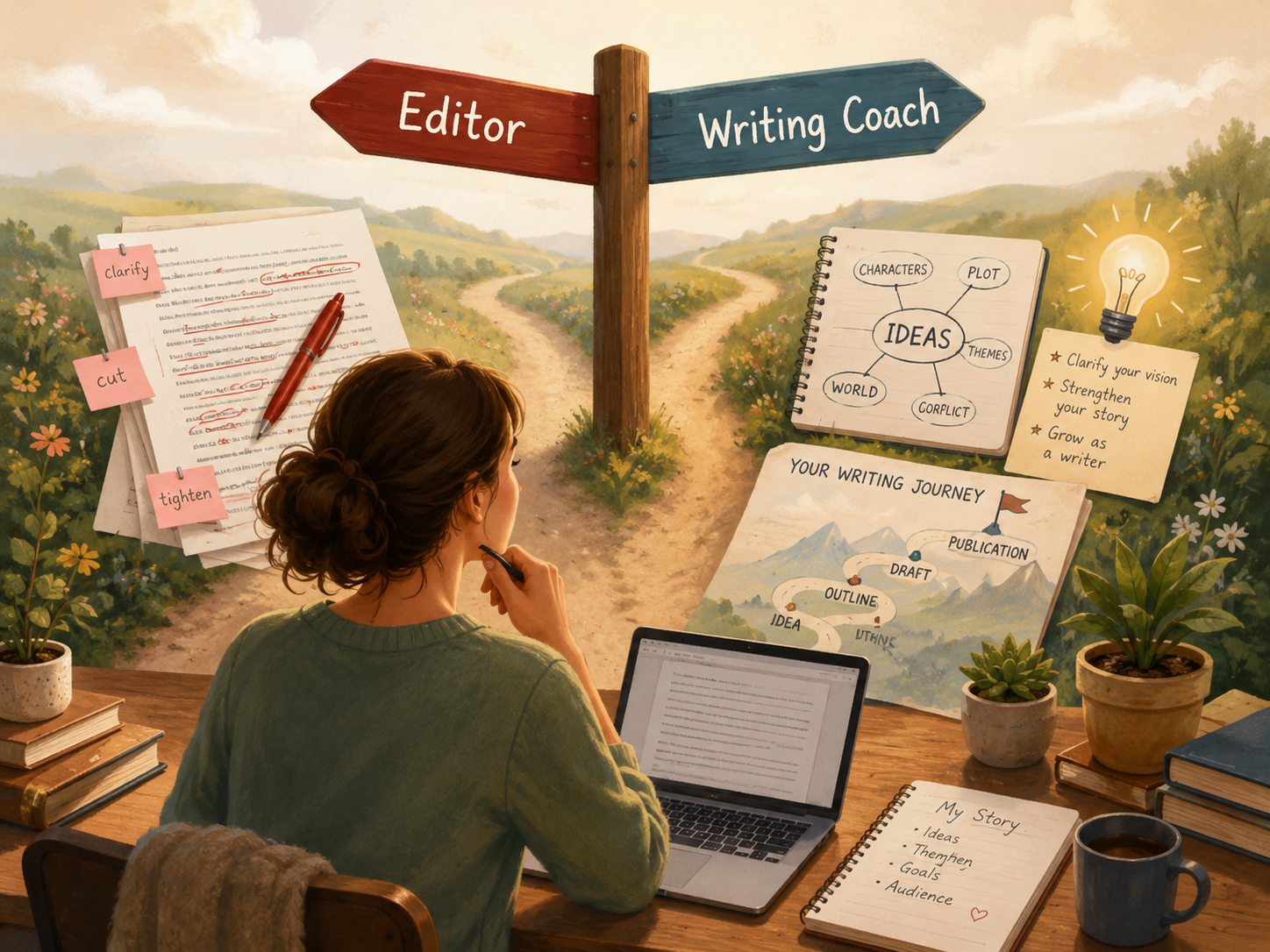
You know your nonfiction book needs help. What you're less sure about is what kind. "Writing coach" and "editor" tend to get tossed around like they're the same service, and plenty of people in the industry blur the line themselves. But a writing coach and an editor do genuinely different jobs, at different stages, for different problems. One helps you produce a manuscript. The other helps you refine one. Hiring the wrong one at the wrong time is an expensive mistake. So let's settle the writing coach vs. editor question for nonfiction writers, so your money is spent on elevating your book and moving it forward.
What a Writing Coach Does
A writing coach works with you while you're writing. You’ve got someone in your corner through the messy, uncertain middle part of a project—the stretch where most books quietly die.
Coaches help with momentum, accountability, and the day-to-day discipline of getting words on the page. A good one helps you set realistic goals, talks through structure before you've committed 40,000 words to the wrong one, and helps you troubleshoot when you're stuck. Some coaches teach craft directly. Others act more like a strategic partner who asks the right questions until you find your own way through.
What a coach generally won't do is take your finished pages and mark them up line by line. Their work is about you—your process, your habits, your confidence. The manuscript gets better as a byproduct of you getting better.
What an Editor Does
An editor works on the page, not the process. You hand over your writing, and they provide suggestions directly on the page to improve it. You can accept or reject those suggestions.
Beyond that, there are several types of editing, depending on what the manuscript needs.
Developmental editing tackles structure and argument.
Line editing works at the sentence level—voice, rhythm, flow.
Copy editing handles grammar and consistency.
Proofreading is the last polish before you publish.
But the common thread is this: editors respond to writing that already exists. They are product-focused, not process-focused. You hire an editor to elevate what you've already written.
The Real Difference: Where You Are in the Process
The cleanest way to tell these two apart is to forget the job titles and ask where you are.
If you're still writing—the draft isn't done, you keep stalling, you're not even sure the thing holds together—you're in coaching territory. A coach helps you produce the manuscript.
If you have a draft—rough is fine, but it needs to be a real, complete one—you're in editing territory. An editor helps you refine it.
Signs You Need a Writing Coach
You haven't finished a draft, and some part of you suspects you won't.
You start strong and lose steam around the middle, every single time.
You have the expertise or the story, but no idea how to shape it into a book.
You need accountability—someone expecting pages from you on a schedule.
This is your first book, and you’re overwhelmed.
If a few of those land, your money is better spent on coaching (or a structured writing program) than on editing. There's no sense paying someone to polish a manuscript that doesn't exist yet.
Signs You Need an Editor
You have a finished draft and know it needs work—you just can't always name what.
You've taken it as far as you can on your own, including self-editing, and need fresh, professional eyes.
You're getting ready to query agents or self-publish and want the writing as sharp as possible.
Beta readers keep flagging the same issues, and you want an expert read on what's really going on.
If you're nodding along, you're ready for editing. The only thing left is figuring out which type—and that hinges on whether your manuscript needs structural work or sentence-level refinement.
Where the Two Overlap
Here's where the line blurs, because it isn't always clean.
Developmental editing, in particular, shares DNA with coaching. A developmental editor diagnoses big-picture problems—structure, argument, pacing—and guides your revision without rewriting the book for you. That guiding role can feel coach-adjacent. The difference is timing and form: a developmental edit responds to a complete draft and arrives as a defined deliverable, usually an editorial letter plus margin comments. Coaching is ongoing and forward-looking. Developmental editing is a high-level assessment of the work you've already done.
Some professionals offer both, and the roles hand off naturally—a coach gets you to a finished draft, an editor helps you make it publishable. They aren't rivals. They're tools for different stages. For example, I offer both and, more often than not, incorporate a small degree of coaching into my editing services, as all of my clients turn out to be better writers by the end of our collaboration (and hopefully, have learned a thing or two they can use moving forward).
So, Which One Do You Need?
Let’s just strip it down to a single question: Do you have a complete draft?
If the answer is no, you need a coach—or build the writing habits that do a coach's job. If the answer is yes, you're ready for an editor, and the only thing left to sort out is which kind.
If you've got a draft and aren't sure what it needs—or whether it's even ready for editing yet—reach out. Sometimes a short conversation is all it takes to figure out where you are and what will actually help.
Signs Your Nonfiction Manuscript Is Ready for Editing (or Not Quite Yet)
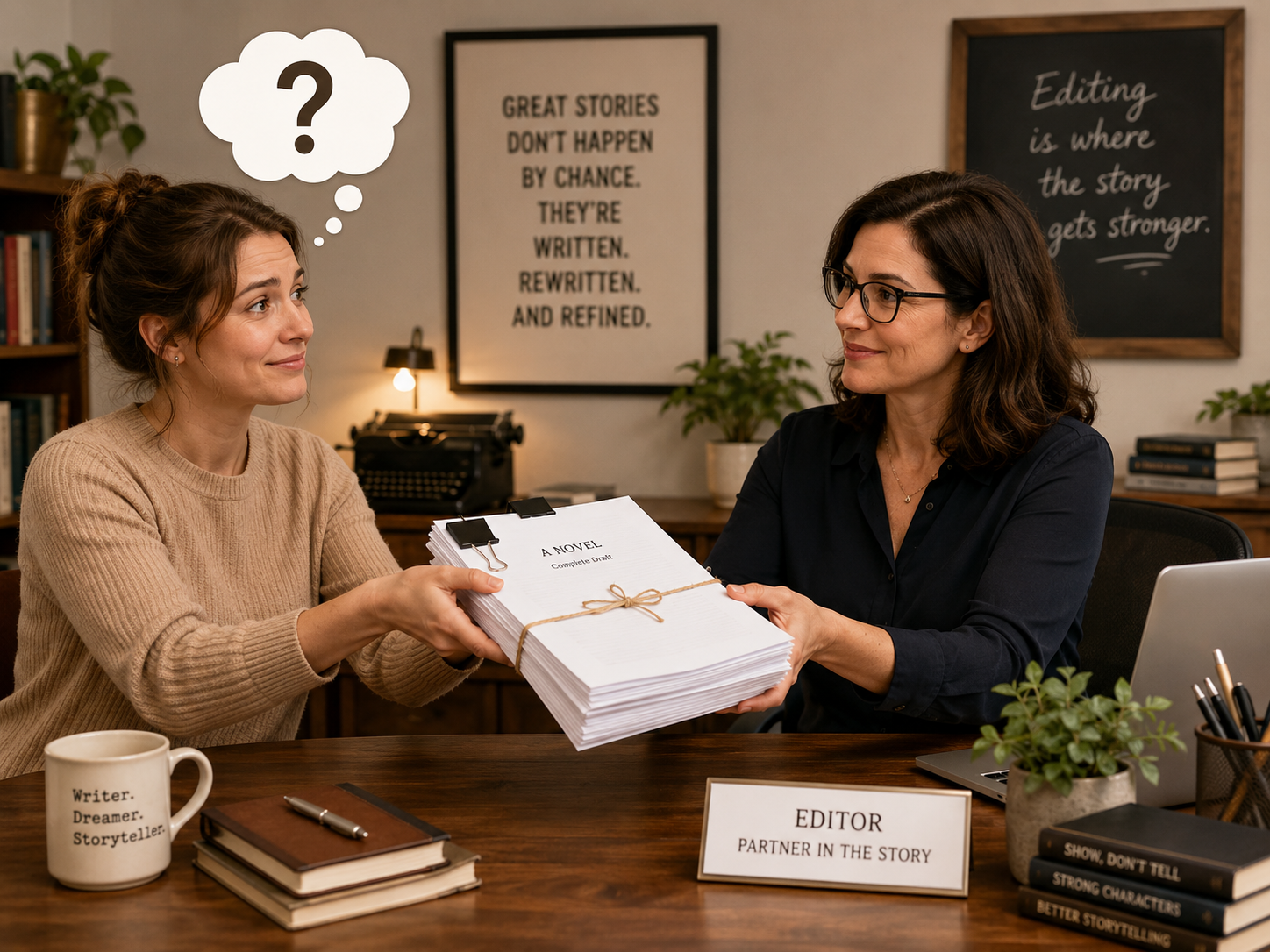
Every writer hits the same crossroads eventually. You've poured months—sometimes years—into your manuscript, and now you're staring at it, wondering whether it's time to bring in a professional or whether you'd just be handing over a draft that isn't there yet.
It's a fair question, and knowing when to hire an editor matters more than most writers realize. Bring one in too early, and you risk paying someone to point out problems you or a beta reader could have caught—or worse, paying for careful work on material you end up cutting anyway. Wait too long, and you can spend months spinning your wheels, polishing a manuscript that needs an outside set of eyes to move forward.
After years of editing nonfiction, I've gotten pretty good at reading the signals on both sides. And almost every writer I work with says the same thing afterward: they wish they'd known the signs sooner. Here's how to figure out where you stand.
You've Finished a Complete Draft
This is the big one. Before you hire an editor, you need a finished draft—beginning, middle, and end. It just has to be complete, not polished.
I can't tell you how many writers reach out when they're a third of the way in, hoping an editor can help them figure out where the book is going. I understand the impulse. But editing a partial manuscript is like asking a contractor to inspect a house with no roof and half the walls still missing. There's not enough there to assess. Finish the draft first, however rough it turns out. A messy, complete manuscript gives an editor something real to work with.
If you are absolutely stuck in the last third of your book but you are clear on its trajectory, then you would need a writing coach—not an editor—to help you get to the end.
You've Already Revised at Least Once
A first draft fresh off the keyboard is not going to be ready for professional editing—unless you’re Stephen King. Countless successful writers say that writing is revision, revision, revision. I just took David Sedaris’s MasterClass, and he said he will rewrite the opening of a short story 14 times before he is convinced he has the right version. Sedaris is a prolific, seasoned writer. You’d think it would come to him, maybe by the third try. But 14 times! In the class, he showed some of the opening rewrites that didn’t make the cut, and even though they were beautifully written, they didn’t create the setup that he was going for. That’s why writing is truly a craft.
If you’re feeling urgency, this next thing may be hard to do, but it works. Step away from the manuscript for a week or two, then come back and revise with fresh eyes. That distance lets you catch the rambling sections, the point you accidentally made twice, the place where you buried your real insight under three paragraphs of throat-clearing.
And if you haven't done a self-editing pass yet, that's your next move, not hiring an editor. (I walk through exactly how to approach this in my post on self-editing your manuscript). Handing over a draft you've already tightened means you're paying for refinement instead of cleanup.
You've Taken It As Far As You Can
You've read the manuscript so many times, you can no longer tell what's working. You've revised it, reorganized it, gone back and tinkered some more, and now you're just moving commas around. Something feels off, but you can't name it.
You’ve just hit the wall of self-editing. You know your material so well that you've lost the ability to read it as a stranger would, which is exactly the perspective a book needs before it goes out into the world. When you hit that wall, it's a strong sign you're ready for an outside reader.
You Know What You're Asking For—Or You're Ready to Find Out What You Need
You don't need to walk in with a perfect diagnosis. But it helps to have a sense of whether you're after big-picture structural feedback, sentence-level polish, or a final proofread. These are different services at different price points, and matching the right one to your manuscript's actual stage saves you real money. If you're unsure which you need, that's a conversation worth having before any work begins. (My breakdown of the different editing types is a good place to start sorting that out.)
So those are the green lights. Now for the other side.
You're Still Making Major Changes
If you're rethinking your structure, cutting whole chapters, or debating what the book is even about, you're not ready—and that's completely fine. Questions like these are worth resolving before line-level work begins, because there's no sense in perfecting prose that might not survive the next round of revision. Sometimes a developmental editor is the right partner for this stage. But if you're still in the process of shaping the book, give yourself room to do that work first.
You're Looking for Reassurance More Than Feedback
Be honest with yourself here. Are you hiring an editor because your manuscript needs sharpening, or because you want someone to tell you it's good? I say that with affection, because every writer feels the pull. Editing is a process of making your work better, which means it involves hearing what isn't landing yet. If you're not in a headspace to receive that, a little more time might serve you better than a little more money.
You're Hoping the Editor Will Do the Hard Part
A good editor diagnoses and guides. They don't write your book for you. If part of you is hoping to hand off a thin draft and get back a finished manuscript, that expectation will disappoint everyone involved. The revision is yours. An editor helps you see it more clearly so you can do it well.
When You're Somewhere in Between
Most writers don't land cleanly in one camp. You've finished a draft and revised it once, but you're still uneasy about the structure. You've taken it as far as you can, but you're not sure it's far enough. That uncertainty is common, and it's exactly where a conversation helps to clarify where you are and what you need. You don't have to figure that out alone.
Not Sure Where You Stand?
If you've read this far and you're still uncertain whether your manuscript is ready for editing, that uncertainty is worth talking through. Reach out, and let's figure out where you are in the process and what kind of support would move your work forward.
What to Expect When Working With a Nonfiction Editor

Handing your manuscript to an editor for the first time feels a little like handing someone your journal and asking them to mark it up in red pen. You've lived with these pages for months, maybe years. You know every soft spot, every paragraph you wrestled with at 2 a.m. and never quite fixed. And now a stranger is going to read all of it.
I get it. As an editor, I've watched plenty of writers approach that first handoff with their shoulders up around their ears. I don’t blame them. It’s an incredibly brave thing to do.
But let me pull back the curtain for a minute. Most of the anxiety around the nonfiction editing process comes from not knowing what happens once you hit "send." When you understand what goes on during the editing process, that anxiety dissipates quite a bit. Here's a behind-the-scenes look at what working with an editor looks like, from first contact to final file.
Conversation First
Before a single word is edited, a professional editor wants to understand your vision. What triggered you to write the book? Where are you in the process? Who are your readers? What's keeping you up at night about it?
That first conversation is about determining what kind of editing service your manuscript needs. Sometimes a writer asks me for a line edit when their manuscript has a structural problem that has to be solved first. Catching that early saves you money and spares you the frustration of polishing sentences that may be cut.
Many editors will also do a short sample edit of a few manuscript pages so you can see how they work before you commit. It also helps determine whether you and the editor will be a good fit. Some editors charge for an editing sample; others don’t. Either way, it’s a valuable test drive that will either reassure you as you move forward or help to refine what you do and don’t want in an editor.
The Writer-Editor Relationship: A Strategic Partnership
Savvy editors are not teachers who are going to mark up your manuscript in red to get you to comply with their agenda. We don’t judge the quality of your writing. And good editors do not rewrite your prose to sound more like they think you should sound. A nonfiction editor's job is to help you sound like the clearest, sharpest version of yourself on the page.
The best editing is invisible. When it works, readers don't notice the edits—they just feel like the writing flows, the argument holds, and the story lands. But the only way to achieve that is to have a meeting of the minds. You articulate high-level goals for your book. And that vision informs how the editor applies best practices, experience, and a style guide.
I once worked with an author who'd recorded dozens of videos for his audience before he ever wrote a word of his book. I watched them, read his social posts, listened to how he actually talked. The point wasn't to impose a style—he had that in spades, bowtie and all. The point was to honor and protect his voice so that it remained intact throughout the edits. That's the spirit of the writer-editor collaboration: your editor is in your corner, working to realize the book you intended.
What You'll Actually Receive
This part varies by the type of editing and editor, but the deliverables are more concrete than you may think. Here’s what I provide:
Developmental editing.
An editorial letter that walks through what's working, what isn't, and how to strengthen the structure and argument. It's a chapter-by-chapter roadmap for your revision, not a list of failures.
You’ll also get comments on the manuscript itself, referring to suggested high-level changes. These comments may point to redundant/repetitive content, inconsistencies, or a gap in logic.
As of this writing, I just did a developmental edit where I also included a “Heading Map” by chapter, so the writer could more easily understand the content included in each chapter. This heading map was needed because the edit required a complete overhaul of the original manuscript.
Line, copy editing, and proofreading.
Your manuscript typically comes back as a tracked-changes document. You'll see every suggested edit right in the text, alongside margin comments that explain the reasoning.
You'll also get queries: questions only you can answer. "You mention this study in Chapter Two, but a different figure here—which is correct?"
I also provide insights that may help with clarity or make the prose more compelling.
You Are in the Driver's Seat
Tracked changes can look alarming when you first open the file. A page lit up with revisions feels like a verdict. It isn't.
Every single change is a suggestion you can accept, reject, or modify. The manuscript is still yours, and so is the final call on every comma. A good editor expects pushback and welcomes it, because the back-and-forth is where the real refinement happens. If a suggested edit changes your meaning or flattens a line you love, say so. You won't hurt anyone's feelings. You'll make the book better.
This is what people mean when they call editing a partnership rather than a service. You bring the expertise and the vision. Your editor brings the outside eyes and the craft. Neither of you could produce the finished book alone.
Timelines, Cost, and Communication
Editing takes time, and the deeper the edit, the longer it runs. Developmental work on a full manuscript can take several weeks; a proofread of a finished, formatted file moves much faster. Your editor should give you a clear timeline up front, along with how they prefer to communicate along the way—email check-ins, a mid-project call, or a single handoff at the end.
Cost tracks with depth, too. Developmental and line editing are more labor-intensive and priced accordingly, while proofreading sits at the lighter end. Reputable editors base their rates on industry benchmarks rather than pulling numbers from thin air, so don't be shy about asking how a quote was built. Clarity here protects both of you.
One thing worth knowing: the cleaner your draft is going in, the less time an editor spends untangling basics, and the more of your budget goes toward elevating your prose. Self-editing before you hire pays for itself.
The Last Word
Working with an editor is not about handing over custody of your manuscript. You are always in control. You gain a strategic collaborator whose entire job is to help your words land exactly the way you meant them to.
The Writer–Editor Relationship: What Collaboration Should Look Like
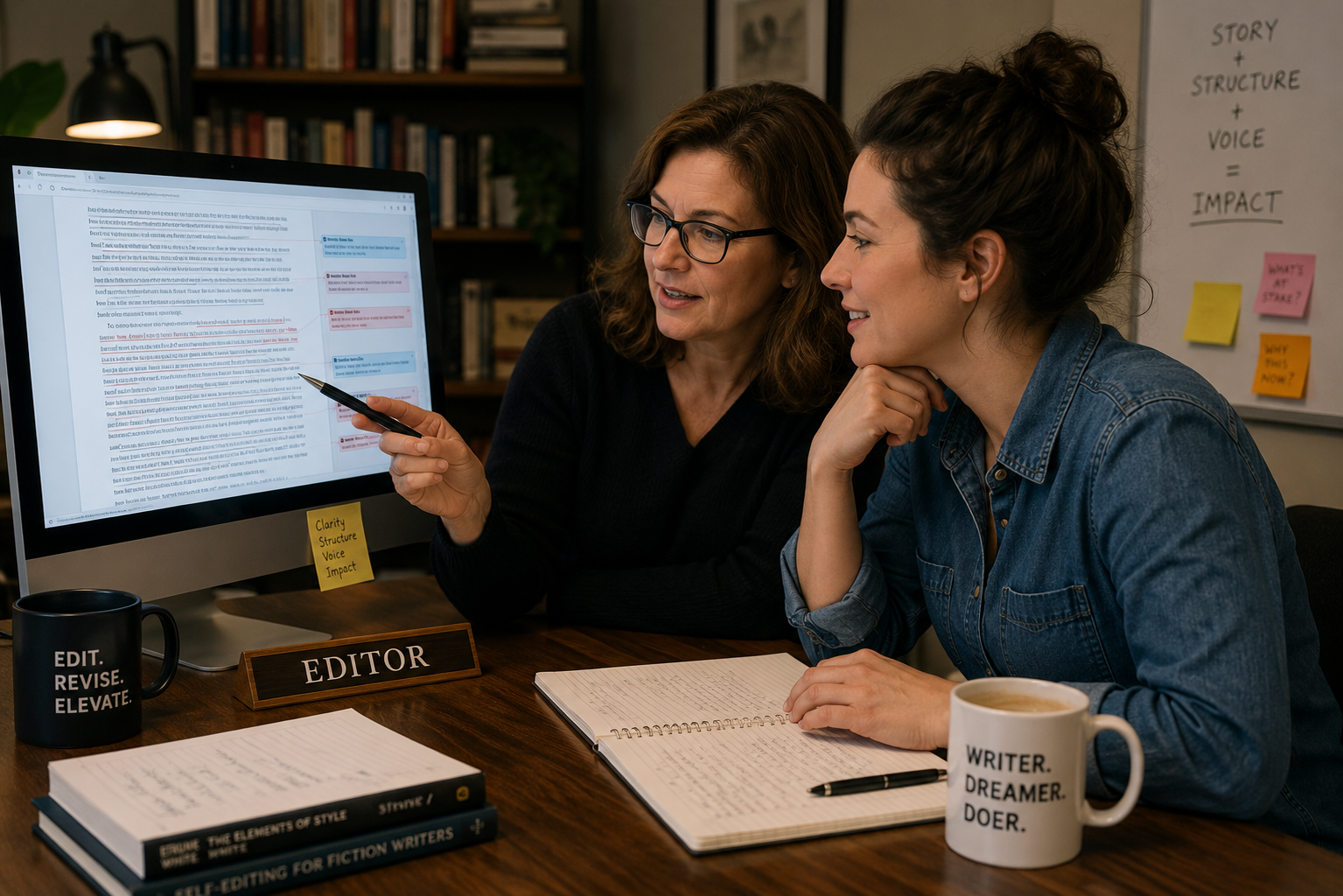
The first time you hand your manuscript to an editor, it can feel like handing over a child. You've lived with these words for months, maybe years. And now some stranger is going to mark them up, point out the flaws, and—you secretly fear—tell you the whole thing was a mistake.
I get it. I've watched that fear show up in writers who've published before and writers who've never put a word out in public. So let me put one worry to rest right away: working with an editor isn't about someone taking a red pen to your work and handing it back covered in corrections you're expected to obey. At least, that's not how I do it, and it's not how good editing works.
What actually happens is closer to a partnership. And the writers who get the most out of the process are the ones who expect that going in.
It Starts With Your Voice, Not My Preferences
Before I change a single sentence, my job is to understand how you sound. Everyone has a natural rhythm on the page—the words you reach for, the way you build an argument, the jokes you can't help making. That's your voice, and it's the most valuable thing in your manuscript.
A while back, I was tasked with taking a bunch of blog posts and papers written by my client and structuring all that content into a book. He also had a website and a YouTube presence, which I studied. We may have Zoomed one time, but we did a lot of messaging back and forth and shared a couple of relevant personal details. Throughout the process, I not only had a grasp of his voice, but I also understood how he thought. When we were wrapping up, he said that it felt like I was in his head.
That's the heart of writer-editor collaboration. A good editor doesn't impose a house style on you. They learn your voice well enough to help you sound more like yourself, not less.
You're Still the Author
Here's something that surprises a lot of first-time clients: when I send back a line edit, every change is a suggestion. You can accept it, reject it, or rewrite it your own way. The tracked-changes document isn't a verdict—it's a starting point for a conversation.
I'll often leave comments explaining why I suggested something: "this paragraph repeats the point you made two pages back," or "I think you're burying your strongest line at the bottom here." But you know things about your book that I don't. You know what you're trying to say, who you're saying it to, and what you're willing to cut. When a writer pushes back on an edit with a good reason, that's the process working exactly as it should.
The authority stays with you. I'm there to give you the clearest possible picture of how your words land so that you can make better decisions about them.
The Back-and-Forth Is the Point
People sometimes imagine editing as a single hand-off: you send the file, I fix it, you publish. Real collaboration is messier and a lot more useful than that.
A developmental edit, for instance, usually comes back as an editorial letter—a few pages walking through what's working, what isn't, and why. Then you sit with it. You decide what to change. You might reorganize chapters, cut a section you loved, or write something new to fill a gap I flagged. After that, we often talk it through. Questions come up. You explain what you were going for, and suddenly the fix becomes obvious to both of us.
One client I worked with on a business book had reorganized his chapters more times than he could count and still wasn't confident. He didn't need me to rewrite anything. He needed a fresh set of eyes to tell him which version actually served his reader. We figured it out together, and he finished ahead of his deadline—on a book he'd called me, a little panicked, to ask whether he even had a book.
What I Need From You
Collaboration runs both directions, so here's my side of the bargain and yours.
Be honest about where you are and what you want. Maybe you're querying agents. Maybe you're self-publishing, or writing something for a narrow professional audience. You could be writing a book that you’ll use more like a business card and a marketing tool to establish credibility and attract clients.
Do you know what kind of editing you need? Deep structural feedback? A final polish before it goes out the door? The more I understand your goals, the more useful my edits become. I'd rather you tell me up front that you're attached to a certain chapter than spend hours suggesting you cut it.
Most writers don't expect how much I lean on context. The history matters—if an editor took your manuscript partway and then walked, that alone tells me a lot about the seams I'm noticing. But so does everything surrounding the writing itself: how long you've been carrying this book, what your experience on the page has been, even how the people in your life feel about you spending your evenings on it. None of that is small talk to me. It all informs the work.
I need access to you. That means when I have a question during the editing process, your answer may inform my edits on subsequent material. I’ve found the most successful collaborations have a real-time feel with solid momentum.
Why So Demanding?
The reason I'm so particular about all of this is simple: the relationship determines the result.
I've had writers tell me, after the fact, about editors who flattened their personality or rewrote them into someone else—who handed back a marked-up file with no explanation and no conversation. They felt managed, not helped. A few of them nearly gave up on their books because of it. One client was convinced that the editor ran her manuscript through an AI platform that marked it up. She had paid professional rates.
That's the opposite of what editing should be. When the collaboration works, you don't come away feeling like your book was taken from you and returned in someone else's handwriting. You come away with a manuscript that's unmistakably yours, just sharper and more assured than the version you handed over.
That's the whole goal. Not to make you sound like me—to help you say exactly what you mean.
The Last Word
If you're thinking about working with an editor and you're not sure what the process would actually look like for your project, reach out. I'm always happy to talk through where you are, what you're trying to accomplish, and whether we'd be a good fit. No pressure, no judgment—just a conversation about your writing.
The Psychology of Reader Engagement in Nonfiction

Every nonfiction writer is competing for the same thing: a reader’s attention. It’s far too easy for a reader’s mind to drift to wondering about what’s for dinner or quickly glancing at their phone. You may think, well, my material is interesting, so my readers aren’t going to do that. But interesting material loses readers all the time. What holds them is something more mechanical, more psychological, and far more learnable than most writers assume.
If you want to engage readers, nonfiction asks you to understand what's really happening in a reader's mind as they move down the page—what pulls attention forward and what loses it. The craft of reader engagement in writing is, essentially, applied psychology. Let’s look at how that works.
Curiosity Is a Gap, Not a Topic
You may want to consider how you think about your reader’s curiosity. Psychologist George Loewenstein argued that curiosity arises from a gap between what we know and what we want to know (Loewenstein 1994). What sparks it, then, is the reader's awareness that something is missing—not the topic itself.
This is the secret sauce and a major reframe for many writers. If you think a reader’s curiosity lives in the topic, you’ll naturally front-load information, explaining thoroughly and answering questions the reader hasn't yet thought to ask. But you’ll do the opposite once you understand the gap: you open a small space of not-knowing and let the reader feel it before they fill it. Malcolm Gladwell opens Outliers with Roseto, a Pennsylvania town whose residents had an impossibly low rate of heart disease, and he describes the mystery in vivid detail for pages before explaining it (Gladwell, 2008). The withholding is the point. The reader leans in not because the topic compels them but because Gladwell opened a gap and hasn’t closed it yet.
Strong nonfiction poses the question before the answer. It names a problem and lets you sit in it for a sentence or two. It tells you something surprising is coming before telling you what. Each move opens a gap, and an open gap is a kind of mild, productive tension the reader wants resolved. That tension is the engine. Close every gap immediately, and you've turned off the motor.
The Power of the Unfinished
A close cousin of the curiosity gap is the Zeigarnik effect, named for the psychologist who observed that people remember interrupted or incomplete tasks more readily than completed ones (Zeigarnik 1927). An open loop occupies the mind. The brain keeps a low background hum running until the loop closes.
This is why a chapter that ends mid-tension pulls you into the next one, and why a chapter that ties everything into a neat bow can give the reader permission to stop. It's why a well-placed "but there was a problem I hadn't anticipated" at the end of a section is worth more than another paragraph of explanation. You're not manipulating anyone. You're working with the way attention naturally behaves.
I think a lot about pacing for exactly this reason—where to close a loop, where to leave one humming. It's some of the most consequential work in shaping a manuscript, and the reader doesn’t even realize it when it's done well.
Transportation and Why Stories Outperform Arguments
Melanie Green and Timothy Brock studied what they called “narrative transportation”—the state of being absorbed into a story—and found that the more transported a reader is, the more their beliefs shift in line with the narrative, and the less they counterargue (Green and Brock 2000).
Sit with that second part. A transported reader stops arguing back. When we read a dry claim, our critical thinking is in full operating mode, generating objections. When we're absorbed in a concrete scene, those faculties quiet down. This is why a single well-told example often persuades more than a page of evidence. The example doesn't just illustrate the point—it lowers the reader's resistance to it.
I’m not saying we should bombard our nonfiction manuscripts with stories. The point is that concreteness and scene are load-bearing. Abstraction invites scrutiny; specificity invites belief. A reader who can picture what you're describing is a reader who has, for that moment, stopped holding you at arm's length.
Cognitive Ease: The Friction You Can't See
Another dynamic that influences engagement works below conscious notice. Daniel Kahneman describes cognitive ease—the sense of mental fluency we feel when information is easy to process—and its strange consequence: things that are easy to read feel more true, more familiar, and more agreeable (Kahneman 2011).
Every source of friction taxes this ease. A tangled sentence, an unexplained term, a paragraph that makes the reader backtrack to figure out who "it" refers to—each one is a tiny cost. Readers rarely notice the cost consciously. They just have this vague sense that reading the text takes effort, and effort erodes engagement. So, they drift.
This is the unglamorous, foundational layer of holding attention, and it's where line editing earns its keep. Smoothing rhythm, cutting the word that makes a reader stumble, ordering a sentence so the reader never has to reread it—this is engagement work, even though it looks like mere tidying, even nitpicking. You're removing the small frictions that, in aggregate, decide whether a reader stays in the dream or wakes up.
Variation Keeps the System Awake
This last mechanism is often overlooked. Attention habituates. A reader who encounters the same sentence length, the same paragraph shape, and the same rhetorical move for too long will start to glaze, because the pattern has become predictable, and the mind stops registering the predictable. The reader’s perceptual system is on autopilot, and their attention fades.
This is the role rhythm plays. A short sentence after three long ones snaps a reader back. A sudden direct address—you—re-establishes contact. A shift from explanation to scene wakes the system up. Skilled nonfiction writers vary their texture because variation is how you keep attention from settling into autopilot. Sameness is comfortable, and comfort is where readers close your book.
None of This Is a Gift
Hopefully, you’re seeing that reader engagement isn't a mysterious gift some writers have. It's the product of understanding how attention, curiosity, and belief operate, and then taking those mechanisms into account when writing.
Remember to:
Open gaps.
Leave a few loops humming.
Trade abstraction for scene.
Remove invisible friction.
Vary your rhythm so the reader never settles.
Master those, and you're no longer hoping readers stay. You're giving their minds reasons they can't quite articulate but always feel.
Sources
Gladwell, Malcolm. Outliers: The Story of Success. Little, Brown and Company, 2008.
Green, Melanie C., and Timothy C. Brock. "The Role of Transportation in the Persuasiveness of Public Narratives." Journal of Personality and Social Psychology, vol. 79, no. 5, 2000, pp. 701–721.
Kahneman, Daniel. Thinking, Fast and Slow. Farrar, Straus and Giroux, 2011.
Loewenstein, George. "The Psychology of Curiosity: A Review and Reinterpretation." Psychological Bulletin, vol. 116, no. 1, 1994, pp. 75–98.
Zeigarnik, Bluma. "Über das Behalten von erledigten und unerledigten Handlungen" ["On Finished and Unfinished Tasks"]. Psychologische Forschung, 1927.
The Mindset Shift Every Writer Needs
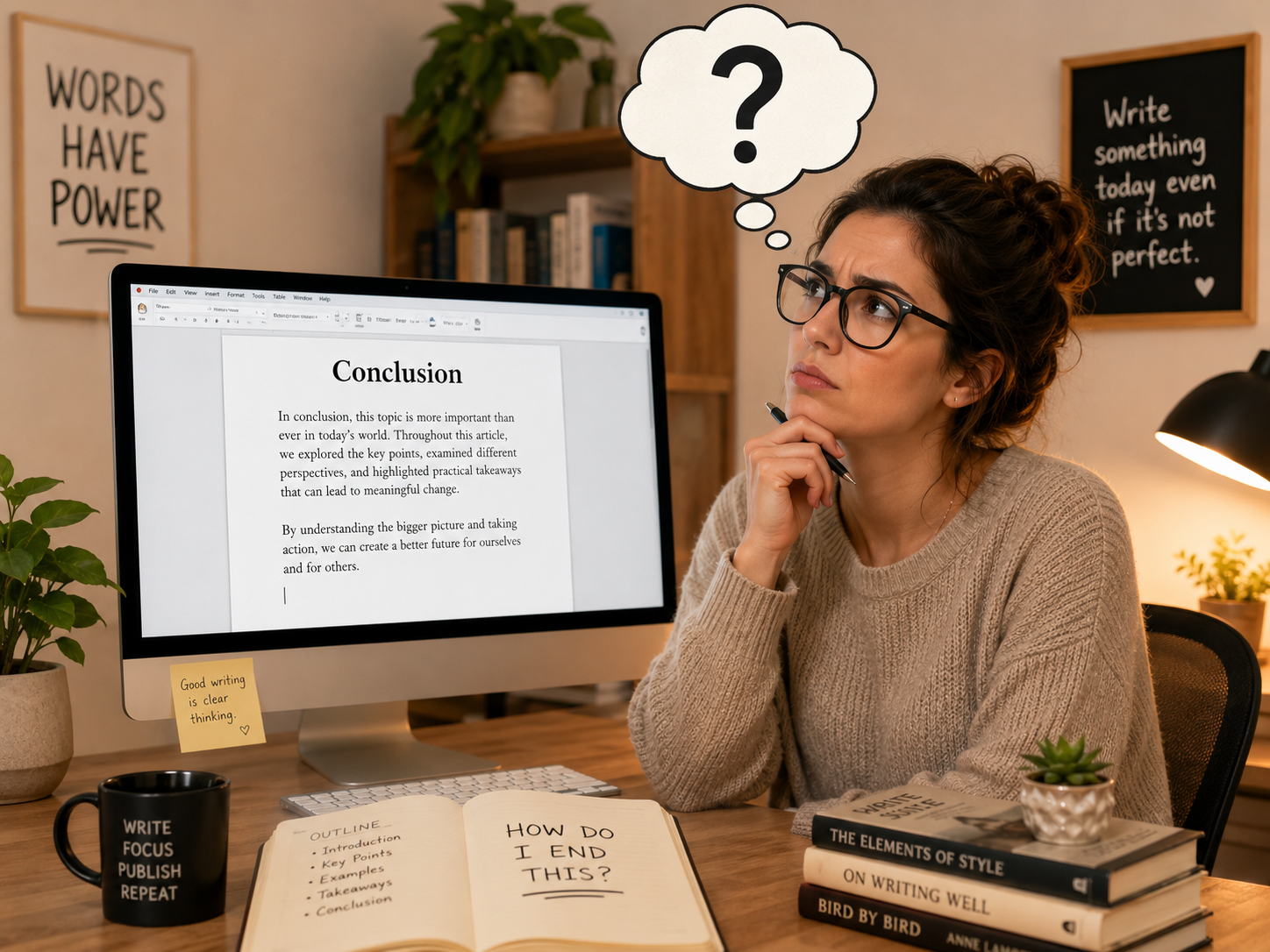
You're stuck.
Maybe you're three chapters from the end and suddenly convinced the whole thing is garbage. Maybe you haven't opened your manuscript in weeks because the thought of facing it makes your stomach clench. Or maybe you keep finding "urgent" tasks—laundry, emails, reorganizing your sock drawer—anything to avoid sitting down with your words.
I feel you. And I have some news that might surprise you: this is completely, frustratingly normal.
The Lie Your Brain Keeps Telling You
Here's what I've learned after years of working with writers: almost everyone, at some point in their manuscript, becomes convinced they're uniquely terrible at this. That they're the only ones struggling while everyone else sails through their drafts with coffee in hand and inspiration flowing like an open faucet.
Psychologists have a name for this feeling. It's called imposter phenomenon, first described by researchers Pauline Rose Clance and Suzanne Imes in 1978. It's that persistent sense of being a fraud—of waiting for someone to discover you have no idea what you're doing—despite evidence that you're actually capable. Research shows that about 70% of professionals experience this at some point in their lives, and writers are certainly no exception.
The cruel irony? The more you care about your work, the more vulnerable you are to this kind of self-doubt. Your inner critic isn't a sign that you're failing. It's a sign that you're invested.
The Mindset That Changes Everything
Stanford psychologist Carol Dweck's research on mindset has revolutionized how we understand achievement and struggle. Her work shows that people tend to operate from one of two belief systems. Some people believe their abilities are fixed—you either have talent or you don't, and no amount of effort will change that. Others believe their abilities can be developed through practice, feedback, and persistence.
That second belief? That's a growth mindset. Along with persistence, it's one of the most important things you can cultivate as a writer.
When you operate from a growth mindset, failure stops being a statement about who you are. It becomes information about what to try next. Dweck's research found that people with a growth mindset are more likely to embrace challenges, persist through setbacks, and ultimately achieve at higher levels—not because they're more talented, but because they're more willing to keep going.
Think about what this means for your manuscript. That chapter that isn't working is in no way proof that you can't write. It's a puzzle to solve. That critical voice that taunts you when you sit down to write has zero credibility. Remember—that inner critic is merely composed of thoughts, which means you can choose not to let them run the show. They’re not the boss of you. You got the wheel here.
Practical Reframes for the Stuck Writer
Let's get specific and get to work. Here are some mindset shifts that can actually get you back to the page.
Replace "I can't do this" with "I haven't figured this out yet." That single word, “yet,” is magic. It acknowledges the struggle without making it permanent. You're not a writer who can't finish. You're a writer in the middle of learning how. It’s true.
Understand that your first draft is just about getting it all down, nothing more. Anne Lamott gave us permission decades ago to write what she calls "shitty first drafts." The purpose of a first draft is to exist. In fact, celebrate that you now have something to work with. You can fix garbage. You cannot fix nothing. (I explore this more in my piece on The 7 Habits of Great Writers—it's habit number three, and it might just save your creative life.)
Separate your identity from your output. A bad writing day doesn't make you a bad writer. A messy chapter doesn't mean you don't have what it takes. Your worth as a creative person isn't determined by how smoothly the words come.
Remember that everyone's process looks different. Some writers draft quickly and revise slowly. Others labor over every sentence. Some write linearly; others jump around. There's no correct way to finish a manuscript—there's only your way.
The Surprising Power of Being Kind to Yourself
Here's something that might feel counterintuitive: being gentle with yourself isn't weakness. It's a sound strategy.
Kristin Neff, a psychologist at the University of Texas, has spent over two decades researching self-compassion. Her findings consistently show that self-compassion is actually a more effective motivator than self-criticism. When we beat ourselves up, we activate the threat-defense system in our brains. We become anxious, avoidant, and less creative. But when we treat ourselves with kindness—the same kindness we'd show a friend in the same situation—we create the psychological safety needed to take risks and keep going.
Neff identifies three core components of self-compassion: kindness toward yourself instead of harsh judgment, recognition that struggle is part of the shared human experience rather than something isolating, and mindful awareness of your emotions without drowning in them.
Applied to writing, this might look like acknowledging that the work is hard today without making it mean something terrible about you. Don’t fall into the trap of thinking a bad writing day means you’re just no good at this, and then chewing on that thought like caramel. Let it go. It’s just a bad session. It might look like remembering that every author whose book you love has sat exactly where you're sitting, wondering if they could pull it off. It might look like noticing your frustration or fear without letting it drive you away from the work.
The Truth About Finishing
Here's what I know to be true after working with hundreds of manuscripts: the writers who finish aren't the ones who never doubt themselves. They're the ones who doubt themselves and keep going anyway. Listen, as of this writing, my writer has before him a completed manuscript (ahead of deadline) ready to be sent to the publisher. But it was only a couple of months ago when he wanted to Zoom to ask me if he really had a book. And he’s already published in a big way. Obviously, we kept going, and here we are with a “real” book.
It’s okay to be filled with uncertainty about your manuscript. But it’s not okay to let your inner critic prevent you from putting butt in chair and writing something, even if it’s terrible. Take it from an editor who knows—terrible can be revised. Nothing cannot.
You may never be able to fully silence the inner critic, but you can change how you meet that voice. Instead of treating it as the final authority on your abilities, treat it as background noise. You can hear it, acknowledge it, and then get back to work.
Your Invitation
If doubt has rendered you too anxious to write—I want to offer you this: you are not broken, and you are not alone. You are experiencing the hard work of writing. That struggle is a sign that you’re a writer, and knowing that is how you move forward.
So close your browser tabs. Silence your phone. Open your manuscript.
And remember: the only way out is through.
Stuck on where to go next with your draft? Sometimes a fresh set of eyes can help you see what's working—and what's keeping you from the finish line. Reach out to me here to talk about how editing support might help you get unstuck.
Sources
Bravata, D. M., et al. "Prevalence, Predictors, and Treatment of Imposter Syndrome: A Systematic Review." Journal of General Internal Medicine, vol. 35, no. 4, 2020, pp. 1252-1275.
Clance, P. R., and S. Imes. "The Imposter Phenomenon in High Achieving Women: Dynamics and Therapeutic Intervention." Psychotherapy: Theory, Research & Practice, vol. 15, no. 3, 1978, pp. 241-247.
Dweck, C. S. Mindset: The New Psychology of Success. Ballantine Books, 2006.
Dweck, C. S., and D. S. Yeager. "Mindsets: A View From Two Eras." Perspectives on Psychological Science, vol. 14, no. 3, 2019, pp. 481-496.
Neff, K. D. "Self-Compassion: Theory, Method, Research, and Intervention." Annual Review of Psychology, vol. 74, 2023, pp. 193-218.
Neff, K. D., et al. "Self-Compassion and Its Link to Adaptive Psychological Functioning." Journal of Research in Personality, vol. 41, no. 1, 2007, pp. 139-154.
Workplace Strategies for Mental Health. "Self-Doubt and Impostor Syndrome." Centre for Applied Research in Mental Health and Addiction, 2022.
How to Build Credibility and Trust as a Nonfiction Author

It might surprise you to know that readers decide whether to trust you long before you deliver your main message. It can happen in the first paragraph or when they come across a sentence that overpromises. It’s like those few precious seconds of a first impression: everything that follows is seen through that lens.
Author credibility can be fluid as the reader gets to know you and your work. It can ebb and flow on the page itself, line by line. And the good news is that nonfiction authority has far less to do with credentials than most writers assume. I've edited published experts who undercut themselves on every page, and I've edited first-time authors whose work radiated trustworthiness. The difference came down to a handful of choices any writer can learn to make.
So let's talk about how you go about building that trust.
Know Exactly Who You're Writing For
Trust starts with relevance. When a reader feels like you understand their situation—what they already know, where they're stuck, what they're afraid the book won't deliver—they relax into your hands. When the book feels aimed at "anyone interested in this topic," that trust never forms.
This is why I push writers so hard on audience before they draft a word. Picture one reader and write to that person. The more precisely you understand who you're talking to, the more your expertise lands as authority rather than noise. A book that knows its reader feels like it was written for them, and readers reward that recognition with their attention.
Show Your Expertise—Don't Announce It
Here's a mistake I see constantly: writers try to establish authority by telling readers how qualified they are. They stack credentials in the introduction and remind you, repeatedly, that they know what they're talking about.
If that’s how you function professionally, please don’t do that on the page. Authority you claim outright reads as insecurity, but authority you demonstrate reads as confidence.
And you demonstrate your authority through specifics, not broad strokes. Writing "I've helped countless clients improve their leadership” tells the reader nothing and is yawn-inducing. But that’s exactly how a lot of experts write. Far fewer of them will tell you about the specific executive who couldn't stop interrupting his team until one uncomfortable meeting changed everything. The concrete example proves what the claim merely asserts. Vague language drains your credibility, because readers sense when you're gesturing at expertise instead of showing it. (I dig into this in my post on the five most common mistakes I see in nonfiction manuscripts.)
Structure Is an Authority Signal
This one surprises people. They think credibility lives in the sentences, but a disorganized book erodes trust no matter how polished the prose. When readers can't tell where they are, why a chapter matters, and where it’s all going, they start to suspect the author doesn't fully know either.
A clear structure does the opposite. It signals that you've thought this through, that there's a foundation of logic supporting the material, and that you're a reliable guide who knows the terrain. Each chapter builds on the last, creating necessary context for subsequent chapters. Concepts unfold in the order that will make most sense to your reader.
That's the architecture work, and it happens before sentence-level polishing—which is exactly what developmental editing addresses. If you want the longer version of how structure holds a book together, I've written about that separately.
Back Up What You Claim
Nonfiction makes promises. Most often, it tells readers that something is true and goes about proving it. Credibility depends on whether you can support that promise.
That means your claims should rest on something a reader can trust: research, documented experience, a real example, a source they can check. When you assert that a technique works, show it working. When you cite a statistic, make sure it's accurate and attributed. Robert Cialdini's work on persuasion describes authority as one of the core drivers of how people decide whom to believe (Cialdini 2006). But borrowed authority only works when it's honest—one inflated or unverifiable claim, and a skeptical reader starts doubting all the others.
Also, don’t underestimate the power of addressing what you don't know. Writers fear that admitting limits will weaken their authority. In my experience, the opposite is true. A writer who says "the evidence here is mixed" or "this won't work for everyone" sounds more trustworthy, not less, because they're clearly more interested in being accurate than in being impressive.
Let Your Voice Do the Work
Readers trust people, not personas. When a writer adopts a stiff, inflated "author voice" because they think that's how serious nonfiction or an expert is supposed to sound, something subtle goes wrong. The prose doesn’t feel authentic, which widens the distance between reader and writer. And trust thrives on closeness.
Your natural voice—the way you'd actually explain this to a smart friend—is one of your strongest credibility tools. It makes you sound like a real person who knows their subject, rather than someone performing expertise. This is the foundation of what the ancient rhetorician Aristotle called ethos: the credibility a speaker establishes through character and how they come across (Aristotle, Rhetoric). Thousands of years later, it still holds. We believe people who sound genuine.
Clean Pages Protect Everything Else
I'll end with the least glamorous point, because it matters more than writers want to believe. Errors erode trust. A typo here, a misused word there, a fact that doesn't quite check out—each one is small, but they accumulate. By the third or fourth, a reader has started to wonder what else you missed.
You've done the hard work of building authority through everything above. Don't let preventable mistakes chip away at it. This is what copy editing and proofreading exist to protect—not your ego, but the reader's confidence in you. A clean manuscript tells your reader you cared enough to get the details right, and that care reads as respect.
The Last Word
Nonfiction authority isn't conferred by a title or a bio. It's built through clarity, specificity, honesty, and respect for your reader—choices you make on every page. The writers readers trust most aren't necessarily the most credentialed. They're the ones who write in their own voice, know their reader, and fulfill their promise to the reader in a way that makes sense.
If you're working on a manuscript and want a professional read on whether it's building the trust you intend—or undermining it—reach out. I'd be glad to talk through where you are and what kind of support would serve your book best.
Sources
Aristotle. Rhetoric. Translated by W. Rhys Roberts, Dover Publications, 2004.
Cialdini, Robert B. Influence: The Psychology of Persuasion. Revised ed., Harper Business, 2006.
Zinsser, William. On Writing Well: The Classic Guide to Writing Nonfiction. Harper Perennial, 2006.
The 7 Habits of Great Writers
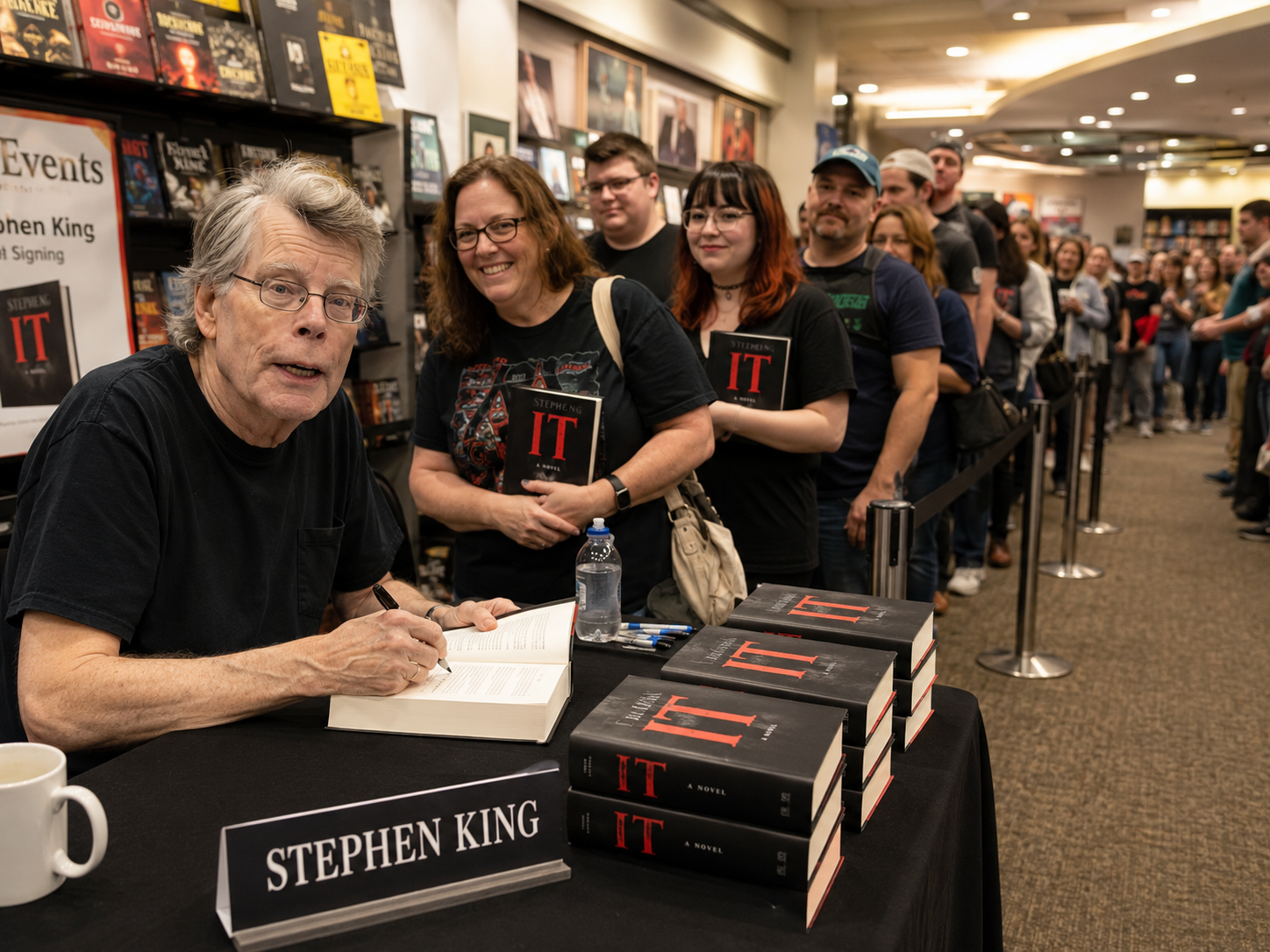
They say imitation is the sincerest form of flattery. And why reinvent the wheel if someone else has already figured out the thing you want to do?
So, I thought it might be helpful (and fun) to pinpoint what separates published authors from people who dream about writing and being published "someday."
Spoiler: it's not talent.
What I’ve discovered about successful writers over the years is that many of them have this love/hate relationship with writing because good writing is hard. And it’s not like the words form in their head, and all they have to do is get them on paper. There’s nothing more daunting than a blank screen and a blinking cursor, and all you can think about is running downstairs and throwing your wet clothes into the dryer. You know you should write anything, even if it’s gibberish, but you can’t even come up with gibberish. I mean, if you do that and continue it, doesn’t that gibberish just snowball into an avalanche of gibberish?
The point is, yes, you can just sit there and see if anything happens. Or you can develop habits and strategies that will keep you planted in your seat and writing. To give you a jumpstart, this guide provides several (surprising) routines shared by the most prolific authors in history. We’ll walk through seven of these habits from these literary legends—and show how each translates into better writing.
Let's look at what the greats actually did (and still do) to produce work that endures.
1. Write Every Day Without Exception — Stephen King
The habit:
Even with his colossal success, King writes 2,000 words every day without exception and, yes, even on holidays. It may sound boring, but he sits down at the same time every single morning and goes through the same ritual: tea or coffee, a vitamin pill, music, same seat, papers arranged identically. He describes this routine as "a way of saying to the mind, you're going to be dreaming soon.”
Why it translates into good writing:
We just mentioned momentum, which is created by consistency. The more you write, the easier it becomes. But waiting and hoping for inspiration is a trap because you need to train your writing muscle by showing up and writing every day. And those 2000 words? Yeah, that’s a lot. But volume matters because it’s so much easier to manage a jumble of words than it is to deal with a blank page. In King’s experience, it is only when he is in the process of writing that he experiences visits from his muse.
How to use it:
Set a daily word count that feels realistic to you (even as small as 300 words). The goal here is to show up and making it achievable and fun.
2. Stop While You Still Know What Comes Next — Ernest Hemingway
The habit:
Hemingway was a disciplined writer, getting up every morning and writing “as soon after first light as possible,” which meant typically from 6 a.m. until noon. You may have heard of his famous rule: you write until you come to a place where you still have momentum and know exactly what follows. Hemingway would stop writing mid-sentence or mid-scene—but always knew what was going to happen next. That may seem counterintuitive because, like an athlete, you’re in a flow. But, this is Ernest Hemingway!
Why it translates into good writing:
In knowing exactly where to start the next day, Hemingway eliminated the terrifying "blank page" problem. You’re also stopping before you are completely drained, which prevents burnout. You’re also building anticipation and a creative energy that carries you back to the desk. Because you’re holding what you’re going to write between sessions, it keeps your content “alive in your subconscious between sessions.
How to use it:
End your writing session mid-thought. Leave yourself a breadcrumb trail. You’ll be thankful tomorrow.
3. Embrace the "Shitty First Draft" — Anne Lamott
The habit:
Lamott gave writers permission to write terrible first drafts in her book Bird by Bird. She tells her readers to “just get it down on paper” without judgment, then revise ruthlessly. When I do this, I actually have to take off my editor hat and give myself permission over and over again. It sounds much easier than it is in practice. She describes the first draft as "the child's draft"—emotional, messy, and uninhibited. Well, let’s be real—there are a lot of adults who fit that description!
Why it translates into good writing:
Perfectionism is the enemy of progress because it paralyzes writers before they begin. I don’t stand a chance with writing when I’m in editing mode. Bad drafts become good second drafts, which become terrific third drafts. You’ve created the raw material to then start the real writing, which is in the revision. Lamott’s process frees your creative voice from your inner critic.
How to use it:
Give yourself permission to write garbage. You can fix garbage. You can't fix nothing.
4. Create a Distraction-Free Sanctuary — Maya Angelou
The habit:
Angelou rented hotel rooms in every city she lived in—specifically to write. She stripped the rooms bare: "I insist that all things are taken off the walls. I don't want anything in there." Armed with only a Bible, dictionary, thesaurus, yellow legal pads, and a bottle of sherry, she wrote lying across the bed from around 6:30 a.m. until early afternoon, every single day.
Why it translates into good writing:
Environment shapes output. Distractions don't just slow you down—they dilute your creative focus entirely. A dedicated writing space signals to your brain that it's time to work, and physical separation from daily life creates mental separation from daily worries. As Angelou put it: "I go into the room, and I feel as if all my beliefs are suspended. Nothing holds me to anything."
How to use it:
You don't need a hotel room. You need a room—or a corner, a coffee shop, a library. Protect your writing space fiercely.
5. Read Voraciously and Constantly — Ray Bradbury
The habit:
Bradbury's advice was deceptively simple: "Just write every day of your life. Read intensely. Then see what happens." But he practiced what he preached with almost obsessive dedication. He recommended reading one short story, one essay, and one poem every night—for a thousand nights. Before he ever published seriously, he spent ten years educating himself in public libraries. "At the end of ten years," he said, "I had read every book in the library and I'd written a thousand stories."
Why it translates into good writing:
Reading fills your creative well, and you can't pour from an empty cup. Exposure to different styles, voices, and structures expands your toolkit in ways you don't even notice until you need them. Great writers absorb rhythm, pacing, and language through osmosis—it seeps into their prose whether they intend it to or not. Bradbury captured this beautifully: "You must lurk in libraries and climb the stacks like ladders to sniff books like perfumes."
How to use it:
Read widely and without apology. Read in your genre. Read outside your genre. Read what challenges you.
6. Warm Up Before the Real Work — John Steinbeck
The habit:
Every day before writing East of Eden, Steinbeck wrote a "letter" to his editor in his journal. These warm-up pages helped him rev his mind like an engine—he'd discuss his mood, his doubts, the day ahead. He also sharpened anywhere from 24 to 100 pencils each morning as part of his ritual. It sounds almost comically meticulous, but for Steinbeck, these small acts were the on-ramp to deeper work.
Why it translates into good writing:
Warm-ups ease you into creative mode without the pressure of producing "real" writing. Journaling clears mental clutter so you can arrive at the manuscript with a quieter mind. But more than that, the ritual itself becomes a signal—a way of telling your brain it's time to create. As Steinbeck put it: "In writing, habit seems to be a much stronger force than either willpower or inspiration."
How to use it:
Try writing a one-page "letter" to anyone (real or imagined) before diving into your project. Let yourself meander. Then get to work.
7. Trust the Power of Saying Less — Toni Morrison
The habit:
Morrison was as deliberate about what she left out as what she put in. She believed in relying on "the reader's own emotions and intelligence" rather than over-explaining, and she worked early mornings when she was "clearer-headed, more confident, and generally more intelligent." Her philosophy was refreshingly direct: "I have been more impressed with myself when I can say more with less."
Why it translates into good writing:
Economy of language creates impact—every word has to earn its place on the page. Trusting your readers makes them active participants rather than passive consumers, and that trust pays dividends. Over-writing dilutes emotional punch; restraint amplifies it. Morrison said it best: "It is what you don't write that frequently gives what you do write its power."
How to use it:
After your draft is complete, ask: What can I cut? Where am I explaining too much? Trust your reader to meet you halfway.
The Bottom Line
These seven habits aren't magic—they're choices, made daily. The writers who "make it" aren't necessarily more talented than the rest of us; they're more consistent. And every habit here is something you can start today, not someday. But here's the thing about habits: they get you to "good enough." And "good enough" is exactly where the real magic begins.
The Last Word
So you've built the habits. You've shown up day after day. You've written the shitty first draft, revised it, tightened it, and now you're holding a manuscript that feels... ready.
Here's my question: Ready for what?
Because "good enough" is the starting line, not the finish. That's where someone like me comes in—a fresh set of professional eyes to help you see what you're too close to notice. Whether you need developmental guidance, a thorough line edit, or a final polish before submission, I'm here to help your words land exactly the way you intended.
Let's get your work where it deserves to be.
Sources
Angelou, Maya. Interview by George Plimpton. "Maya Angelou, The Art of Fiction No. 119." The Paris Review, 1990.
Bradbury, Ray. "Zen in the Art of Writing: Essays on Creativity." Joshua Odell Editions, 1990.
Hemingway, Ernest. Interview by George Plimpton. "Ernest Hemingway, The Art of Fiction No. 21." The Paris Review, 1958.
King, Stephen. "On Writing: A Memoir of the Craft." Scribner, 2000.
Lamott, Anne. "Bird by Bird: Some Instructions on Writing and Life." Anchor Books, 1994.
Morrison, Toni. Interview by Elissa Schappell. "Toni Morrison, The Art of Fiction No. 134." The Paris Review, 1993.
Morrison, Toni. "Toni Morrison on Creative Failure." National Endowment for the Arts, 2014.
Steinbeck, John. "Journal of a Novel: The East of Eden Letters." Viking Press, 1969.