A Realistic Timeline for Writing and Editing a Nonfiction Book
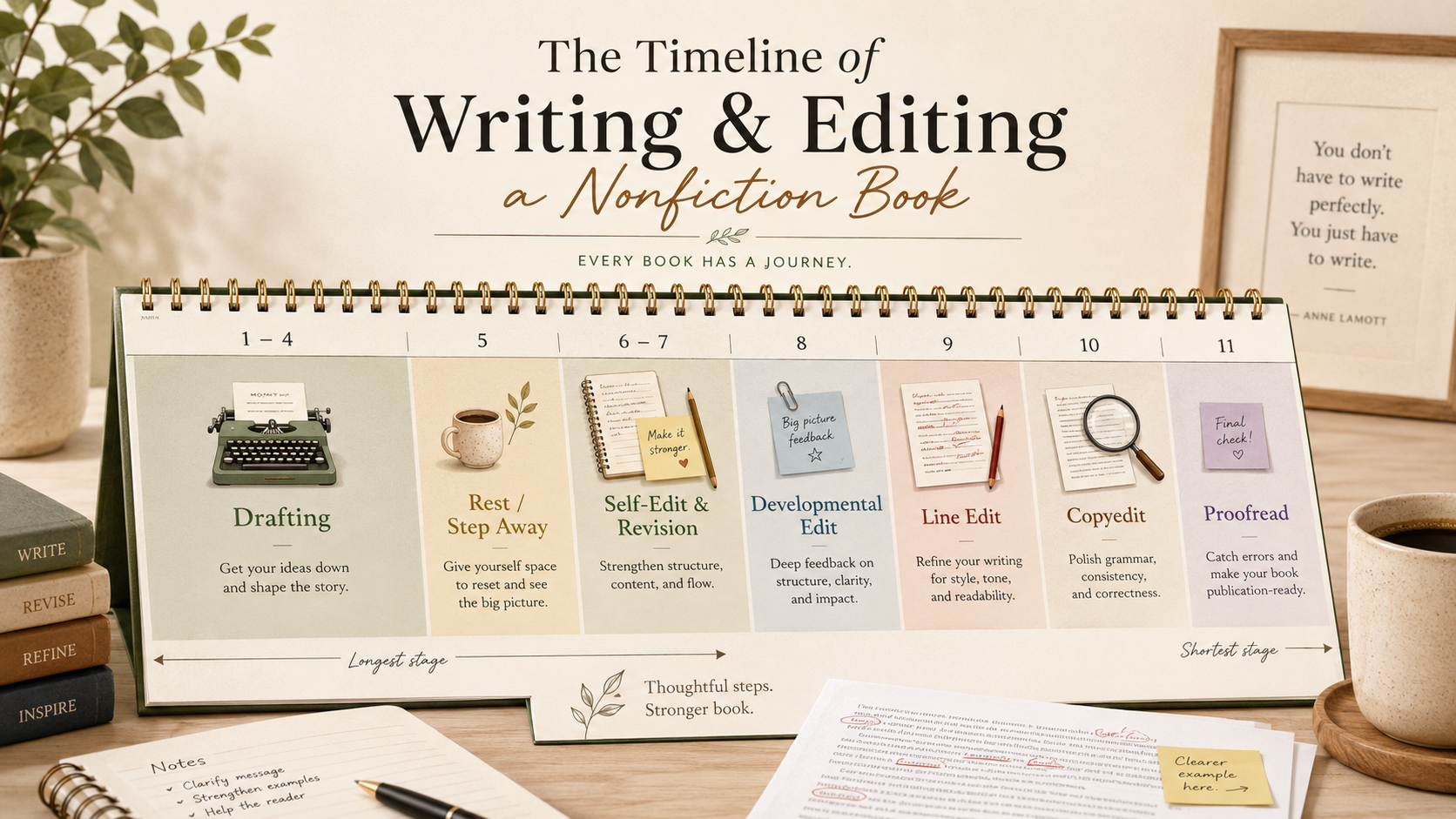
The question comes up before some writers have typed a single word: How long is this whole thing going to take? It's reasonable to want to know. You're about to pour a meaningful chunk of your life into a book, and you'd like some sense of whether you're signing up for months or years.
Here's the honest answer, and I promise to do better than stopping here: it depends. A 30,000-word business book written by someone with an open calendar moves at a wildly different pace than a 90,000-word memoir squeezed into the margins of a full-time job and a houseful of kids. So rather than give you one magic number to make it nice and neat, let me walk you through a realistic nonfiction writing timeline, stage by stage, so you can build one that fits your day-to-day life.
Consider what follows a planning tool, not numbers set in stone. The ranges are real, but your mileage will vary—and that's perfectly on par.
The Drafting Stage: Slower Than You Hope, Faster Than You Fear
Most writers underestimate how long a first draft takes, then beat themselves up for falling behind a schedule that was never realistic to begin with. Let's not do that to you.
A typical nonfiction book runs somewhere between 40,000 and 80,000 words. If you write 500 words on the days you genuinely sit down—and we both know you won't sit down every day, because you have a life—you're looking at several months of drafting. Many of the writers I work with take six months to a year to get a complete first draft down. Some move faster. Others move more slowly, especially when the book leans on research, interviews, or excavating old journals to reconstruct what happened.
Many writers are surprised when I tell them that the biggest variable here isn't talent, and it’s not even the hours on your calendar. It's consistency. A writer who produces 300 words four mornings a week will almost always finish ahead of the one holding out for a free weekend and a thunderbolt of inspiration. Stephen King writes daily for a reason: momentum is far easier to maintain than to rebuild from a cold start.
When you map your own drafting timeline, be generous. Pick a word count you can hit on an ordinary Tuesday, do the multiplication, and then pad it for the weeks when life decides to get chaotic.
Self-Editing and Revision: The Stage Everyone Wants to Skip
Once you've got a complete draft, the urge to fire it off to an editor while it's still warm is almost physical. Resist it for a week or two. Literally step away. That distance is what lets you come back and read what's on the page instead of what you meant to put there. Do you get what I’m saying by that? When we’re too close to the writing, our brains tend to fill in any gaps on the page (this is especially true for those of you who are subject matter experts!), and we don’t process the content in the same way a reader with fresh eyes would. We already know what we mean when we read a sentence. That’s why you need that space and time to pivot your attention and let that manuscript rest.
Next is revision, which is where a lot of the real writing happens. Budget a few weeks to a couple of months here, depending on how much reshaping the draft needs. A self-editing pass—hunting for the patterns nearly every nonfiction writer falls into, like overwriting and weak transitions—does double duty. It sharpens the book, and it means you'll eventually pay your editor to refine your prose rather than untangle the basics.
This stage is unglamorous and easy to rush past. Take. Your. Time. The weeks you invest here tend to pay for themselves later, in both time and money.
What Moves the Needle
Before we get to the editing calendar, it helps to know what truly stretches or shrinks these ranges, because two writers with the same word count can finish a year apart.
Length. A 35,000-word guide is a different animal from a sprawling family saga.
Complexity. A book heavy with research, citations, or interwoven timelines asks more of every stage.
Available time. The writer with two protected hours a day will lap the one stealing 15 minutes between meetings.
Condition of your draft when it reaches an editor. Writers wildly underestimate this. A clean, self-edited manuscript moves through editing faster than a rough one, simply because there's less to wade through before the meaningful work begins.
The Editing Stages: Broad to Fine, in Order
Here's where the editing timeline takes on its own rhythm, and where sequence earns its keep. Editing happens in stages—a progression that runs from the big-picture architecture down to the last stray comma—and tackling them out of order is how writers end up paying for the same work twice. I've covered the different types of editing in depth elsewhere, but here's how each one tends to sit on a calendar.
Developmental editing comes first, and it's the heaviest lift. This is the architectural work: structure, argument, pacing, and whether the book delivers on its promise. For a full manuscript, the edit itself often runs several weeks, and the revision it sets in motion can take you weeks or even months, since a developmental pass frequently means reordering chapters or writing fresh material. It's the stage most likely to send your timeline sideways, which is exactly why you want it early, before you've buffed sentences that may not survive the cut.
Line editing arrives once your structure holds. Working at the sentence and paragraph level—voice, rhythm, clarity—a line edit on a full-length manuscript generally takes a few weeks, plus your own time to work through the suggestions.
Copyediting follows, handling grammar, consistency, and mechanics. The edit lands in a similar ballpark, though your turnaround on the changes is usually quicker, since you're reviewing corrections rather than rebuilding paragraphs.
Proofreading is the final pass, and the speediest by a comfortable margin. On a clean, formatted file, it's often a matter of days to a couple of weeks.
One factor writers almost never build in: the queue. Sought-after editors are frequently booked weeks, sometimes months, ahead. The edit might take three weeks, but if your editor can't start until spring, that wait belongs on your timeline too. Reach out earlier than feels necessary.
Putting It Together: A Sample Timeline
Let me make this concrete with a plausible scenario: Our writer has a full-time day job, and this is their first book at 60,000 words. That means the bulk of the writing will be done on weekends with occasional sessions during weekday evenings. You can easily decrease the following times by half if, say, you’ve got a part-time job. Your numbers will land differently, but this will give you an idea.
Drafting. Around eight or nine months at a sustainable pace.
Revision and a self-edit pass. Two months.
Developmental editing. Two to three months once you fold in scheduling.
Line editing. Six to eight weeks.
Copyediting. Roughly a month.
Proofreading. A week or two.
Stack those up, leave breathing room between stages for the life interruptions that will absolutely arrive, and you're somewhere in the neighborhood of 18 months to two years from blank page to publication-ready manuscript.
If that number made you wince, take a breath. Many books move faster—shorter ones, second books, writers who can give the project real daily time. And not every manuscript needs every stage; a writer with a strong structural instinct or a chapter flow that is inherently logical might skip developmental editing altogether. The principle behind these timeframes is that a book of substance takes real time, and knowing that up front spares you that nagging sense of feeling perpetually behind.
Why a Realistic Timeline Is a Gift
The writers who finish are the ones who kept going when the work took longer than they'd hoped—and it almost always takes longer than they'd hoped. With as many manuscripts as I’ve handled, you’d think I’d be able to look one over and give the writer an accurate estimate of how long the editing process will take. And let me say here that I’m a bit of a workhorse because I have the flexibility in my life to do so (and it’s just how my brain works). But I can never understand the depth or breadth of what changes are needed in a manuscript by a cursory look. Remember, we are talking about the real work of editing that includes more than corrections to spelling, grammar, and punctuation. We usually sail through that stuff.
So, giving yourself a realistic writing timeline for your nonfiction book does something powerful: it turns "I'm so far behind" into "I'm right on schedule." When you know drafting eats most of a year, you stop spiraling in month four. When you know a developmental edit can reshuffle your entire second half, you build in the room ahead of time instead of resenting it later. Most of the discouragement I see in writers traces back to measuring an honest pace against a fantasy schedule that never existed in the first place. That unrealistic schedule is only because the writer didn’t know better.
So plan for the long haul, pad your estimates, and treat the timeline as directional, not an endpoint set in stone. Your book will take as long as it takes. Your job is to keep showing up for it.
The difference between published and non-published writers is persistence.
The Last Word
A nonfiction book is a serious undertaking, and pretending otherwise only sets you up to feel like a failure when you're simply somewhere in the middle. Give the writing its months. Give the revision its weeks. And let each editing stage take its turn in line. Do that, and the timeline stops being a source of frustration and turns into a reasonable plan you can follow.
Now, hurry up and write your book already! 🙂 If you’re having trouble getting started, writers have found the content in this post helpful.