
Blog
Whether you’re outlining your first chapter or polishing your final draft, you’ll find practical guidance, editorial insight, and a steady nudge forward.
Browse by Topic
-
Editing & Revision
- Jul 28, 2026 A Realistic Timeline for Writing and Editing a Nonfiction Book Jul 28, 2026
- Jul 23, 2026 Why Great Editing Preserves Your Voice (Instead of Editing It Out) Jul 23, 2026
- Jun 27, 2026 What Is Copyediting, and When Do You Need It? Jun 27, 2026
- Jun 27, 2026 What Is Proofreading? Your Manuscript's Last Line of Defense Jun 27, 2026
- Jun 27, 2026 What Is Line Editing? The Service That Sharpens Your Voice Without Replacing It Jun 27, 2026
- Jun 20, 2026 Developmental Editing for Nonfiction: What It Is and When You Need It Jun 20, 2026
-
Editing Tips
- May 21, 2026 What Type of Editing Does Your Manuscript Need? May 21, 2026
- May 19, 2026 How to Self-Edit Your Nonfiction Manuscript May 19, 2026
-
Getting Started
- May 12, 2026 How to Outline a Nonfiction Book (With Templates and Examples) May 12, 2026
- May 8, 2026 How to Turn Your Expertise Into a Compelling Book May 8, 2026
- May 8, 2026 How to Start Writing a Nonfiction Book (When You Don’t Know Where to Start) May 8, 2026
-
Memoir/Personal Narrative
- Jun 30, 2026 How to Write a Memoir That Doesn't Read Like a Diary Jun 30, 2026
-
Reader Engagement
- Jun 25, 2026 The Psychology of Reader Engagement in Nonfiction Jun 25, 2026
- Jun 23, 2026 How to Build Credibility and Trust as a Nonfiction Author Jun 23, 2026
- Jun 9, 2026 Using Research In Your Writing Without Boring Readers Jun 9, 2026
- Jun 4, 2026 The Art of Clarity: How to Write Complex Ideas Simply Jun 4, 2026
-
Storytelling
- Jun 23, 2026 Storytelling in Nonfiction Writing Jun 23, 2026
-
Structure
- Jun 20, 2026 Developmental Editing for Nonfiction: What It Is and When You Need It Jun 20, 2026
- Jun 11, 2026 How to Craft a Strong Central Argument for Your Nonfiction Book Jun 11, 2026
- Jun 4, 2026 The Art of Clarity: How to Write Complex Ideas Simply Jun 4, 2026
- May 14, 2026 How to Structure a Nonfiction Book for Maximum Clarity and Impact May 14, 2026
- May 12, 2026 How to Outline a Nonfiction Book (With Templates and Examples) May 12, 2026
-
Writer Editor Collaboration
- Jul 21, 2026 Red Flags When Choosing a Nonfiction Editor (and What to Look For Instead) Jul 21, 2026
-
Writer-Editor Collaboration
- Jul 16, 2026 Writing Coach vs. Editor: Which One Do You Need? Jul 16, 2026
- Jul 14, 2026 Signs Your Nonfiction Manuscript Is Ready for Editing (or Not Quite Yet) Jul 14, 2026
- Jul 9, 2026 What to Expect When Working With a Nonfiction Editor Jul 9, 2026
- Jul 2, 2026 The Writer–Editor Relationship: What Collaboration Should Look Like Jul 2, 2026
-
Writing Mindset
- Jul 16, 2026 Writing Coach vs. Editor: Which One Do You Need? Jul 16, 2026
- Jul 14, 2026 Signs Your Nonfiction Manuscript Is Ready for Editing (or Not Quite Yet) Jul 14, 2026
- Jul 9, 2026 What to Expect When Working With a Nonfiction Editor Jul 9, 2026
- Jul 2, 2026 The Writer–Editor Relationship: What Collaboration Should Look Like Jul 2, 2026
- Jun 25, 2026 The Psychology of Reader Engagement in Nonfiction Jun 25, 2026
- Jun 23, 2026 The Mindset Shift Every Writer Needs Jun 23, 2026
- Jun 23, 2026 How to Build Credibility and Trust as a Nonfiction Author Jun 23, 2026
- May 28, 2026 The 7 Habits of Great Writers May 28, 2026
-
Writing Process
- Jul 28, 2026 A Realistic Timeline for Writing and Editing a Nonfiction Book Jul 28, 2026
-
Writing Tips
- Jun 23, 2026 The Mindset Shift Every Writer Needs Jun 23, 2026
- Jun 23, 2026 Storytelling in Nonfiction Writing Jun 23, 2026
- Jun 11, 2026 How to Craft a Strong Central Argument for Your Nonfiction Book Jun 11, 2026
- Jun 9, 2026 Using Research In Your Writing Without Boring Readers Jun 9, 2026
- Jun 4, 2026 The Art of Clarity: How to Write Complex Ideas Simply Jun 4, 2026
- May 28, 2026 The 7 Habits of Great Writers May 28, 2026
- May 26, 2026 The 5 Most Common Mistakes Writers Make (And the Simple Fixes) May 26, 2026
- May 14, 2026 How to Structure a Nonfiction Book for Maximum Clarity and Impact May 14, 2026
- May 12, 2026 How to Outline a Nonfiction Book (With Templates and Examples) May 12, 2026
- May 8, 2026 How to Turn Your Expertise Into a Compelling Book May 8, 2026
- May 8, 2026 How to Start Writing a Nonfiction Book (When You Don’t Know Where to Start) May 8, 2026
A Realistic Timeline for Writing and Editing a Nonfiction Book
The question comes up before some writers have typed a single word: How long is this whole thing going to take? It's reasonable to want to know. You're about to pour a meaningful chunk of your life into a book, and you'd like some sense of whether you're signing up for months or years.
Here's the honest answer, and I promise to do better than stopping here: it depends. A 30,000-word business book written by someone with an open calendar moves at a wildly different pace than a 90,000-word memoir squeezed into the margins of a full-time job and a houseful of kids. So rather than give you one magic number to make it nice and neat, let me walk you through a realistic nonfiction writing timeline, stage by stage, so you can build one that fits your day-to-day life.
Consider what follows a planning tool, not numbers set in stone. The ranges are real, but your mileage will vary—and that's perfectly on par.
The Drafting Stage: Slower Than You Hope, Faster Than You Fear
Most writers underestimate how long a first draft takes, then beat themselves up for falling behind a schedule that was never realistic to begin with. Let's not do that to you.
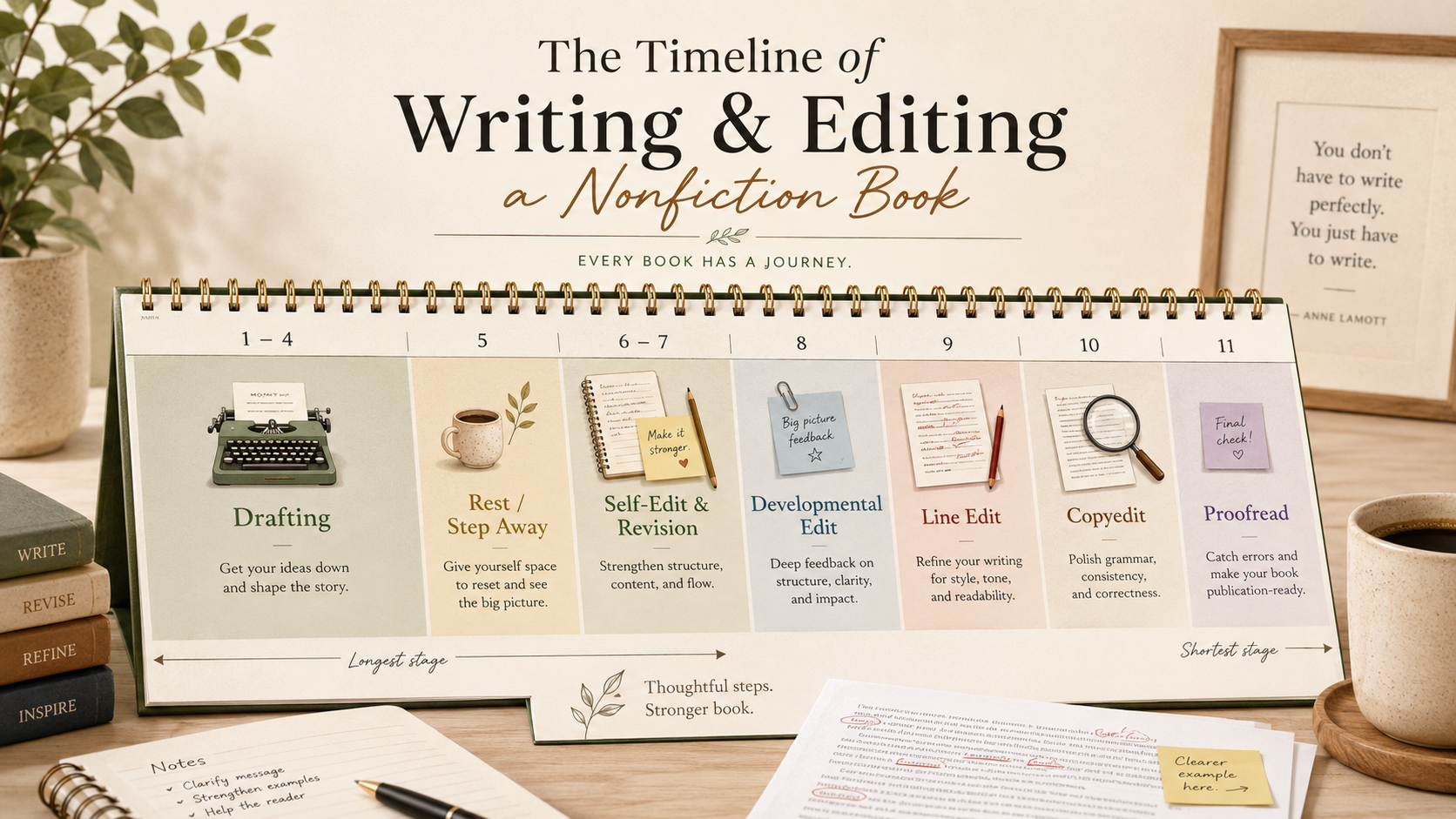
A typical nonfiction book runs somewhere between 40,000 and 80,000 words. If you write 500 words on the days you genuinely sit down—and we both know you won't sit down every day, because you have a life—you're looking at several months of drafting. Many of the writers I work with take six months to a year to get a complete first draft down. Some move faster. Others move more slowly, especially when the book leans on research, interviews, or excavating old journals to reconstruct what happened.
Many writers are surprised when I tell them that the biggest variable here isn't talent, and it’s not even the hours on your calendar. It's consistency. A writer who produces 300 words four mornings a week will almost always finish ahead of the one holding out for a free weekend and a thunderbolt of inspiration. Stephen King writes daily for a reason: momentum is far easier to maintain than to rebuild from a cold start.
When you map your own drafting timeline, be generous. Pick a word count you can hit on an ordinary Tuesday, do the multiplication, and then pad it for the weeks when life decides to get chaotic.
Self-Editing and Revision: The Stage Everyone Wants to Skip
Once you've got a complete draft, the urge to fire it off to an editor while it's still warm is almost physical. Resist it for a week or two. Literally step away. That distance is what lets you come back and read what's on the page instead of what you meant to put there. Do you get what I’m saying by that? When we’re too close to the writing, our brains tend to fill in any gaps on the page (this is especially true for those of you who are subject matter experts!), and we don’t process the content in the same way a reader with fresh eyes would. We already know what we mean when we read a sentence. That’s why you need that space and time to pivot your attention and let that manuscript rest.
Next is revision, which is where a lot of the real writing happens. Budget a few weeks to a couple of months here, depending on how much reshaping the draft needs. A self-editing pass—hunting for the patterns nearly every nonfiction writer falls into, like overwriting and weak transitions—does double duty. It sharpens the book, and it means you'll eventually pay your editor to refine your prose rather than untangle the basics.
This stage is unglamorous and easy to rush past. Take. Your. Time. The weeks you invest here tend to pay for themselves later, in both time and money.
What Moves the Needle
Before we get to the editing calendar, it helps to know what truly stretches or shrinks these ranges, because two writers with the same word count can finish a year apart.
Length. A 35,000-word guide is a different animal from a sprawling family saga.
Complexity. A book heavy with research, citations, or interwoven timelines asks more of every stage.
Available time. The writer with two protected hours a day will lap the one stealing 15 minutes between meetings.
Condition of your draft when it reaches an editor. Writers wildly underestimate this. A clean, self-edited manuscript moves through editing faster than a rough one, simply because there's less to wade through before the meaningful work begins.
The Editing Stages: Broad to Fine, in Order
Here's where the editing timeline takes on its own rhythm, and where sequence earns its keep. Editing happens in stages—a progression that runs from the big-picture architecture down to the last stray comma—and tackling them out of order is how writers end up paying for the same work twice. I've covered the different types of editing in depth elsewhere, but here's how each one tends to sit on a calendar.
Developmental editing comes first, and it's the heaviest lift. This is the architectural work: structure, argument, pacing, and whether the book delivers on its promise. For a full manuscript, the edit itself often runs several weeks, and the revision it sets in motion can take you weeks or even months, since a developmental pass frequently means reordering chapters or writing fresh material. It's the stage most likely to send your timeline sideways, which is exactly why you want it early, before you've buffed sentences that may not survive the cut.
Line editing arrives once your structure holds. Working at the sentence and paragraph level—voice, rhythm, clarity—a line edit on a full-length manuscript generally takes a few weeks, plus your own time to work through the suggestions.
Copyediting follows, handling grammar, consistency, and mechanics. The edit lands in a similar ballpark, though your turnaround on the changes is usually quicker, since you're reviewing corrections rather than rebuilding paragraphs.
Proofreading is the final pass, and the speediest by a comfortable margin. On a clean, formatted file, it's often a matter of days to a couple of weeks.
One factor writers almost never build in: the queue. Sought-after editors are frequently booked weeks, sometimes months, ahead. The edit might take three weeks, but if your editor can't start until spring, that wait belongs on your timeline too. Reach out earlier than feels necessary.
Putting It Together: A Sample Timeline
Let me make this concrete with a plausible scenario: Our writer has a full-time day job, and this is their first book at 60,000 words. That means the bulk of the writing will be done on weekends with occasional sessions during weekday evenings. You can easily decrease the following times by half if, say, you’ve got a part-time job. Your numbers will land differently, but this will give you an idea.
Drafting. Around eight or nine months at a sustainable pace.
Revision and a self-edit pass. Two months.
Developmental editing. Two to three months once you fold in scheduling.
Line editing. Six to eight weeks.
Copyediting. Roughly a month.
Proofreading. A week or two.
Stack those up, leave breathing room between stages for the life interruptions that will absolutely arrive, and you're somewhere in the neighborhood of 18 months to two years from blank page to publication-ready manuscript.
If that number made you wince, take a breath. Many books move faster—shorter ones, second books, writers who can give the project real daily time. And not every manuscript needs every stage; a writer with a strong structural instinct or a chapter flow that is inherently logical might skip developmental editing altogether. The principle behind these timeframes is that a book of substance takes real time, and knowing that up front spares you that nagging sense of feeling perpetually behind.
Why a Realistic Timeline Is a Gift
The writers who finish are the ones who kept going when the work took longer than they'd hoped—and it almost always takes longer than they'd hoped. With as many manuscripts as I’ve handled, you’d think I’d be able to look one over and give the writer an accurate estimate of how long the editing process will take. And let me say here that I’m a bit of a workhorse because I have the flexibility in my life to do so (and it’s just how my brain works). But I can never understand the depth or breadth of what changes are needed in a manuscript by a cursory look. Remember, we are talking about the real work of editing that includes more than corrections to spelling, grammar, and punctuation. We usually sail through that stuff.
So, giving yourself a realistic writing timeline for your nonfiction book does something powerful: it turns "I'm so far behind" into "I'm right on schedule." When you know drafting eats most of a year, you stop spiraling in month four. When you know a developmental edit can reshuffle your entire second half, you build in the room ahead of time instead of resenting it later. Most of the discouragement I see in writers traces back to measuring an honest pace against a fantasy schedule that never existed in the first place. That unrealistic schedule is only because the writer didn’t know better.
So plan for the long haul, pad your estimates, and treat the timeline as directional, not an endpoint set in stone. Your book will take as long as it takes. Your job is to keep showing up for it.
The difference between published and non-published writers is persistence.
The Last Word
A nonfiction book is a serious undertaking, and pretending otherwise only sets you up to feel like a failure when you're simply somewhere in the middle. Give the writing its months. Give the revision its weeks. And let each editing stage take its turn in line. Do that, and the timeline stops being a source of frustration and turns into a reasonable plan you can follow.
Now, hurry up and write your book already! 🙂 If you’re having trouble getting started, writers have found the content in this post helpful.
Why Great Editing Preserves Your Voice (Instead of Editing It Out)
There's a particular fear I hear from writers before we've even started working together. They'll send me a few chapters, then add a nervous note: "Please don't make it sound like someone else wrote it."
I get it. You've spent months—maybe years—getting your words to sound like you. The last thing you want is to hand your manuscript to a stranger and get back something polished, coherent, and completely unrecognizable.
So let me put this to rest right away. The whole point of good editing is to preserve author voice, not bury it. A skilled editor isn't trying to turn your prose into theirs. They're trying to help you sound more like yourself, not less.
That distinction—editing without losing voice—is the heart of what I do. Let me show you how it works.
What Is Your Voice Anyway?
Voice is slippery to define, but you know it when you read it. It's the rhythm of your sentences and the words you reach for when you're not overthinking. It's the way your personality flows onto the page, intentionally or not. Two writers can describe the same event and sound nothing alike, and that gap is voice.
The first thing to know is that voice isn't the same as polish. A manuscript can be riddled with comma splices, yet crackle with personality. It can also be technically flawless and read like a chemistry textbook. The mechanics and the music are separate things—and a seasoned editor treats them that way.
That separation is why editing and rewriting aren't the same job.
Editing and Rewriting: Not the Same Job
When someone rewrites your prose, they replace your choices with theirs. Your sentence becomes their sentence. You read it back and think, "That's... fine, I guess," because you can't argue with it—but it isn't how you'd have said it. Something got swapped out.
Editing works differently. A good edit first questions before even considering any alternatives: what were you reaching for here, and is the sentence getting you there? The goal is to help you land it while still sounding like you.
I tell clients this constantly: I'm not here to make you sound like me. I'm here to make you sound like the best version of yourself on the page. If you've read my breakdown of the different types of editing your manuscript needs, you know line editing in particular is built around this idea. A line edit amplifies your voice. It doesn't overwrite it.
How an Editor Keeps the Writer’s Voice Intact
So what does this look like when a manuscript is actually in front of me?
For one, I work in tracked changes with comments—it’s all transparent.. You see every suggestion, and you get to accept it, reject it, or counter with something better. The manuscript stays yours the entire time. I'm a collaborator, not a teacher correcting your paper.
Before I edit anything, I pay attention to patterns, not only on the page, but also in our exchanged messages. I read enough, for example, to learn how you build a paragraph, where your humor lives, and how you handle a hard transition. Once I understand your natural moves, I can tell the difference between a quirk worth protecting and a habit worth fixing. And everybody gets into some kind of a pattern of writing that we need to discontinue. It could be switching verb tenses from one paragraph to the next, using a particular word too frequently, or using filler words that amount to “throat clearing” before launching into a critical idea.
That’s it. That's the whole game. An adverb you lean on for rhythm is a different animal from an adverb propping up a weak verb, and a good editor learns to hear which is which.
When I do suggest a change, I explain why. A comment like "tightening this so the punchline lands harder" tells you what I'm protecting: your joke, your point, your effect. You're never left guessing whether I understood what you were going for.
When Your Voice Isn't Actually the Problem
Here's the honest part. Sometimes what feels like "losing your voice" in an edit is something else entirely.
I once worked with an author who came to me convinced editing meant getting sanded down, because a previous editor had left his book sounding like a press release. When we dug in, the issue wasn't that he had too much voice. It was that he'd been hiding it—writing in the stiff, over-formal register he assumed a "serious" book required. The flattening hadn't started with his old editor. It started with him trying to sound like someone he wasn't.
We worked to clear away the borrowed formality so the personality already there could finally come through. That's a pattern I see all the time, and it's one of the traps I get into in my post on the mistakes I see in nearly every manuscript. Sometimes, the most voice-preserving thing an editor can do is give you permission to sound like yourself.
Trust Is Paramount
You're handing an editor something you made. That takes trust, and trust gets earned by how an editor treats your words—not how confidently they replace them.
The right editor reads you closely enough to protect what makes your writing yours. The wrong one imposes a house style and calls it improvement. If you've done the work of self-editing your manuscript and you still love how it sounds, a good editor should love that too, then build on it instead of overriding it.
Your voice is the reason someone will want to read your book instead of the thousand others on the same shelf. No editor worth hiring would take that from you. The job is to make it sharper, clearer, and more unmistakably yours.
If you've been holding off on hiring an editor because you're afraid of being rewritten, I'd love to change your mind. Reach out and tell me about your project. Let's talk about how to make your manuscript sound exactly like you—only better.
What Is Copyediting, and When Do You Need It?
A reader is moving happily through your chapter, nodding along, fully with you—and then they hit a snag. You cited a study from 2019 back in Chapter Three, and here in Chapter Nine, you talk about the same study as being in 2020. It's a tiny thing. That may be a millisecond snag, but it might be enough for the reader to stop trusting that you've got the wheel.
That inconsistency is exactly what thorough copyediting prevents. It's the service most people picture when they hear "editing"—and, as it happens, it's also what a lot of writers mean when they say "proofreading," even though the two aren't the same job. The mechanical layer of a manuscript that copyediting addresses does load-bearing work in the background. Get it right, and nobody notices. Get it wrong, and your reader notices everything. So let's talk about what copyediting is, what it isn't, and when your manuscript is ready for it.
What Copyediting Is
Copyediting is about rules and mechanics—grammar, punctuation, spelling, consistency. My attention is on the engine room of your prose rather than its melody.
In practice, that means I'm making sure your timeline holds together, so the wedding that happens "two years later" actually lands two years later. I'm checking that a term you capitalized early on stays capitalized throughout. I'm catching the homophones—your/you're, their/there/they're—and the comma splices that slipped past you at 2 a.m. And I'm applying a style guide so your formatting, hyphenation, and capitalization stay uniform from the first page to the last. Did you write "e-mail" on page four and "email" on page forty? That's mine to reconcile.
A quick word on style guides, since writers ask. Chicago is the standard for most books. AP turns up more in journalism and business writing. Some projects run on a custom style sheet—a running document of the specific choices your manuscript makes, especially if you've invented terms or made deliberate exceptions. If you have a preference, tell me. If you don't, I'll recommend one and build the style sheet as I go.
Copyediting vs. Line Editing
These two get conflated all the time, and it's a costly mix-up, because they solve different problems.
Line editing works at the level of voice and rhythm—does this sentence land the way you intended, is this paragraph carrying too much? Copyediting works at the level of correctness—is the grammar sound, is the spelling consistent, does the style hold throughout?
The shorthand I give clients: line editing asks whether your writing is effective; copyediting asks whether it's right. Both matter. They're just different stages, and the order matters, which brings me to the part writers most often get backward.
What Copyediting Isn't
copyediting is not developmental editing or line editing. I'm not restructuring your chapters, reworking your argument, or rewriting your sentences for style and flow. I'm working with prose that's already doing what you want it to do, and my job is to make sure it's mechanically clean and internally consistent. If your manuscript still needs big-picture or sentence-level work, we should handle that first. There's no sense perfecting the punctuation in a sentence that a line edit might restructure, or a paragraph that a developmental pass might cut entirely.
Copyediting also isn't proofreading. They feel like cousins, and people use the words interchangeably, but a proofread comes later—it's the final quality-control pass after your manuscript has been formatted for publication. Copyediting happens after line editing, and proofreading is the last look before the book goes out the door.
This is why copyediting should happen when you're confident you won't be making major revisions. I'll say it plainly because it saves writers real money: there's no point in perfecting the mechanics of sentences that may be deleted.
What I Need From You
A copyedit goes faster and lands better when you bring a few things to the table:
A manuscript that's content-complete, with no major revisions still pending.
Your preferred style guide, if you have one.
A style sheet, if you've been tracking specific choices—character names, invented terms, intentional decisions you don't want "corrected."
Any house preferences or exceptions I should know about.
That last one matters more than writers expect. I once worked with an author whose manuscript was full of deliberately invented words. Had he not flagged them up front, I might have spent hours dutifully marking them as errors—billable hours, his hours. A page of context spares both of us a dozen rounds of needless queries.
What You'll Receive
When I finish, your manuscript comes back with tracked changes where every correction is visible. Those are yours to accept, reject, or modify. Alongside the edits, you'll get queries—the questions only you can answer. "You mention Sarah's birthday is in March here, but it was June in Chapter Two. Which is correct?" I will never guess about something like that on your behalf and hope I got it right; I will always ask.
You'll also get a style sheet documenting the choices made throughout your manuscript: spellings, hyphenations, capitalization calls, the treatment of numbers and terms, etc. Keep it. It's a reference for you, for any future editor, and for the next book. Consider it a record of how your manuscript handles the thousand small decisions a reader feels but never consciously registers.
The Last Word
Copyediting is the layer nobody compliments, and everybody notices when it's missing. It's the difference between a manuscript that reads as careful and one that quietly leaks the reader's confidence, one small inconsistency at a time. You've done the work to get your content and your prose where you want them. This is the step that makes sure nothing small undermines all of it.
If your manuscript is content-complete and you're confident the big revisions are behind you, it may be ready for a copyedit. Reach out, and let's chat about where you’re having challenges with your manuscript.
What Is Proofreading? Your Manuscript's Last Line of Defense
You've been through it all. The structure holds, the sentences sing, the mechanics are clean. Your manuscript has survived round after round of revision, and you're so close to being done you can taste it. Then a friend reads the formatted version and emails you: "Loved it—but there's a typo on the dedication page." The dedication page. The first thing anyone reads.
That sinking feeling is exactly what proofreading spares you. It's the final quality-control pass on a manuscript that's otherwise finished—the last set of eyes before your book goes out into the world. I can tell you that proofreading is the least glamorous service I offer and, at the very end, one of the most important. So let's talk about what proofreading is, what it isn't, and when your manuscript is genuinely ready for it.
What Proofreading Is
Proofreading is your last line of defense. By the time a manuscript reaches me for a proofread, the real editing is done—I'm not rewriting sentences or second-guessing your word choices. I'm catching the small things that slipped through everything that came before: the lingering typo, the missing period, a book title that should be italicized, not in quotation marks.
Picture it as the final polish before your work goes public. At this stage, I'm watching for the typos and spelling errors that survived earlier rounds, the missing or misplaced punctuation, and style inconsistencies. I'm also doing a light read for any glaring errors that somehow made it this far. (They always do. Really, it’s no wonder when you consider that a book is tens of thousands of words. Something always hides.)
What you get back is a clean, publication-ready manuscript.
Proofreading vs. Copyediting (The Costly Mix-up)
Here's the confusion I run into most: writers say "proofreading" when they mean copyediting. The two get used interchangeably all the time, and it's an easy mistake—but they're different jobs at different stages, and conflating them can cost you real money.
Copyediting is about rules and mechanics—grammar, punctuation, spelling, consistency. It happens while your words are still being shaped, often before the manuscript is formatted, and it's substantial work: applying a style guide, reconciling inconsistencies, and querying you about things only you can answer. Proofreading comes after line editing and copyediting, so the changes are minimal by comparison. Copyediting assumes your manuscript still has open questions. Proofreading assumes those questions are settled, and you just need a final, careful read. If you hand me a raw draft and ask for a proofread, I'll tell you honestly that you're not there yet—and that paying proofreading rates for copy-edit-level work would shortchange you.
What Proofreading Isn't
Proofreading is not editing, full stop. I'm not rewriting awkward sentences, tightening your prose, or addressing anything structural. If I spot something significant, I'll flag it—but proofreading assumes your manuscript has already moved through developmental editing, line editing, and copy editing as your project needed. This is a final read-through, not a revision.
That sequence matters, and it's worth saying plainly because writers get it backward and pay for it. Developmental editing handles the architecture. Line editing sharpens voice and rhythm at the sentence level. Copyediting cleans up the mechanics. Proofreading is the last pass, after the rest is done and the file is formatted. There's no sense in proofreading a manuscript you're still revising—you'd just be polishing words that might not survive the next round.
What I Need From You
A proofread goes smoothly when a few things are in place. A final, formatted document—ideally the exact version headed to print or publication. Confirmation that all your content revisions and edits are genuinely complete, so we're not reopening doors that should be closed. And a style sheet from your copyedit or your own house preferences.
That last one saves us both time. If you've already got a style sheet documenting how your manuscript handles numbers, hyphenation, and the like, hand it over. A proofreader working from your established choices is far more useful than one guessing at them.
What You'll Receive
You'll get a clean manuscript with corrections made—or flagged, depending on your preference. Some writers want the changes done directly; others want every catch marked so they can make the call themselves. Either way works, and we'll sort out which you prefer before I start.
What you won't get at this stage is an editorial letter or pages of margin comments. Because by the time you need proofreading, your manuscript is ready to publish. The deliverable is short on commentary and long on polish, which is exactly what you want this late in the game.
A Word on Timeline
Proofreading has the fastest turnaround of any service I offer, simply because the changes are minimal. It's not a deep edit—it's a careful final read. I'll give you a specific timeframe based on your manuscript's length and where it falls in my schedule, but of all the stages, this is the one that moves quickest.
The Last Word
Proofreading happens at the very end—after all the other editing, after you've poured months or years into getting every word right. It's the final read-through before your book goes out into the world, and its whole job is to make sure nothing small undermines all the big work you've done. You've earned the clean copy. Let's make sure you—not stray typos—get the last word.
If your manuscript is fully edited, formatted, and ready for that final pass, it may be ready for a proofread. Reach out and let's chat about where your book stands and what might move it forward.
What Is Line Editing? The Service That Sharpens Your Voice Without Replacing It
You've got a sentence that's nagging at you. It says what you mean—technically—but sounds more like a restatement than a revelation. You've rearranged it four or five times, and it still feels slightly off. You can't name the problem, which means you can't fix it either.
That space between a sentence that's correct and a sentence that's right is exactly where line editing does its work. I've come to think of line editing as the most misunderstood service I offer—and the one that does the most for a finished draft. It's the work that takes prose that's already functional and makes it unmistakably yours and compelling for your readers.
Let’s get into what line editing is, what it isn't, and how to tell whether it's what your manuscript needs.
What Line Editing Is
Line editing happens at the level of the sentence and the paragraph. Your voice, your rhythm, your word choices, the way one thought hands off to the next—that's my territory. I'm not hunting for typos or stray commas, though I'll certainly notice them as I go. My attention is on clarity, style, and impact.
Here's the part writers don't always expect: a good line edit doesn't impose a new voice on your work. It amplifies the one you already have. I read closely enough to learn how you build a sentence, where your humor tends to surface, and how you handle a hard turn in your argument. Once I understand the cadence and rhythm of your voice—and even how you think—that knowledge informs how I edit your prose. That’s how I help you sound like the best version of yourself on the page. What I think about here is if you happen to meet somebody in person who has read your book, they’d say, “Wow, you sound exactly like your book.”
Line Editing vs. Copyediting (The Confusion Worth Clearing Up)
These two get mixed up constantly, and it's an expensive thing to get wrong, because they solve different problems.
Copyediting is about rules and mechanics—grammar, punctuation, spelling, consistency. A copyeditor catches the comma splice, the stat you cited two different ways, the term you capitalized in Chapter Three and lowercased in Chapter Nine. Line editing is about how you're saying it. Does this sentence land the way you intended? A line editor is also the one who notices when a paragraph is straining under too much work, or when you've told the reader something you already showed them two pages back.
The shorthand I give clients: copyediting asks whether your writing is correct. Line editing asks whether it's effective. Both matter, and most manuscripts eventually need both. But they're different stages with different goals, and the order matters—there's little sense tightening a comma in a sentence a line edit might still rewrite.
Let me show you the difference with a real line. Here's a sentence the way a writer might first put it down:
"It was at that particular point in time that I came to the realization that leaving had perhaps been a mistake."
Nothing in there is technically wrong. A copyeditor would wave it through. But it's wearing about a dozen words it doesn't need, and the weight of the moment gets buried under all that padding. Here's a decent line edit:
"That was the moment I knew leaving had been a mistake."
Same meaning, same voice, roughly half the words—and a lot more punch. (For what it's worth, I cut sentences like the first one out of my own drafts all the time. The padding sneaks in when you're thinking out loud on the page.) In the margin, I'd leave a note explaining what I trimmed and why, so you can catch the pattern yourself next time.
What Line Editing Isn't
Line editing isn't developmental editing. I won't be restructuring your chapters, reworking your central argument, or solving pacing problems at the level of the whole book. If your manuscript needs that kind of architectural work, sentence-level polish is premature, and we'd want to talk about whether developmental editing makes more sense as a first step. Polishing prose in a chapter that might get cut is a heartbreak nobody needs.
It's also not proofreading. I'll catch errors as I move through your pages, but a final proofread—the last pass after you've accepted revisions and formatted the file—is its own separate service. Think of all of this as a sequence that runs from the biggest questions about your book down to the smallest. Line editing sits in the middle, where the writing stops being merely clear and starts being compelling.
What You'll Receive
When I finish a line edit, your manuscript comes back as a Word document with tracked changes and margin comments. Every suggestion is visible, and every one is yours to accept, reject, or rewrite your own way. The file stays yours from the first page to the last.
The comments are explanations. "Tightening this so your punchline lands harder." "You've got a strong line buried at the bottom of this paragraph; what if it opened instead?" The reasoning matters because once you understand why a change works, you start making that move on your own, in this book and the next one. That's the bonus of a good line edit: you come out of it a stronger writer than you went in.
The Last Word
You did the hard part. You got your ideas out of your head and onto the page, in your own words, in an order that makes sense. Line editing is the work of helping those ideas land exactly the way you meant them to—clearly, powerfully, and in a voice that's recognizably yours.
If you've got a draft that's structurally sound but isn't quite singing yet, that's precisely the manuscript a line edit was built for. Reach out, and let’s chat about your manuscript.
Developmental Editing for Nonfiction: What It Is and When You Need It
You've finished your draft—or at least a substantial chunk of it—and you know it needs work. But what kind of work, exactly? When you start researching editing services, you'll encounter terms like developmental editing, line editing, copyediting, and proofreading. They all sound like they involve making your writing better, so what's the difference?
If you're writing nonfiction—a memoir, a business book, a self-help guide, a narrative history—you need to understand the distinctions. Hiring the wrong type of editor at the wrong stage is one of the most common (and costly) mistakes writers make. And developmental editing, in particular, is often misunderstood.
You can see why writers get this one wrong: "developmental" sounds like the editor's job is to help you develop your ideas—feeding you questions and providing feedback until the book takes shape. That's not what it means.
So, let's clear that up.
What Developmental Editing Is
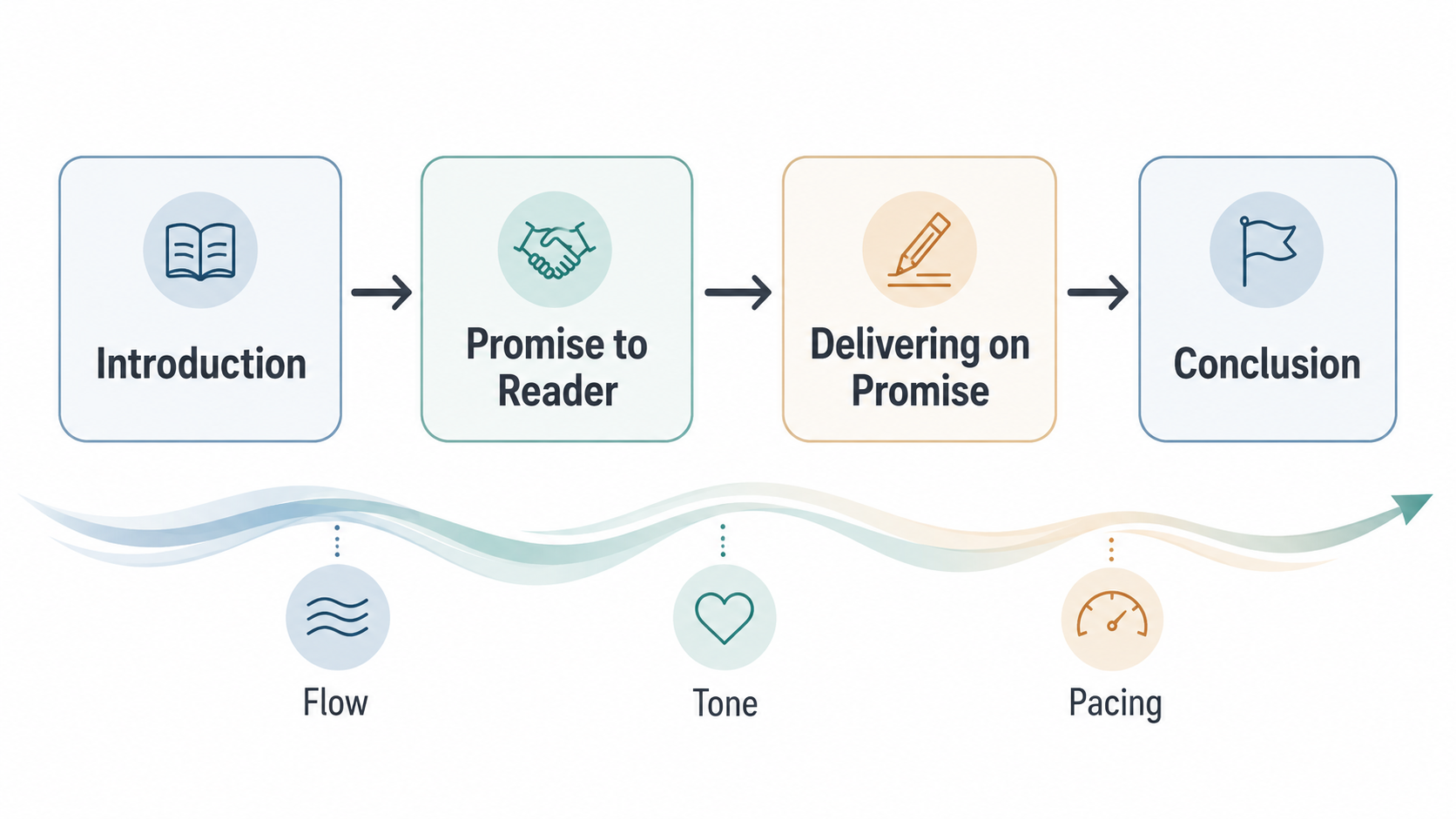
Developmental editing addresses the big-picture elements of your manuscript: structure, argument, pacing, clarity of purpose, and audience alignment. A developmental editor isn't looking at your sentences (that comes later). They're looking at your book as a whole and asking fundamental questions.
Does this structure serve the book's goals? Is the argument coherent and well-supported? Does the pacing keep readers engaged, or do certain sections drag? Is the intended audience clear, and does every chapter speak to that audience? Are there gaps in the logic, missing context, or sections that don't earn their place?
Think of it this way: if your book were a house, developmental editing is about the architecture. Are the rooms in the right places? Does the layout make sense? Is the foundation solid? Is there a staircase leading up to the second floor? You don't want to hang curtains and arrange furniture (line editing and copyediting) in a house that needs walls knocked down.
Scott Norton, author of Developmental Editing: A Handbook for Freelancers, Authors, and Publishers, describes the developmental editor's role as helping authors "discover and realize their intentions." A successful developmental edit clarifies and strengthens the vision you already have.
What a Developmental Editor Looks At
Every nonfiction book has its own challenges, but developmental editors typically focus on several core areas.
Structure and organization. Nonfiction books live or die by their structure. Your reader needs to feel oriented—to understand where they are, where they're going, and why each section matters. A developmental editor examines whether your chapters are in the right order, whether sections within chapters flow logically, and whether the overall arc of the book makes sense.
This is especially critical for books built around frameworks, methodologies, or arguments. If you're a consultant writing about your approach to leadership, for instance, your reader needs to understand each concept before you build on it. A developmental editor catches those moments where you've assumed knowledge your reader doesn't have yet, or where you've buried a key concept in the wrong chapter.
Argument and evidence. Nonfiction makes claims, and those claims need support. Whether you're drawing on research, case studies, personal experience, or client stories, a developmental editor evaluates whether your evidence actually supports your arguments—and whether your arguments are clear in the first place.
This isn't about fact-checking (though that matters too). It's about logical coherence. Does your conclusion follow from your premises? Have you addressed obvious counterarguments? Are there leaps in logic that will make skeptical readers disengage?
Audience alignment. One of the most common problems in nonfiction manuscripts is a mismatch between the book and its intended reader. Sometimes the author is writing for experts when the book is meant for beginners. Other times, the tone is too academic for a general audience, or too casual for a professional one.
A developmental editor helps you see your book through your reader's eyes. They ask: Who is this book for, and does every chapter serve that reader? Research on effective communication consistently shows that audience awareness is one of the strongest predictors of whether a message lands. As cognitive psychologist Daniel Willingham puts it, "the mind is not designed to think—it's designed to save you from thinking." Your reader won't do the work of figuring out why your book matters to them. You have to make it clear.
Pacing and engagement. Nonfiction doesn't get a pass on being engaging just because it's informational. Readers still need momentum. They need to feel like they're making progress, learning something new, moving toward a destination.
Developmental editors identify where your manuscript drags—where you've over-explained, repeated yourself, or lost the thread. They also spot where you've rushed, glossing over material that deserves more attention. Pacing problems often stem from structural problems, which is why this level of editing needs to happen before you start polishing sentences.
Signs You Might Need Developmental Editing
Not every manuscript needs developmental editing. But here are some indicators that yours might.
You're not sure if your structure is working.
You've organized your chapters in a way that makes sense to you, but you're uncertain whether a reader will follow. Or you've reorganized multiple times and still aren't confident.
Feedback has been confusing or contradictory.
Beta readers or writing group members have given you feedback, but it's all over the map. Some say the book is too long; others say it needs more detail. Some love Chapter 3; others find it boring. When feedback is inconsistent, it often signals a structural issue that readers sense but can't quite articulate.
You know something's off, but you can't put your finger on it.
The book doesn't feel right, but you've been too close to it for too long to see why. You need an outside perspective—someone who can read with fresh eyes and diagnostic expertise.
Your book has a complex argument or framework.
The more intricate your content, the more important structure becomes. If you're presenting a methodology, a theory, or a multi-part argument, developmental editing helps ensure that complexity serves your reader rather than overwhelming them.
You're writing your first book.
First-time authors often underestimate how different book-length writing is from articles, blog posts, or reports. The architecture of a book requires skills that take time to develop. Working with a developmental editor on your first project is an education in itself.
When You Might Not Need It
If your structure is solid, your argument is clear, and your feedback has been consistently positive on the big-picture elements, you might be ready to skip straight to line editing. Some writers—especially those who've written multiple books or who have backgrounds in journalism or academic writing—have internalized structural thinking. They've already done the developmental work themselves.
The key is honest self-assessment. If you're uncertain, a developmental editor can often tell within the first few chapters whether your manuscript needs deep structural work or just refinement at the sentence level. Many editors offer manuscript evaluations—a shorter, less intensive read-through that assesses what kind of editing your book actually needs.
What the Process Looks Like
Developmental editing is collaborative. It's not a situation where you hand off your manuscript and get back a "fixed" version. Instead, you typically receive a detailed editorial letter addressing the big-picture issues, along with comments throughout the manuscript pointing to specific passages where those issues show up.
Then comes the revision. You take the feedback, sit with it, and decide what you want to change. Sometimes that means reorganizing chapters. Sometimes it means cutting sections that aren't working or writing new material to fill gaps. The editor's job is to diagnose and guide; the revision work is yours.
This is why developmental editing often happens earlier in the process than people expect. Ideally, you want a developmental edit before you've polished every sentence to a shine—because polished sentences in a chapter that needs to be cut, moved, or substantially rewritten are wasted effort.
Finding the Right Editor
Not every editor offers developmental editing, and not every developmental editor works with nonfiction. When you're evaluating potential editors, ask about their experience with your genre and subject matter. Ask how they approach developmental feedback—do they provide an editorial letter, in-line comments, or both? Ask about their revision philosophy. You want someone who will push you to do your best work while respecting your voice and vision.
The right developmental editor doesn't rewrite your book. They help you see it more clearly so you can rewrite it yourself, with confidence.
Your Next Step
If you're wondering whether your nonfiction manuscript needs developmental editing—or if you're not sure what kind of editing it needs at all—I'm happy to talk it through. Sometimes, a short conversation is all it takes to get clarity on where you are in the process and what kind of support would actually help.
Sources
Norton, Scott. Developmental Editing: A Handbook for Freelancers, Authors, and Publishers. University of Chicago Press, 2009.
Willingham, Daniel T. Why Don't Students Like School?: A Cognitive Scientist Answers Questions About How the Mind Works and What It Means for the Classroom. Jossey-Bass, 2009.