
Blog
Whether you’re outlining your first chapter or polishing your final draft, you’ll find practical guidance, editorial insight, and a steady nudge forward.
Browse by Topic
-
Editing & Revision
- Jul 28, 2026 A Realistic Timeline for Writing and Editing a Nonfiction Book Jul 28, 2026
- Jul 23, 2026 Why Great Editing Preserves Your Voice (Instead of Editing It Out) Jul 23, 2026
- Jun 27, 2026 What Is Copyediting, and When Do You Need It? Jun 27, 2026
- Jun 27, 2026 What Is Proofreading? Your Manuscript's Last Line of Defense Jun 27, 2026
- Jun 27, 2026 What Is Line Editing? The Service That Sharpens Your Voice Without Replacing It Jun 27, 2026
- Jun 20, 2026 Developmental Editing for Nonfiction: What It Is and When You Need It Jun 20, 2026
-
Editing Tips
- May 21, 2026 What Type of Editing Does Your Manuscript Need? May 21, 2026
- May 19, 2026 How to Self-Edit Your Nonfiction Manuscript May 19, 2026
-
Getting Started
- May 12, 2026 How to Outline a Nonfiction Book (With Templates and Examples) May 12, 2026
- May 8, 2026 How to Turn Your Expertise Into a Compelling Book May 8, 2026
- May 8, 2026 How to Start Writing a Nonfiction Book (When You Don’t Know Where to Start) May 8, 2026
-
Memoir/Personal Narrative
- Jun 30, 2026 How to Write a Memoir That Doesn't Read Like a Diary Jun 30, 2026
-
Reader Engagement
- Jun 25, 2026 The Psychology of Reader Engagement in Nonfiction Jun 25, 2026
- Jun 23, 2026 How to Build Credibility and Trust as a Nonfiction Author Jun 23, 2026
- Jun 9, 2026 Using Research In Your Writing Without Boring Readers Jun 9, 2026
- Jun 4, 2026 The Art of Clarity: How to Write Complex Ideas Simply Jun 4, 2026
-
Storytelling
- Jun 23, 2026 Storytelling in Nonfiction Writing Jun 23, 2026
-
Structure
- Jun 20, 2026 Developmental Editing for Nonfiction: What It Is and When You Need It Jun 20, 2026
- Jun 11, 2026 How to Craft a Strong Central Argument for Your Nonfiction Book Jun 11, 2026
- Jun 4, 2026 The Art of Clarity: How to Write Complex Ideas Simply Jun 4, 2026
- May 14, 2026 How to Structure a Nonfiction Book for Maximum Clarity and Impact May 14, 2026
- May 12, 2026 How to Outline a Nonfiction Book (With Templates and Examples) May 12, 2026
-
Writer Editor Collaboration
- Jul 21, 2026 Red Flags When Choosing a Nonfiction Editor (and What to Look For Instead) Jul 21, 2026
-
Writer-Editor Collaboration
- Jul 16, 2026 Writing Coach vs. Editor: Which One Do You Need? Jul 16, 2026
- Jul 14, 2026 Signs Your Nonfiction Manuscript Is Ready for Editing (or Not Quite Yet) Jul 14, 2026
- Jul 9, 2026 What to Expect When Working With a Nonfiction Editor Jul 9, 2026
- Jul 2, 2026 The Writer–Editor Relationship: What Collaboration Should Look Like Jul 2, 2026
-
Writing Mindset
- Jul 16, 2026 Writing Coach vs. Editor: Which One Do You Need? Jul 16, 2026
- Jul 14, 2026 Signs Your Nonfiction Manuscript Is Ready for Editing (or Not Quite Yet) Jul 14, 2026
- Jul 9, 2026 What to Expect When Working With a Nonfiction Editor Jul 9, 2026
- Jul 2, 2026 The Writer–Editor Relationship: What Collaboration Should Look Like Jul 2, 2026
- Jun 25, 2026 The Psychology of Reader Engagement in Nonfiction Jun 25, 2026
- Jun 23, 2026 The Mindset Shift Every Writer Needs Jun 23, 2026
- Jun 23, 2026 How to Build Credibility and Trust as a Nonfiction Author Jun 23, 2026
- May 28, 2026 The 7 Habits of Great Writers May 28, 2026
-
Writing Process
- Jul 28, 2026 A Realistic Timeline for Writing and Editing a Nonfiction Book Jul 28, 2026
-
Writing Tips
- Jun 23, 2026 The Mindset Shift Every Writer Needs Jun 23, 2026
- Jun 23, 2026 Storytelling in Nonfiction Writing Jun 23, 2026
- Jun 11, 2026 How to Craft a Strong Central Argument for Your Nonfiction Book Jun 11, 2026
- Jun 9, 2026 Using Research In Your Writing Without Boring Readers Jun 9, 2026
- Jun 4, 2026 The Art of Clarity: How to Write Complex Ideas Simply Jun 4, 2026
- May 28, 2026 The 7 Habits of Great Writers May 28, 2026
- May 26, 2026 The 5 Most Common Mistakes Writers Make (And the Simple Fixes) May 26, 2026
- May 14, 2026 How to Structure a Nonfiction Book for Maximum Clarity and Impact May 14, 2026
- May 12, 2026 How to Outline a Nonfiction Book (With Templates and Examples) May 12, 2026
- May 8, 2026 How to Turn Your Expertise Into a Compelling Book May 8, 2026
- May 8, 2026 How to Start Writing a Nonfiction Book (When You Don’t Know Where to Start) May 8, 2026
The Psychology of Reader Engagement in Nonfiction

Every nonfiction writer is competing for the same thing: a reader’s attention. It’s far too easy for a reader’s mind to drift to wondering about what’s for dinner or quickly glancing at their phone. You may think, well, my material is interesting, so my readers aren’t going to do that. But interesting material loses readers all the time. What holds them is something more mechanical, more psychological, and far more learnable than most writers assume.
If you want to engage readers, nonfiction asks you to understand what's really happening in a reader's mind as they move down the page—what pulls attention forward and what loses it. The craft of reader engagement in writing is, essentially, applied psychology. Let’s look at how that works.
Curiosity Is a Gap, Not a Topic
You may want to consider how you think about your reader’s curiosity. Psychologist George Loewenstein argued that curiosity arises from a gap between what we know and what we want to know (Loewenstein 1994). What sparks it, then, is the reader's awareness that something is missing—not the topic itself.
This is the secret sauce and a major reframe for many writers. If you think a reader’s curiosity lives in the topic, you’ll naturally front-load information, explaining thoroughly and answering questions the reader hasn't yet thought to ask. But you’ll do the opposite once you understand the gap: you open a small space of not-knowing and let the reader feel it before they fill it. Malcolm Gladwell opens Outliers with Roseto, a Pennsylvania town whose residents had an impossibly low rate of heart disease, and he describes the mystery in vivid detail for pages before explaining it (Gladwell, 2008). The withholding is the point. The reader leans in not because the topic compels them but because Gladwell opened a gap and hasn’t closed it yet.
Strong nonfiction poses the question before the answer. It names a problem and lets you sit in it for a sentence or two. It tells you something surprising is coming before telling you what. Each move opens a gap, and an open gap is a kind of mild, productive tension the reader wants resolved. That tension is the engine. Close every gap immediately, and you've turned off the motor.
The Power of the Unfinished
A close cousin of the curiosity gap is the Zeigarnik effect, named for the psychologist who observed that people remember interrupted or incomplete tasks more readily than completed ones (Zeigarnik 1927). An open loop occupies the mind. The brain keeps a low background hum running until the loop closes.
This is why a chapter that ends mid-tension pulls you into the next one, and why a chapter that ties everything into a neat bow can give the reader permission to stop. It's why a well-placed "but there was a problem I hadn't anticipated" at the end of a section is worth more than another paragraph of explanation. You're not manipulating anyone. You're working with the way attention naturally behaves.
I think a lot about pacing for exactly this reason—where to close a loop, where to leave one humming. It's some of the most consequential work in shaping a manuscript, and the reader doesn’t even realize it when it's done well.
Transportation and Why Stories Outperform Arguments
Melanie Green and Timothy Brock studied what they called “narrative transportation”—the state of being absorbed into a story—and found that the more transported a reader is, the more their beliefs shift in line with the narrative, and the less they counterargue (Green and Brock 2000).
Sit with that second part. A transported reader stops arguing back. When we read a dry claim, our critical thinking is in full operating mode, generating objections. When we're absorbed in a concrete scene, those faculties quiet down. This is why a single well-told example often persuades more than a page of evidence. The example doesn't just illustrate the point—it lowers the reader's resistance to it.
I’m not saying we should bombard our nonfiction manuscripts with stories. The point is that concreteness and scene are load-bearing. Abstraction invites scrutiny; specificity invites belief. A reader who can picture what you're describing is a reader who has, for that moment, stopped holding you at arm's length.
Cognitive Ease: The Friction You Can't See
Another dynamic that influences engagement works below conscious notice. Daniel Kahneman describes cognitive ease—the sense of mental fluency we feel when information is easy to process—and its strange consequence: things that are easy to read feel more true, more familiar, and more agreeable (Kahneman 2011).
Every source of friction taxes this ease. A tangled sentence, an unexplained term, a paragraph that makes the reader backtrack to figure out who "it" refers to—each one is a tiny cost. Readers rarely notice the cost consciously. They just have this vague sense that reading the text takes effort, and effort erodes engagement. So, they drift.
This is the unglamorous, foundational layer of holding attention, and it's where line editing earns its keep. Smoothing rhythm, cutting the word that makes a reader stumble, ordering a sentence so the reader never has to reread it—this is engagement work, even though it looks like mere tidying, even nitpicking. You're removing the small frictions that, in aggregate, decide whether a reader stays in the dream or wakes up.
Variation Keeps the System Awake
This last mechanism is often overlooked. Attention habituates. A reader who encounters the same sentence length, the same paragraph shape, and the same rhetorical move for too long will start to glaze, because the pattern has become predictable, and the mind stops registering the predictable. The reader’s perceptual system is on autopilot, and their attention fades.
This is the role rhythm plays. A short sentence after three long ones snaps a reader back. A sudden direct address—you—re-establishes contact. A shift from explanation to scene wakes the system up. Skilled nonfiction writers vary their texture because variation is how you keep attention from settling into autopilot. Sameness is comfortable, and comfort is where readers close your book.
None of This Is a Gift
Hopefully, you’re seeing that reader engagement isn't a mysterious gift some writers have. It's the product of understanding how attention, curiosity, and belief operate, and then taking those mechanisms into account when writing.
Remember to:
Open gaps.
Leave a few loops humming.
Trade abstraction for scene.
Remove invisible friction.
Vary your rhythm so the reader never settles.
Master those, and you're no longer hoping readers stay. You're giving their minds reasons they can't quite articulate but always feel.
Sources
Gladwell, Malcolm. Outliers: The Story of Success. Little, Brown and Company, 2008.
Green, Melanie C., and Timothy C. Brock. "The Role of Transportation in the Persuasiveness of Public Narratives." Journal of Personality and Social Psychology, vol. 79, no. 5, 2000, pp. 701–721.
Kahneman, Daniel. Thinking, Fast and Slow. Farrar, Straus and Giroux, 2011.
Loewenstein, George. "The Psychology of Curiosity: A Review and Reinterpretation." Psychological Bulletin, vol. 116, no. 1, 1994, pp. 75–98.
Zeigarnik, Bluma. "Über das Behalten von erledigten und unerledigten Handlungen" ["On Finished and Unfinished Tasks"]. Psychologische Forschung, 1927.
How to Build Credibility and Trust as a Nonfiction Author

It might surprise you to know that readers decide whether to trust you long before you deliver your main message. It can happen in the first paragraph or when they come across a sentence that overpromises. It’s like those few precious seconds of a first impression: everything that follows is seen through that lens.
Author credibility can be fluid as the reader gets to know you and your work. It can ebb and flow on the page itself, line by line. And the good news is that nonfiction authority has far less to do with credentials than most writers assume. I've edited published experts who undercut themselves on every page, and I've edited first-time authors whose work radiated trustworthiness. The difference came down to a handful of choices any writer can learn to make.
So let's talk about how you go about building that trust.
Know Exactly Who You're Writing For
Trust starts with relevance. When a reader feels like you understand their situation—what they already know, where they're stuck, what they're afraid the book won't deliver—they relax into your hands. When the book feels aimed at "anyone interested in this topic," that trust never forms.
This is why I push writers so hard on audience before they draft a word. Picture one reader and write to that person. The more precisely you understand who you're talking to, the more your expertise lands as authority rather than noise. A book that knows its reader feels like it was written for them, and readers reward that recognition with their attention.
Show Your Expertise—Don't Announce It
Here's a mistake I see constantly: writers try to establish authority by telling readers how qualified they are. They stack credentials in the introduction and remind you, repeatedly, that they know what they're talking about.
If that’s how you function professionally, please don’t do that on the page. Authority you claim outright reads as insecurity, but authority you demonstrate reads as confidence.
And you demonstrate your authority through specifics, not broad strokes. Writing "I've helped countless clients improve their leadership” tells the reader nothing and is yawn-inducing. But that’s exactly how a lot of experts write. Far fewer of them will tell you about the specific executive who couldn't stop interrupting his team until one uncomfortable meeting changed everything. The concrete example proves what the claim merely asserts. Vague language drains your credibility, because readers sense when you're gesturing at expertise instead of showing it. (I dig into this in my post on the five most common mistakes I see in nonfiction manuscripts.)
Structure Is an Authority Signal
This one surprises people. They think credibility lives in the sentences, but a disorganized book erodes trust no matter how polished the prose. When readers can't tell where they are, why a chapter matters, and where it’s all going, they start to suspect the author doesn't fully know either.
A clear structure does the opposite. It signals that you've thought this through, that there's a foundation of logic supporting the material, and that you're a reliable guide who knows the terrain. Each chapter builds on the last, creating necessary context for subsequent chapters. Concepts unfold in the order that will make most sense to your reader.
That's the architecture work, and it happens before sentence-level polishing—which is exactly what developmental editing addresses. If you want the longer version of how structure holds a book together, I've written about that separately.
Back Up What You Claim
Nonfiction makes promises. Most often, it tells readers that something is true and goes about proving it. Credibility depends on whether you can support that promise.
That means your claims should rest on something a reader can trust: research, documented experience, a real example, a source they can check. When you assert that a technique works, show it working. When you cite a statistic, make sure it's accurate and attributed. Robert Cialdini's work on persuasion describes authority as one of the core drivers of how people decide whom to believe (Cialdini 2006). But borrowed authority only works when it's honest—one inflated or unverifiable claim, and a skeptical reader starts doubting all the others.
Also, don’t underestimate the power of addressing what you don't know. Writers fear that admitting limits will weaken their authority. In my experience, the opposite is true. A writer who says "the evidence here is mixed" or "this won't work for everyone" sounds more trustworthy, not less, because they're clearly more interested in being accurate than in being impressive.
Let Your Voice Do the Work
Readers trust people, not personas. When a writer adopts a stiff, inflated "author voice" because they think that's how serious nonfiction or an expert is supposed to sound, something subtle goes wrong. The prose doesn’t feel authentic, which widens the distance between reader and writer. And trust thrives on closeness.
Your natural voice—the way you'd actually explain this to a smart friend—is one of your strongest credibility tools. It makes you sound like a real person who knows their subject, rather than someone performing expertise. This is the foundation of what the ancient rhetorician Aristotle called ethos: the credibility a speaker establishes through character and how they come across (Aristotle, Rhetoric). Thousands of years later, it still holds. We believe people who sound genuine.
Clean Pages Protect Everything Else
I'll end with the least glamorous point, because it matters more than writers want to believe. Errors erode trust. A typo here, a misused word there, a fact that doesn't quite check out—each one is small, but they accumulate. By the third or fourth, a reader has started to wonder what else you missed.
You've done the hard work of building authority through everything above. Don't let preventable mistakes chip away at it. This is what copy editing and proofreading exist to protect—not your ego, but the reader's confidence in you. A clean manuscript tells your reader you cared enough to get the details right, and that care reads as respect.
The Last Word
Nonfiction authority isn't conferred by a title or a bio. It's built through clarity, specificity, honesty, and respect for your reader—choices you make on every page. The writers readers trust most aren't necessarily the most credentialed. They're the ones who write in their own voice, know their reader, and fulfill their promise to the reader in a way that makes sense.
If you're working on a manuscript and want a professional read on whether it's building the trust you intend—or undermining it—reach out. I'd be glad to talk through where you are and what kind of support would serve your book best.
Sources
Aristotle. Rhetoric. Translated by W. Rhys Roberts, Dover Publications, 2004.
Cialdini, Robert B. Influence: The Psychology of Persuasion. Revised ed., Harper Business, 2006.
Zinsser, William. On Writing Well: The Classic Guide to Writing Nonfiction. Harper Perennial, 2006.
Using Research In Your Writing Without Boring Readers

You've done the due diligence. You've read the studies, interviewed the experts, filled a document with quotes, statistics, and citations you're proud of. Now comes the part you’re not going to be happy about: most of it can't go in the book.
That's the paradox of research in nonfiction writing. The more you gather, the harder it becomes to use well. I've watched skilled writers undermine strong arguments by burying them under data. No doubt, the information was relevant, but there was too much of it, and all of it was given equal weight, so the reader didn’t know where to focus.
You’re the expert with the research in hand. Finding it is not the problem. The bigger challenge is knowing what to leave out and how to weave in what stays so it enhances your message and serves the reader.
Let's get to work.
Research Is the Seasoning, Not the Meal
Here's the reframe that changes everything: your research exists to support your argument, not to be the argument.
When you've spent months immersed in a subject, every fact feels essential. You know the provenance of each statistic, the nuance behind each study, and the reason that one obscure source matters. But your reader doesn't share your investment, and they don't need to. They need just enough evidence to trust you and the information you’re providing—and to follow your thinking.
A good cook doesn’t use the salt so you can taste it in and of itself. The salt is used to enhance the taste of everything else. When readers notice your research as research—when they feel the seams, the data dumps, the parade of citations—you've over-salted. The evidence has lost its purpose and has started to detract from your prose. This is really just overwriting wearing a lab coat. Toni Morrison's line applies as much to evidence as to prose: "I have been more impressed with myself when I can say more with less." One well-chosen study lands harder than five mediocre ones.
The Litmus Test for Every Source
Before any piece of research earns its place, make it pass a single question: Does this change what the reader believes or does?
If a statistic confirms something you've already established, cut it. If a second study says the same thing as the first, you don't need both—you need the stronger one. If a quote is interesting but tangential, it belongs in your notes, not your manuscript.
While cutting it may feel like a waste, unused research isn't wasted—it helped to build a foundation that lets you write with authority even on the pages where it never appears. The reader feels the depth of your knowledge precisely because you're not dumping all of it on them.
These nonfiction research tips come down to a discipline of subtraction. The expertise that makes you a credible author is the same expertise that should make you ruthless about what stays.
Integrate, Don't Interrupt
Even the most compelling research can muddle up an otherwise excellent point if you’re not strategic about how and where to include it. The most common failure I see in manuscripts is the research interruption—a smooth passage of the author's own thinking that suddenly stops cold for a block quote, a string of figures, or a three-sentence study summary, then resumes as if nothing happened.
The reader feels that jolt. In this context, jolts are not a good thing. It's the same disorientation a weak transition creates: Wait—how did we get here?
The fix is to make your evidence move at the speed of your prose. A few techniques can help make that happen.
Paraphrase more than you quote. Direct quotes should be rare—reserved for language so precise or so memorable that rewording would diminish it. Most of the time, restating a finding in your own voice keeps the rhythm intact and keeps the reader inside your argument rather than someone else's phrasing.
Lead with your point, then support it. Don't open a paragraph with "A 2019 study found ..." and make the reader wait to learn why they should care. State your claim, then bring in the evidence that backs it. The research arrives as reinforcement, not a detour.
Attribute in passing, not in ceremony. "Researchers have found that ..." or "One study of remote teams showed ..." carries enough authority for most readers. Save the full citation for your sources section. You're writing a book, not defending a dissertation.
Trust the Reader to Connect the Dots
Expert writers often over-explain their evidence because they're afraid of being misunderstood. You present a statistic, then spend a paragraph telling the reader exactly what to conclude from it. But readers are smarter than we give them credit for, and spelling out every implication drains the life from the work.
This is where economy of language and respect for your audience meet. Present the evidence cleanly, point it in the right direction, and let the reader arrive at the conclusion themselves. That act of arrival—the small click of oh, I see—is what makes an argument stick. When you do the thinking for them, you rob them of it.
Restraint, here, is a form of confidence. You're trusting your research to do its job and your reader to meet you halfway.
The Last Word
Bringing research into your writing so that it enhances your point, your credibility, and the reader’s understanding is about how much you can leave out while keeping your argument airtight. The studies, the data, the quotes—they're in service to the reader's understanding, never to your need to prove you did the homework.
So when you revise, go through your evidence the way you'd go through your prose: asking what can be cut, what can be tightened, what's earning its place. Most of your research should stay invisible—beneath confident, clean writing rather than the clutter on top of it.
That's the difference between a manuscript that informs and one that overwhelms. And it's usually the last thing standing between a good nonfiction book and a great one.
Wrestling with whether your evidence is serving your argument or burying it? That's exactly the kind of thing a fresh set of professional eyes can spot. Reach out and let's talk about where your manuscript stands.
The Art of Clarity: How to Write Complex Ideas Simply

If you've ever read a business book or thought leadership piece and thought, I have no clue what I just read, you're not alone. And if you've ever written about a topic in depth that still came across as convoluted, you're definitely not alone.
I live in a town full of engineers and rocket scientists. At one point, Huntsville, Alabama, had the most PhDs per capita in the country. Here's a truth that you’ve likely experienced yourself: When people with deep subject expertise talk about it, they often forget that the listener doesn’t share that default knowledge. The same thing happens with their writing. It's not that they're bad writers. It's that the material is second-nature to them and they assume the reader is on the same level. These experts often live and breathe their subject and love to delve into nuance, and don’t want to be seen as simplistic. So they overcomplicate. They hedge. They reach for jargon when plain words would do. And that’s fine as long as they’re writing for their colleagues, and not a mainstream audience.
The result is writing that is clearly authoritative but doesn't reach the reader. And in business writing—where you're trying to build trust, establish expertise, or move someone to action—that's a problem.
Writing clearly doesn’t mean dumbing down your subject. You’re meeting the reader where they’re at. Let's talk about how to achieve it.
Clarity Is Not the Same as Simplicity
Before we go any further, let's clear up a misconception. When I tell writers that we need to work on clarity, some of them hear, “We’re going to make it less sophisticated." That's not what I mean.
Clear writing can address the most complex ideas in the world. The difference is that the complexity lives in the idea, not in the prose. Your job as a writer is to be the bridge between what you understand and what your reader needs to understand. The harder the concept, the more important it is that your sentences carry the reader across that bridge rather than letting them flounder in that understanding gap.
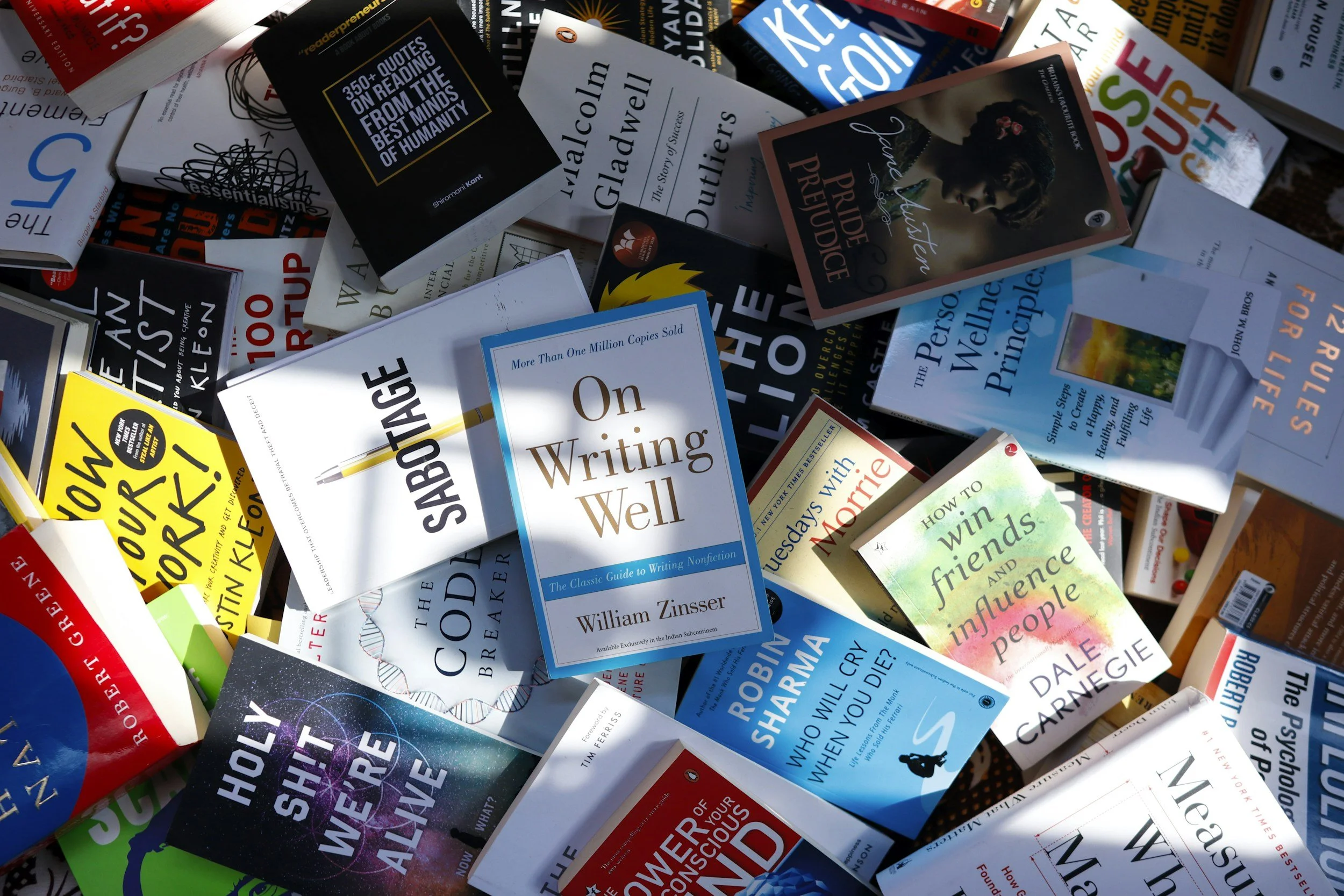
One way to do that is to get rid of unessential content—clutter. William Zinsser, in On Writing Well, called clutter "the disease of American writing." He was talking about prose that functions as filler and leaves no space for the idea to land.
Know Exactly What You're Trying to Say
Most unclear writing stems from a thinking problem.
When writers haven't fully worked out their thesis statement, their prose gets fuzzy. They circle the idea instead of stating it and use abstract language because it doesn't require commitment.
You address this before you write the first word. Ask yourself: If I had to explain this idea to one person, in one sentence, what would I say?
That sentence becomes your anchor. Everything else either supports it or gets cut. If you can't write that sentence, you're not ready to write the piece yet. Sit with the idea longer and talk it through. Once you can say it clearly out loud, you can write it clearly on the page.
Use Plain Words
There's a persistent belief in business writing that sophisticated ideas require sophisticated vocabulary. The opposite is true. The most respected thinkers in any field tend to write in remarkably plain language—because they understand their material well enough to translate it.
Compare these two sentences:
"To maximize organizational efficiency, leadership is focused on streamlining communication workflows and enhancing cross-departmental visibility to reduce friction points.”
"Leaders want teams to communicate more clearly and share information more easily so work doesn’t get slowed down."
The second sentence is not only clearer but also reflects how people (who aren’t using business lingo) really talk.
Jargon often functions as a kind of insider signaling—a way of saying I belong here. But your reader is more interested in whether you can help them understand something. Think of it like this: Every time you reach for a five-syllable word when a one-syllable word would do, you're choosing your ego over your reader.
But do use technical terms when appropriate. A neurosurgeon writing for other neurosurgeons should use the language of the field. But the moment your audience widens, your language has to widen with it.
Cut the Throat-Clearing
Open most business writing, and you'll find the first paragraph (or two, or three) doing nothing. Setting up. Contextualizing. Easing in. Throat-clearing.
Readers don't need a warm-up. They need to know why they should keep reading.
How many of your opening sentences say something like "In today's dynamic business landscape..." or "Now more than ever..." or "It's important to consider..."? These are placeholders, not ideas. Cut them. Start with the actual point. You can contextualize later, after you've earned the reader's attention.
The same applies to sentences inside the piece. Watch for phrases like "It is important to note that..." or "What is interesting here is that..." Just say the thing.
Use Concrete Examples
Abstract ideas are slick, but examples make them stick.
If you're explaining a concept—a framework, a principle, a methodology—stop and ask: Have I shown the reader what this looks like in practice? If not, find an example. A client story. A scenario. A specific case where the principle played out.
Many SMEs explain the theory beautifully but never show it in action. The reader nods along, then closes the book, having retained almost nothing. Examples are what convert understanding into memory.
This is also where storytelling techniques do their work in business writing. A two-sentence anecdote about a specific person facing a specific problem is worth ten sentences of abstract principle. You don't need to write narrative nonfiction to use a scene. You just need to give your reader something to hold onto.
Read for Rhythm
Clear prose has rhythm. Sentences vary in length. Short sentences punch. Longer sentences develop ideas, build context, and give the reader room to think. When every sentence runs the same length—particularly when they all run long—the reader's brain starts to slide off the page.
Read your work aloud. If reading a sentence makes you run out of breath, it’s too long. When the rhythm flattens, you've stacked too many similar structures. Break it up. Let some sentences be six words. Let others be twenty-five. Variation keeps the reader engaged.
Trust Your Reader
A lot of unclear writing comes from a place of anxiety—the writer worried that the reader won't get it, so they over-explain, over-qualify, over-justify. The irony is that this almost always makes the writing harder to follow, not easier.
Your reader is smart, so trust them to meet you halfway. One explanation for an idea—not three—will suffice. You don’t have to spell out every implication. And what I see so much of these days is this pattern of presenting counterarguments at the sentence level.
Say it once, clearly, and move on. If you've done your job, they'll get it.
This is one of the hardest shifts for thought leaders, specifically, because expertise comes with a deep awareness of nuance. You know all the exceptions. You know all the ways a sophisticated reader might push back. The temptation is to address every one of them in the body of your argument. Don't. Acknowledge nuance where it matters, then keep moving. Footnotes and appendices exist for a reason.
The One-Question Test
When you’ve completed your first draft, ask Would a smart person outside my field understand what I'm saying?
Someone capable, curious, and willing to read carefully—but without your specialized knowledge. If the answer is yes, your writing is doing its job. If the answer is no, you've got revision ahead of you.
Even better, give it to that person. Watch where they pause, where they reread, where they ask what you meant. Those are the spots where your clarity broke down. Fix them.
The Last Word
Writing clearly about complex ideas is harder than writing about them in dense, jargon-filled prose. It takes more thinking, more revision, and more willingness to be understood.
Wondering if your writing is landing the way you intend? A professional line edit catches the places where complexity is obscuring your message instead of communicating it. Reach out, and let's talk about your project.
Sources
Zinsser, William. On Writing Well: The Classic Guide to Writing Nonfiction. Harper Perennial, 2006.