
Blog
Whether you’re outlining your first chapter or polishing your final draft, you’ll find practical guidance, editorial insight, and a steady nudge forward.
Browse by Topic
-
Editing & Revision
- Jul 28, 2026 A Realistic Timeline for Writing and Editing a Nonfiction Book Jul 28, 2026
- Jul 23, 2026 Why Great Editing Preserves Your Voice (Instead of Editing It Out) Jul 23, 2026
- Jun 27, 2026 What Is Copyediting, and When Do You Need It? Jun 27, 2026
- Jun 27, 2026 What Is Proofreading? Your Manuscript's Last Line of Defense Jun 27, 2026
- Jun 27, 2026 What Is Line Editing? The Service That Sharpens Your Voice Without Replacing It Jun 27, 2026
- Jun 20, 2026 Developmental Editing for Nonfiction: What It Is and When You Need It Jun 20, 2026
-
Editing Tips
- May 21, 2026 What Type of Editing Does Your Manuscript Need? May 21, 2026
- May 19, 2026 How to Self-Edit Your Nonfiction Manuscript May 19, 2026
-
Getting Started
- May 12, 2026 How to Outline a Nonfiction Book (With Templates and Examples) May 12, 2026
- May 8, 2026 How to Turn Your Expertise Into a Compelling Book May 8, 2026
- May 8, 2026 How to Start Writing a Nonfiction Book (When You Don’t Know Where to Start) May 8, 2026
-
Memoir/Personal Narrative
- Jun 30, 2026 How to Write a Memoir That Doesn't Read Like a Diary Jun 30, 2026
-
Reader Engagement
- Jun 25, 2026 The Psychology of Reader Engagement in Nonfiction Jun 25, 2026
- Jun 23, 2026 How to Build Credibility and Trust as a Nonfiction Author Jun 23, 2026
- Jun 9, 2026 Using Research In Your Writing Without Boring Readers Jun 9, 2026
- Jun 4, 2026 The Art of Clarity: How to Write Complex Ideas Simply Jun 4, 2026
-
Storytelling
- Jun 23, 2026 Storytelling in Nonfiction Writing Jun 23, 2026
-
Structure
- Jun 20, 2026 Developmental Editing for Nonfiction: What It Is and When You Need It Jun 20, 2026
- Jun 11, 2026 How to Craft a Strong Central Argument for Your Nonfiction Book Jun 11, 2026
- Jun 4, 2026 The Art of Clarity: How to Write Complex Ideas Simply Jun 4, 2026
- May 14, 2026 How to Structure a Nonfiction Book for Maximum Clarity and Impact May 14, 2026
- May 12, 2026 How to Outline a Nonfiction Book (With Templates and Examples) May 12, 2026
-
Writer Editor Collaboration
- Jul 21, 2026 Red Flags When Choosing a Nonfiction Editor (and What to Look For Instead) Jul 21, 2026
-
Writer-Editor Collaboration
- Jul 16, 2026 Writing Coach vs. Editor: Which One Do You Need? Jul 16, 2026
- Jul 14, 2026 Signs Your Nonfiction Manuscript Is Ready for Editing (or Not Quite Yet) Jul 14, 2026
- Jul 9, 2026 What to Expect When Working With a Nonfiction Editor Jul 9, 2026
- Jul 2, 2026 The Writer–Editor Relationship: What Collaboration Should Look Like Jul 2, 2026
-
Writing Mindset
- Jul 16, 2026 Writing Coach vs. Editor: Which One Do You Need? Jul 16, 2026
- Jul 14, 2026 Signs Your Nonfiction Manuscript Is Ready for Editing (or Not Quite Yet) Jul 14, 2026
- Jul 9, 2026 What to Expect When Working With a Nonfiction Editor Jul 9, 2026
- Jul 2, 2026 The Writer–Editor Relationship: What Collaboration Should Look Like Jul 2, 2026
- Jun 25, 2026 The Psychology of Reader Engagement in Nonfiction Jun 25, 2026
- Jun 23, 2026 The Mindset Shift Every Writer Needs Jun 23, 2026
- Jun 23, 2026 How to Build Credibility and Trust as a Nonfiction Author Jun 23, 2026
- May 28, 2026 The 7 Habits of Great Writers May 28, 2026
-
Writing Process
- Jul 28, 2026 A Realistic Timeline for Writing and Editing a Nonfiction Book Jul 28, 2026
-
Writing Tips
- Jun 23, 2026 The Mindset Shift Every Writer Needs Jun 23, 2026
- Jun 23, 2026 Storytelling in Nonfiction Writing Jun 23, 2026
- Jun 11, 2026 How to Craft a Strong Central Argument for Your Nonfiction Book Jun 11, 2026
- Jun 9, 2026 Using Research In Your Writing Without Boring Readers Jun 9, 2026
- Jun 4, 2026 The Art of Clarity: How to Write Complex Ideas Simply Jun 4, 2026
- May 28, 2026 The 7 Habits of Great Writers May 28, 2026
- May 26, 2026 The 5 Most Common Mistakes Writers Make (And the Simple Fixes) May 26, 2026
- May 14, 2026 How to Structure a Nonfiction Book for Maximum Clarity and Impact May 14, 2026
- May 12, 2026 How to Outline a Nonfiction Book (With Templates and Examples) May 12, 2026
- May 8, 2026 How to Turn Your Expertise Into a Compelling Book May 8, 2026
- May 8, 2026 How to Start Writing a Nonfiction Book (When You Don’t Know Where to Start) May 8, 2026
Developmental Editing for Nonfiction: What It Is and When You Need It
You've finished your draft—or at least a substantial chunk of it—and you know it needs work. But what kind of work, exactly? When you start researching editing services, you'll encounter terms like developmental editing, line editing, copyediting, and proofreading. They all sound like they involve making your writing better, so what's the difference?
If you're writing nonfiction—a memoir, a business book, a self-help guide, a narrative history—you need to understand the distinctions. Hiring the wrong type of editor at the wrong stage is one of the most common (and costly) mistakes writers make. And developmental editing, in particular, is often misunderstood.
You can see why writers get this one wrong: "developmental" sounds like the editor's job is to help you develop your ideas—feeding you questions and providing feedback until the book takes shape. That's not what it means.
So, let's clear that up.
What Developmental Editing Is
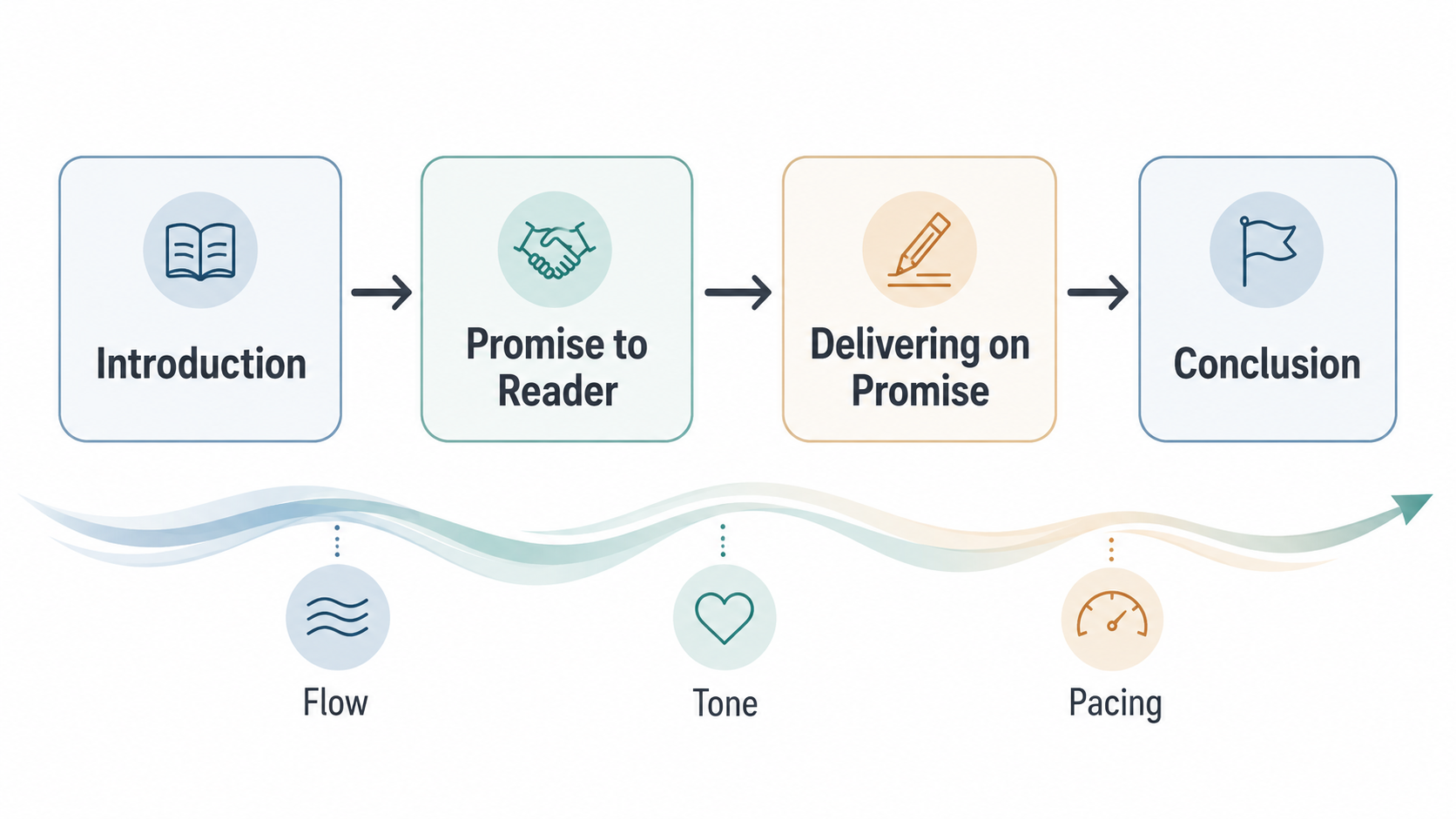
Developmental editing addresses the big-picture elements of your manuscript: structure, argument, pacing, clarity of purpose, and audience alignment. A developmental editor isn't looking at your sentences (that comes later). They're looking at your book as a whole and asking fundamental questions.
Does this structure serve the book's goals? Is the argument coherent and well-supported? Does the pacing keep readers engaged, or do certain sections drag? Is the intended audience clear, and does every chapter speak to that audience? Are there gaps in the logic, missing context, or sections that don't earn their place?
Think of it this way: if your book were a house, developmental editing is about the architecture. Are the rooms in the right places? Does the layout make sense? Is the foundation solid? Is there a staircase leading up to the second floor? You don't want to hang curtains and arrange furniture (line editing and copyediting) in a house that needs walls knocked down.
Scott Norton, author of Developmental Editing: A Handbook for Freelancers, Authors, and Publishers, describes the developmental editor's role as helping authors "discover and realize their intentions." A successful developmental edit clarifies and strengthens the vision you already have.
What a Developmental Editor Looks At
Every nonfiction book has its own challenges, but developmental editors typically focus on several core areas.
Structure and organization. Nonfiction books live or die by their structure. Your reader needs to feel oriented—to understand where they are, where they're going, and why each section matters. A developmental editor examines whether your chapters are in the right order, whether sections within chapters flow logically, and whether the overall arc of the book makes sense.
This is especially critical for books built around frameworks, methodologies, or arguments. If you're a consultant writing about your approach to leadership, for instance, your reader needs to understand each concept before you build on it. A developmental editor catches those moments where you've assumed knowledge your reader doesn't have yet, or where you've buried a key concept in the wrong chapter.
Argument and evidence. Nonfiction makes claims, and those claims need support. Whether you're drawing on research, case studies, personal experience, or client stories, a developmental editor evaluates whether your evidence actually supports your arguments—and whether your arguments are clear in the first place.
This isn't about fact-checking (though that matters too). It's about logical coherence. Does your conclusion follow from your premises? Have you addressed obvious counterarguments? Are there leaps in logic that will make skeptical readers disengage?
Audience alignment. One of the most common problems in nonfiction manuscripts is a mismatch between the book and its intended reader. Sometimes the author is writing for experts when the book is meant for beginners. Other times, the tone is too academic for a general audience, or too casual for a professional one.
A developmental editor helps you see your book through your reader's eyes. They ask: Who is this book for, and does every chapter serve that reader? Research on effective communication consistently shows that audience awareness is one of the strongest predictors of whether a message lands. As cognitive psychologist Daniel Willingham puts it, "the mind is not designed to think—it's designed to save you from thinking." Your reader won't do the work of figuring out why your book matters to them. You have to make it clear.
Pacing and engagement. Nonfiction doesn't get a pass on being engaging just because it's informational. Readers still need momentum. They need to feel like they're making progress, learning something new, moving toward a destination.
Developmental editors identify where your manuscript drags—where you've over-explained, repeated yourself, or lost the thread. They also spot where you've rushed, glossing over material that deserves more attention. Pacing problems often stem from structural problems, which is why this level of editing needs to happen before you start polishing sentences.
Signs You Might Need Developmental Editing
Not every manuscript needs developmental editing. But here are some indicators that yours might.
You're not sure if your structure is working.
You've organized your chapters in a way that makes sense to you, but you're uncertain whether a reader will follow. Or you've reorganized multiple times and still aren't confident.
Feedback has been confusing or contradictory.
Beta readers or writing group members have given you feedback, but it's all over the map. Some say the book is too long; others say it needs more detail. Some love Chapter 3; others find it boring. When feedback is inconsistent, it often signals a structural issue that readers sense but can't quite articulate.
You know something's off, but you can't put your finger on it.
The book doesn't feel right, but you've been too close to it for too long to see why. You need an outside perspective—someone who can read with fresh eyes and diagnostic expertise.
Your book has a complex argument or framework.
The more intricate your content, the more important structure becomes. If you're presenting a methodology, a theory, or a multi-part argument, developmental editing helps ensure that complexity serves your reader rather than overwhelming them.
You're writing your first book.
First-time authors often underestimate how different book-length writing is from articles, blog posts, or reports. The architecture of a book requires skills that take time to develop. Working with a developmental editor on your first project is an education in itself.
When You Might Not Need It
If your structure is solid, your argument is clear, and your feedback has been consistently positive on the big-picture elements, you might be ready to skip straight to line editing. Some writers—especially those who've written multiple books or who have backgrounds in journalism or academic writing—have internalized structural thinking. They've already done the developmental work themselves.
The key is honest self-assessment. If you're uncertain, a developmental editor can often tell within the first few chapters whether your manuscript needs deep structural work or just refinement at the sentence level. Many editors offer manuscript evaluations—a shorter, less intensive read-through that assesses what kind of editing your book actually needs.
What the Process Looks Like
Developmental editing is collaborative. It's not a situation where you hand off your manuscript and get back a "fixed" version. Instead, you typically receive a detailed editorial letter addressing the big-picture issues, along with comments throughout the manuscript pointing to specific passages where those issues show up.
Then comes the revision. You take the feedback, sit with it, and decide what you want to change. Sometimes that means reorganizing chapters. Sometimes it means cutting sections that aren't working or writing new material to fill gaps. The editor's job is to diagnose and guide; the revision work is yours.
This is why developmental editing often happens earlier in the process than people expect. Ideally, you want a developmental edit before you've polished every sentence to a shine—because polished sentences in a chapter that needs to be cut, moved, or substantially rewritten are wasted effort.
Finding the Right Editor
Not every editor offers developmental editing, and not every developmental editor works with nonfiction. When you're evaluating potential editors, ask about their experience with your genre and subject matter. Ask how they approach developmental feedback—do they provide an editorial letter, in-line comments, or both? Ask about their revision philosophy. You want someone who will push you to do your best work while respecting your voice and vision.
The right developmental editor doesn't rewrite your book. They help you see it more clearly so you can rewrite it yourself, with confidence.
Your Next Step
If you're wondering whether your nonfiction manuscript needs developmental editing—or if you're not sure what kind of editing it needs at all—I'm happy to talk it through. Sometimes, a short conversation is all it takes to get clarity on where you are in the process and what kind of support would actually help.
Sources
Norton, Scott. Developmental Editing: A Handbook for Freelancers, Authors, and Publishers. University of Chicago Press, 2009.
Willingham, Daniel T. Why Don't Students Like School?: A Cognitive Scientist Answers Questions About How the Mind Works and What It Means for the Classroom. Jossey-Bass, 2009.
How to Craft a Strong Central Argument for Your Nonfiction Book
Something's off with your manuscript, and you can't quite name it.
The chapters are solid on their own. The writing is decent. But when you read the whole thing through, it feels scattered—like a collection of related essays rather than a single, building case. You've reorganized it twice and it still doesn't cohere. You suspect the problem is structural, but every time you go looking for it, you end up rearranging chapters and hoping it sticks.
When a book feels structurally broken, many times the problem isn't the structure at all. It's that there's no clear central argument holding the structure together. You can't organize chapters around a throughline that doesn't exist yet.
Get the argument right, and the structure tends to fall into place on its own. Let's get to it.
The Real Source of Mushy Structure
Most structural problems are about purpose.
When writers come to me convinced their chapters are in the wrong sequence, many times, I find that the chapters don't agree on what the book is saying. Each one is pulling in a slightly different direction. Chapter three is making one case, chapter six is making a subtly different one, and the reader feels the drift even if they can't put their finger on it.
This can be a death sentence for author credibility. Readers don't consciously think "this book lacks a unifying argument." They just feel less convinced as they go, and they trust the author a little less with each chapter that doesn't connect. Structural confusion reads as muddled thinking, even when your thinking is perfectly sound. You just haven't pinned it down yet.
So before you move yet another chapter, don’t worry about structure right now. Ask yourself: What’s this book’s argument?
Topic vs. Argument
Okay—you’re going to read this distinction and say, “Julie, I know that already.” But what feels off with your book may be explained by the difference between a topic and an argument. A topic is what your book is about. An argument is what your book says.
"Productivity" is a topic. "Sustainable productivity comes from managing energy, not time" is an argument. The first gives you no way to decide what belongs in the book. The second tells you instantly: a chapter on energy management belongs; a chapter that drifts into general time-hacking does not, however interesting it is.
That's why this matters for structure. An argument is a filter. Once you can state in a single sentence what your book is claiming, every chapter becomes easy to evaluate—it either advances that claim or it doesn't. Without that filter, you're left organizing by instinct, which is exactly why you keep reshuffling without ever feeling settled.
Before you do anything else to your manuscript, finish this sentence:
By the end of this book, the reader will understand that ______.
If you can't fill that blank with something specific, that's your real problem—not the chapter order.
Make the Argument Carry Weight
A central argument that's too safe won't hold a book together. "Communication matters in relationships" is true, but it's so universally agreed upon that it gives your chapters nothing to build toward. There's no tension, no momentum, no push and pull.
A strong argument takes a position—this, not that. It makes a claim specific enough that someone could reasonably disagree. That specificity is what gives your book a spine. Each chapter’s job is to advance the claim, address an objection to it, or supply the evidence it needs. The argument creates the work, and the work creates the structure.
Nonfiction authority is not about how much you know—it’s about the clarity with which you make and defend a specific case. A sharp central argument, supported chapter by chapter, demonstrates rigorous thinking. That demonstration is what earns the reader's trust, and it's impossible without a claim worth defending in the first place.
Use the Argument to Diagnose Your Structure
Only now do you have a tool to fix the structure.
Here’s what you do:
Go through your manuscript chapter by chapter and ask one question of each: How does this advance my central argument?
Write the answer in a single sentence.
This is the most clarifying exercise I know, and it surfaces problems immediately:
If you can't write that sentence for a chapter, that’s great! You’ve just determined that the chapter isn't earning its place. Cut it or rewrite it to serve the argument.
If two chapters produce nearly identical sentences, you're making the same point twice and probably need to merge them.
If the sentences don't build on one another—if Chapter Five doesn't depend on anything Chapter Four established—your sequence is arbitrary, and you have just identified your ordering problem.
When I wear my developmental editor hat, your book is the house, the central argument is the load-bearing wall. Every chapter either supports it or it's just taking up space. Through that lens, once you can see which chapters carry weight and which ones merely sit nearby, the right structure stops being a guessing game.
Stop Rearranging, Start Arguing
If your manuscript feels scattered, resist the urge to keep rearranging. Shuffling chapters is treating a symptom. The cure is upstream: a central argument clear and specific enough that every chapter knows its job.
Do that work first, and the structure that frustrated you starts to take root. Chapters that don't belong become obvious. The right order reveals itself because order follows logic and logic follows the argument. And a clearly argued book reads like clear thinking, which fosters your credibility.
Figure out what you're really trying to say. Then let that argument tell you where everything goes.
Still can't see why your structure isn't working? That's exactly what a developmental edit is for—an outside set of eyes to find the throughline you're too close to see. Let's talk about the throughline you're trying to land—and how to get every chapter working toward it.
The Art of Clarity: How to Write Complex Ideas Simply

If you've ever read a business book or thought leadership piece and thought, I have no clue what I just read, you're not alone. And if you've ever written about a topic in depth that still came across as convoluted, you're definitely not alone.
I live in a town full of engineers and rocket scientists. At one point, Huntsville, Alabama, had the most PhDs per capita in the country. Here's a truth that you’ve likely experienced yourself: When people with deep subject expertise talk about it, they often forget that the listener doesn’t share that default knowledge. The same thing happens with their writing. It's not that they're bad writers. It's that the material is second-nature to them and they assume the reader is on the same level. These experts often live and breathe their subject and love to delve into nuance, and don’t want to be seen as simplistic. So they overcomplicate. They hedge. They reach for jargon when plain words would do. And that’s fine as long as they’re writing for their colleagues, and not a mainstream audience.
The result is writing that is clearly authoritative but doesn't reach the reader. And in business writing—where you're trying to build trust, establish expertise, or move someone to action—that's a problem.
Writing clearly doesn’t mean dumbing down your subject. You’re meeting the reader where they’re at. Let's talk about how to achieve it.
Clarity Is Not the Same as Simplicity
Before we go any further, let's clear up a misconception. When I tell writers that we need to work on clarity, some of them hear, “We’re going to make it less sophisticated." That's not what I mean.
Clear writing can address the most complex ideas in the world. The difference is that the complexity lives in the idea, not in the prose. Your job as a writer is to be the bridge between what you understand and what your reader needs to understand. The harder the concept, the more important it is that your sentences carry the reader across that bridge rather than letting them flounder in that understanding gap.
One way to do that is to get rid of unessential content—clutter. William Zinsser, in On Writing Well, called clutter "the disease of American writing." He was talking about prose that functions as filler and leaves no space for the idea to land.
Know Exactly What You're Trying to Say
Most unclear writing stems from a thinking problem.
When writers haven't fully worked out their thesis statement, their prose gets fuzzy. They circle the idea instead of stating it and use abstract language because it doesn't require commitment.
You address this before you write the first word. Ask yourself: If I had to explain this idea to one person, in one sentence, what would I say?
That sentence becomes your anchor. Everything else either supports it or gets cut. If you can't write that sentence, you're not ready to write the piece yet. Sit with the idea longer and talk it through. Once you can say it clearly out loud, you can write it clearly on the page.
Use Plain Words
There's a persistent belief in business writing that sophisticated ideas require sophisticated vocabulary. The opposite is true. The most respected thinkers in any field tend to write in remarkably plain language—because they understand their material well enough to translate it.
Compare these two sentences:
"To maximize organizational efficiency, leadership is focused on streamlining communication workflows and enhancing cross-departmental visibility to reduce friction points.”
"Leaders want teams to communicate more clearly and share information more easily so work doesn’t get slowed down."
The second sentence is not only clearer but also reflects how people (who aren’t using business lingo) really talk.
Jargon often functions as a kind of insider signaling—a way of saying I belong here. But your reader is more interested in whether you can help them understand something. Think of it like this: Every time you reach for a five-syllable word when a one-syllable word would do, you're choosing your ego over your reader.
But do use technical terms when appropriate. A neurosurgeon writing for other neurosurgeons should use the language of the field. But the moment your audience widens, your language has to widen with it.
Cut the Throat-Clearing
Open most business writing, and you'll find the first paragraph (or two, or three) doing nothing. Setting up. Contextualizing. Easing in. Throat-clearing.
Readers don't need a warm-up. They need to know why they should keep reading.
How many of your opening sentences say something like "In today's dynamic business landscape..." or "Now more than ever..." or "It's important to consider..."? These are placeholders, not ideas. Cut them. Start with the actual point. You can contextualize later, after you've earned the reader's attention.
The same applies to sentences inside the piece. Watch for phrases like "It is important to note that..." or "What is interesting here is that..." Just say the thing.
Use Concrete Examples
Abstract ideas are slick, but examples make them stick.
If you're explaining a concept—a framework, a principle, a methodology—stop and ask: Have I shown the reader what this looks like in practice? If not, find an example. A client story. A scenario. A specific case where the principle played out.
Many SMEs explain the theory beautifully but never show it in action. The reader nods along, then closes the book, having retained almost nothing. Examples are what convert understanding into memory.
This is also where storytelling techniques do their work in business writing. A two-sentence anecdote about a specific person facing a specific problem is worth ten sentences of abstract principle. You don't need to write narrative nonfiction to use a scene. You just need to give your reader something to hold onto.
Read for Rhythm
Clear prose has rhythm. Sentences vary in length. Short sentences punch. Longer sentences develop ideas, build context, and give the reader room to think. When every sentence runs the same length—particularly when they all run long—the reader's brain starts to slide off the page.
Read your work aloud. If reading a sentence makes you run out of breath, it’s too long. When the rhythm flattens, you've stacked too many similar structures. Break it up. Let some sentences be six words. Let others be twenty-five. Variation keeps the reader engaged.
Trust Your Reader
A lot of unclear writing comes from a place of anxiety—the writer worried that the reader won't get it, so they over-explain, over-qualify, over-justify. The irony is that this almost always makes the writing harder to follow, not easier.
Your reader is smart, so trust them to meet you halfway. One explanation for an idea—not three—will suffice. You don’t have to spell out every implication. And what I see so much of these days is this pattern of presenting counterarguments at the sentence level.
Say it once, clearly, and move on. If you've done your job, they'll get it.
This is one of the hardest shifts for thought leaders, specifically, because expertise comes with a deep awareness of nuance. You know all the exceptions. You know all the ways a sophisticated reader might push back. The temptation is to address every one of them in the body of your argument. Don't. Acknowledge nuance where it matters, then keep moving. Footnotes and appendices exist for a reason.
The One-Question Test
When you’ve completed your first draft, ask Would a smart person outside my field understand what I'm saying?
Someone capable, curious, and willing to read carefully—but without your specialized knowledge. If the answer is yes, your writing is doing its job. If the answer is no, you've got revision ahead of you.
Even better, give it to that person. Watch where they pause, where they reread, where they ask what you meant. Those are the spots where your clarity broke down. Fix them.
The Last Word
Writing clearly about complex ideas is harder than writing about them in dense, jargon-filled prose. It takes more thinking, more revision, and more willingness to be understood.
Wondering if your writing is landing the way you intend? A professional line edit catches the places where complexity is obscuring your message instead of communicating it. Reach out, and let's talk about your project.
Sources
Zinsser, William. On Writing Well: The Classic Guide to Writing Nonfiction. Harper Perennial, 2006.
How to Structure a Nonfiction Book for Maximum Clarity and Impact
You're in the thick of it now. You've got chapters written, ideas scattered across multiple documents, and that nagging feeling that something isn't quite clicking. The words are there, but when you step back and look at the whole thing, it feels... muddled. Like the pieces of a puzzle that should fit together but don't.
If this sounds familiar, you're not alone. After nearly a decade of editing nonfiction, I can tell you that structural issues are among the most common problems I encounter in mid-draft manuscripts. Writers know what they want to say. They've done the research, lived the experiences, and developed the expertise. But organizing all of that into a shape that carries a reader from beginning to end is where things typically fall apart.
Here's the good news: structure is fixable. And understanding how to organize nonfiction writing effectively can transform a meandering manuscript into a memorable reading journey.
Why Structure Matters More Than You Think
When readers pick up a nonfiction book, they're making an implicit deal with you. They're giving you their time and attention, and in return, they expect you to guide them somewhere meaningful. A well-structured book honors that deal. It says: I know where we're going, and I'm going to get you there in a way that makes sense.
Poor structure breaks that promise. It leaves readers confused about how ideas connect, frustrated by repetition, or worse—they put the book down entirely. I've seen beautifully written manuscripts fail to find publishers or readers simply because the organization worked against the content instead of supporting it.
The truth is, structure isn't separate from your ideas. It is how your ideas make sense. British author Tony Buzan, who pioneered mind mapping techniques, recognized that our brains don't naturally think in linear sequences—they make leaps and connections that don't always follow a straight path (Buzan, 1996). Your job as a nonfiction writer is to take those organic connections and shape them into something a reader can follow without getting lost.
Diagnose Your Structural Problems
Before you can fix your structure, you need to identify what's broken. Step away from the sentence-level work and look at your manuscript from a distance. You can use ChatGPT to do this or just do it manually: create a one-pager for all of your chapters, listing your chapter titles and one-sentence summaries. Spread them on a table or tape them to a wall. Now ask yourself some hard questions.
Does each chapter have a clear purpose that supports your book's central argument? Can you articulate what each chapter accomplishes in a single sentence? If you can't, the chapter might be trying to do too much—or too little.
Is there a logical progression from one chapter to the next? Your reader should feel carried forward, not jerked around. If Chapter Four could swap places with Chapter Seven without anyone noticing, you have a structural problem.
Are you repeating yourself? This is incredibly common, especially in books that grew organically from blog posts, talks, or years of accumulated thinking. You might be making the same point in three different chapters without realizing it.
Where do you lose momentum? Be honest. Is there a section where even you get bored rereading? That's a signal that either the content doesn't belong or it's not positioned correctly in the arc of your book.
Three Frameworks That Create Clarity
Once you've diagnosed the issues, you need a framework to rebuild. Most nonfiction books organize around one of three structures, and understanding which one serves your material best can clarify everything.
The problem-solution structure works beautifully for prescriptive nonfiction—books that teach readers how to do something or solve a challenge they're facing. You establish the problem, explore why it exists and why conventional approaches fail, then walk readers through your solution. The bulk of your content lives in that solution section, broken into principles, steps, or strategies that build on each other.
The chronological structure serves memoir, biography, and narrative nonfiction well. Time becomes your organizing principle, and events unfold in sequence. But here's the nuance: strict chronology isn't mandatory. Many successful memoirs open with a pivotal moment that hooks the reader before circling back to the beginning. The key is that your reader always knows where they are in time and how events connect.
The thematic structure is organized around ideas rather than time or problems. Each chapter explores a different facet of your central argument. This works for essay collections, philosophical explorations, and books examining a topic from multiple angles. The challenge here is making sure your themes build toward something rather than simply sitting side by side.
The Throughline Test
Whatever structure you choose, every chapter needs to pass what I call the throughline test. Your book has a central argument—or maybe you’ve heard it referred to as a thesis. This is the one core thing you want readers to understand, believe, or be able to do by the end. Every single chapter should connect to that throughline. If a chapter doesn't serve your book's central purpose, it doesn't belong in your book, no matter how well-written it is.
This is exactly where I see mid-draft writers struggle the most. They've written chapters they love, chapters that represent real work and real insight, but those chapters don't actually support the book they're writing. Cutting them feels like failure. It's not. It's discernment. It's the difference between a focused book that delivers on its promise and a scattered one that loses readers along the way.
Transitions Are Your Secret Weapon
Let me tell you something. Listen closely to this because if you do the following in your manuscript, you are going to be miles ahead of most other writers, and you’ll surely save time and money on editing.
What’s tricky is that you can have a super-solid structure, but if you don’t have effective transitions, your manuscript will not only sound choppy but it’ll lack any sense of cohesion. That’s because transitions are the connective tissue that holds your chapters and sections together. They tell readers how one idea relates to the next and why it matters that these ideas appear in this order.
You’ll want to look at the endings of your chapters. Are they creating momentum or setting up for what’s coming next? At no point in your book should a reader feel that jolt of confusion: ”Wait, how did we get here?” That signals a missing bridge. Sometimes a single sentence does the work. Sometimes you need a paragraph that explicitly connects two ideas. Either way, never assume the connection is obvious to the reader just because it's obvious to you.
The Last Word
Structure isn't about imposing rigid rules on your creativity. It's about making your ideas accessible to readers who don't live inside your head. A well-structured nonfiction book feels effortless to read precisely because the writer did the hard work of organization behind the scenes.
If your mid-draft manuscript feels stuck, the problem might not be your writing. It might be your architecture. Step back, diagnose the structural issues, and don't be afraid to move things around—or cut them entirely. Your book will be stronger for it.
Struggling to see your manuscript's structure clearly? Sometimes a fresh set of professional eyes can help you identify what's working and what needs to shift. Reach out and let's talk about where your book stands and what kind of support might help you get it where it needs to go.
Sources
Buzan, Tony. The Mind Map Book: How to Use Radiant Thinking to Maximize Your Brain's Untapped Potential. Plume, 1996.
How to Outline a Nonfiction Book (With Templates and Examples)
You have a book in you. Maybe you've been turning an idea over in your head for years. Maybe you finally sat down to write—and realized you have no idea where to start.
Here's the thing: sitting down to write a nonfiction book without an outline is like driving cross-country without a map. You might eventually get there, but you'll waste a lot of time, make wrong turns, and probably want to quit somewhere around Kansas.
After nearly a decade of editing nonfiction—memoirs, business books, guides, and everything in between—I've watched writers struggle with the same problem over and over. They know what they want to say. They just don't know how to organize it. A solid outline solves that problem before it derails your entire project.
Why Outlining Matters More Than You Think
An outline isn't just organizational busywork—it's your defense against writer's block, scope creep, and the dreaded abandoned manuscript. British author Tony Buzan, who popularized mind mapping techniques in the 1970s, understood that our brains don't naturally think in linear sequences. They jump from idea to idea, making connections that don't always follow a straight line. An outline helps you capture that natural creative process and then shape it into something a reader can follow.
More practically, an outline reveals structural problems before you've written 30,000 words. I've seen writers realize mid-draft that their chapter three should actually be chapter eight, or that they've accidentally written three chapters about the same concept. An outline catches these issues when they're still easy to fix.
Start With Your Core Message
Before you outline a single chapter, you need to answer one question: What is this book actually about?
I don't mean the topic. I mean the argument. What do you want readers to understand, believe, or be able to do after reading your book? Write it in one to three sentences. This becomes your North Star—every chapter should connect back to it.
For example, a book about productivity isn't really about productivity. It might be about how small daily habits compound into significant life changes. A memoir about addiction isn't just a chronicle of events—it's about resilience, identity, or the complicated nature of family. Get specific about what you're really saying.
Three Proven Outline Structures
Not every nonfiction book follows the same structure. The right framework depends on what you're writing and who you're writing it for. Here are three that work across most nonfiction genres:
Problem-Solution Structure
This framework works beautifully for self-help, business books, and how-to guides. You establish the problem your reader faces, explore why it exists, and then walk them through the solution. Most of your content lives in the solution section, broken into actionable steps or principles.
Chronological Structure
Memoirs, biographies, and historical nonfiction often benefit from a timeline-based approach. You move through events in sequence, using time as your organizing principle. That said, strict chronology isn't mandatory—many memoirs open with a pivotal moment before circling back to the beginning.
Thematic Structure
Some books organize around key themes or principles rather than time or problem-solving. Each chapter explores a different facet of your central idea. This works well for essay collections, philosophical explorations, and books that examine a topic from multiple angles.
A Simple Template to Get You Started
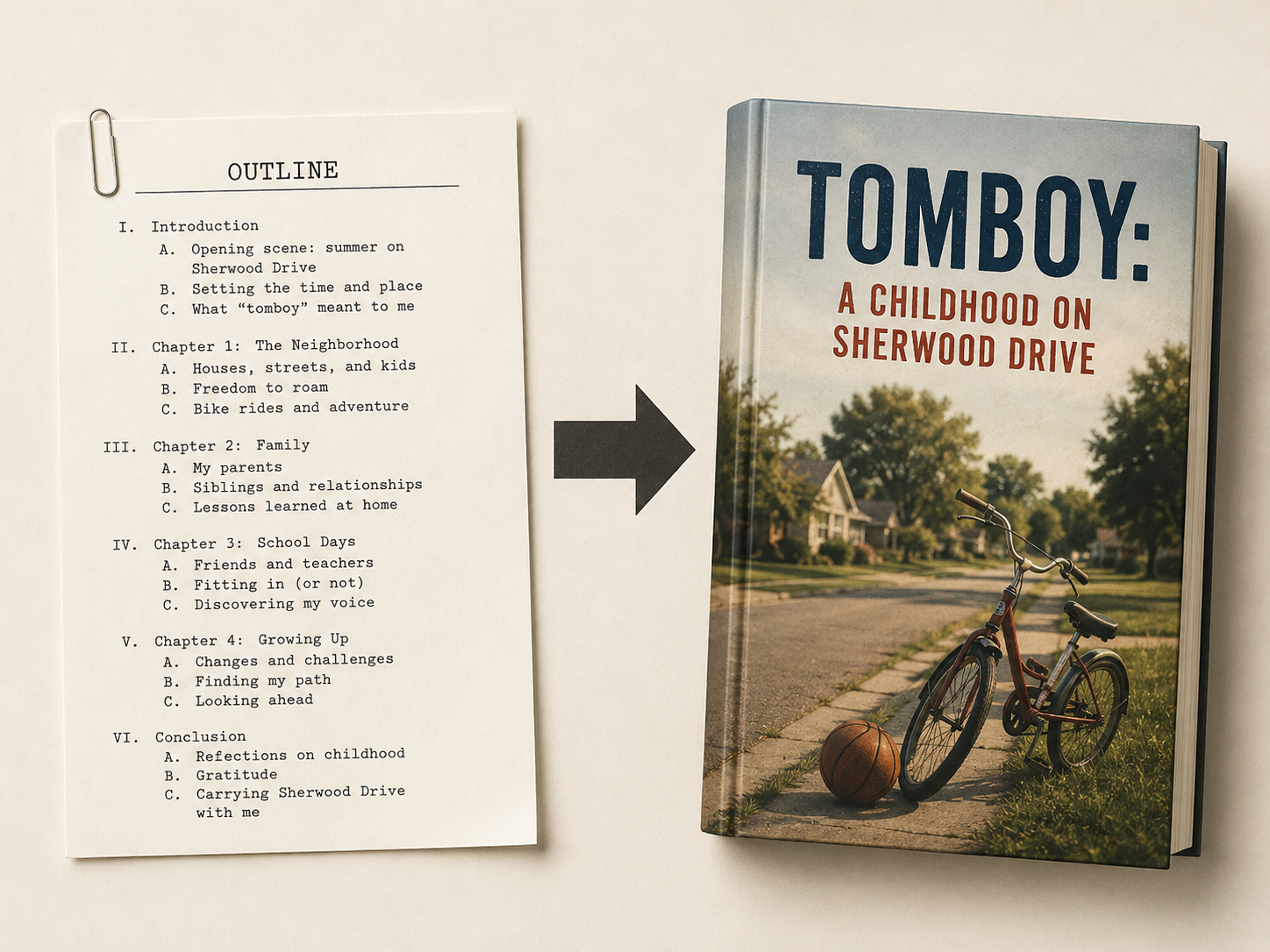
Here's a basic chapter outline template you can adapt for your project:
Chapter Title: [Clear, specific title that signals the chapter's focus]
Core Point: [One sentence describing what this chapter accomplishes]
Opening Hook: [How will you draw readers in? A story, question, or surprising fact?]
Key Sections: [Three to five main points or subtopics you'll cover]
Supporting Evidence: [Research, anecdotes, examples, or data you'll include]
Transition: [How does this chapter connect to the next?]
Work through this template for each chapter before you start writing. You don't need elaborate detail—bullet points are fine. The goal is to know where you're going before you set out.
The Mind Map Method
If traditional outlines feel too rigid, try mind mapping. Start with your book's central idea in the middle of a blank page. Draw branches outward for major themes or chapters. From each branch, add smaller branches for subtopics, examples, and supporting points. This visual approach lets you see connections between ideas and often reveals structural possibilities you wouldn't have noticed in a linear list.
When Your Outline Will Change (And That's Okay)
Here's something nobody tells you: your outline is a living document. It will change as you write. You'll discover that one chapter needs to become two, or that a section you planned doesn't actually serve your argument. That's not failure—that's the writing process working exactly as it should.
The outline gives you a starting point. It means you're never staring at a blank page, wondering what comes next. But it's not a contract. Give yourself permission to revise it as your book takes shape.
The Last Word
A good outline transforms the overwhelming task of writing a book into a series of manageable steps. It's the difference between building a house with blueprints and building one by guessing where the walls should go. Take the time to map out your structure before you dive into drafting. Your future self—the one who actually finishes the manuscript—will thank you.
Ready to move from outline to draft? Check out my post on "How to Start Writing a Nonfiction Book: A Clear, Practical Roadmap" for the next steps in your writing journey.
Sources
Buzan, Tony. The Mind Map Book: How to Use Radiant Thinking to Maximize Your Brain's Untapped Potential. Plume, 1996.