
Blog
Whether you’re outlining your first chapter or polishing your final draft, you’ll find practical guidance, editorial insight, and a steady nudge forward.
Browse by Topic
-
Editing & Revision
- Jul 28, 2026 A Realistic Timeline for Writing and Editing a Nonfiction Book Jul 28, 2026
- Jul 23, 2026 Why Great Editing Preserves Your Voice (Instead of Editing It Out) Jul 23, 2026
- Jun 27, 2026 What Is Copyediting, and When Do You Need It? Jun 27, 2026
- Jun 27, 2026 What Is Proofreading? Your Manuscript's Last Line of Defense Jun 27, 2026
- Jun 27, 2026 What Is Line Editing? The Service That Sharpens Your Voice Without Replacing It Jun 27, 2026
- Jun 20, 2026 Developmental Editing for Nonfiction: What It Is and When You Need It Jun 20, 2026
-
Editing Tips
- May 21, 2026 What Type of Editing Does Your Manuscript Need? May 21, 2026
- May 19, 2026 How to Self-Edit Your Nonfiction Manuscript May 19, 2026
-
Getting Started
- May 12, 2026 How to Outline a Nonfiction Book (With Templates and Examples) May 12, 2026
- May 8, 2026 How to Turn Your Expertise Into a Compelling Book May 8, 2026
- May 8, 2026 How to Start Writing a Nonfiction Book (When You Don’t Know Where to Start) May 8, 2026
-
Memoir/Personal Narrative
- Jun 30, 2026 How to Write a Memoir That Doesn't Read Like a Diary Jun 30, 2026
-
Reader Engagement
- Jun 25, 2026 The Psychology of Reader Engagement in Nonfiction Jun 25, 2026
- Jun 23, 2026 How to Build Credibility and Trust as a Nonfiction Author Jun 23, 2026
- Jun 9, 2026 Using Research In Your Writing Without Boring Readers Jun 9, 2026
- Jun 4, 2026 The Art of Clarity: How to Write Complex Ideas Simply Jun 4, 2026
-
Storytelling
- Jun 23, 2026 Storytelling in Nonfiction Writing Jun 23, 2026
-
Structure
- Jun 20, 2026 Developmental Editing for Nonfiction: What It Is and When You Need It Jun 20, 2026
- Jun 11, 2026 How to Craft a Strong Central Argument for Your Nonfiction Book Jun 11, 2026
- Jun 4, 2026 The Art of Clarity: How to Write Complex Ideas Simply Jun 4, 2026
- May 14, 2026 How to Structure a Nonfiction Book for Maximum Clarity and Impact May 14, 2026
- May 12, 2026 How to Outline a Nonfiction Book (With Templates and Examples) May 12, 2026
-
Writer Editor Collaboration
- Jul 21, 2026 Red Flags When Choosing a Nonfiction Editor (and What to Look For Instead) Jul 21, 2026
-
Writer-Editor Collaboration
- Jul 16, 2026 Writing Coach vs. Editor: Which One Do You Need? Jul 16, 2026
- Jul 14, 2026 Signs Your Nonfiction Manuscript Is Ready for Editing (or Not Quite Yet) Jul 14, 2026
- Jul 9, 2026 What to Expect When Working With a Nonfiction Editor Jul 9, 2026
- Jul 2, 2026 The Writer–Editor Relationship: What Collaboration Should Look Like Jul 2, 2026
-
Writing Mindset
- Jul 16, 2026 Writing Coach vs. Editor: Which One Do You Need? Jul 16, 2026
- Jul 14, 2026 Signs Your Nonfiction Manuscript Is Ready for Editing (or Not Quite Yet) Jul 14, 2026
- Jul 9, 2026 What to Expect When Working With a Nonfiction Editor Jul 9, 2026
- Jul 2, 2026 The Writer–Editor Relationship: What Collaboration Should Look Like Jul 2, 2026
- Jun 25, 2026 The Psychology of Reader Engagement in Nonfiction Jun 25, 2026
- Jun 23, 2026 The Mindset Shift Every Writer Needs Jun 23, 2026
- Jun 23, 2026 How to Build Credibility and Trust as a Nonfiction Author Jun 23, 2026
- May 28, 2026 The 7 Habits of Great Writers May 28, 2026
-
Writing Process
- Jul 28, 2026 A Realistic Timeline for Writing and Editing a Nonfiction Book Jul 28, 2026
-
Writing Tips
- Jun 23, 2026 The Mindset Shift Every Writer Needs Jun 23, 2026
- Jun 23, 2026 Storytelling in Nonfiction Writing Jun 23, 2026
- Jun 11, 2026 How to Craft a Strong Central Argument for Your Nonfiction Book Jun 11, 2026
- Jun 9, 2026 Using Research In Your Writing Without Boring Readers Jun 9, 2026
- Jun 4, 2026 The Art of Clarity: How to Write Complex Ideas Simply Jun 4, 2026
- May 28, 2026 The 7 Habits of Great Writers May 28, 2026
- May 26, 2026 The 5 Most Common Mistakes Writers Make (And the Simple Fixes) May 26, 2026
- May 14, 2026 How to Structure a Nonfiction Book for Maximum Clarity and Impact May 14, 2026
- May 12, 2026 How to Outline a Nonfiction Book (With Templates and Examples) May 12, 2026
- May 8, 2026 How to Turn Your Expertise Into a Compelling Book May 8, 2026
- May 8, 2026 How to Start Writing a Nonfiction Book (When You Don’t Know Where to Start) May 8, 2026
How to Outline a Nonfiction Book (With Templates and Examples)
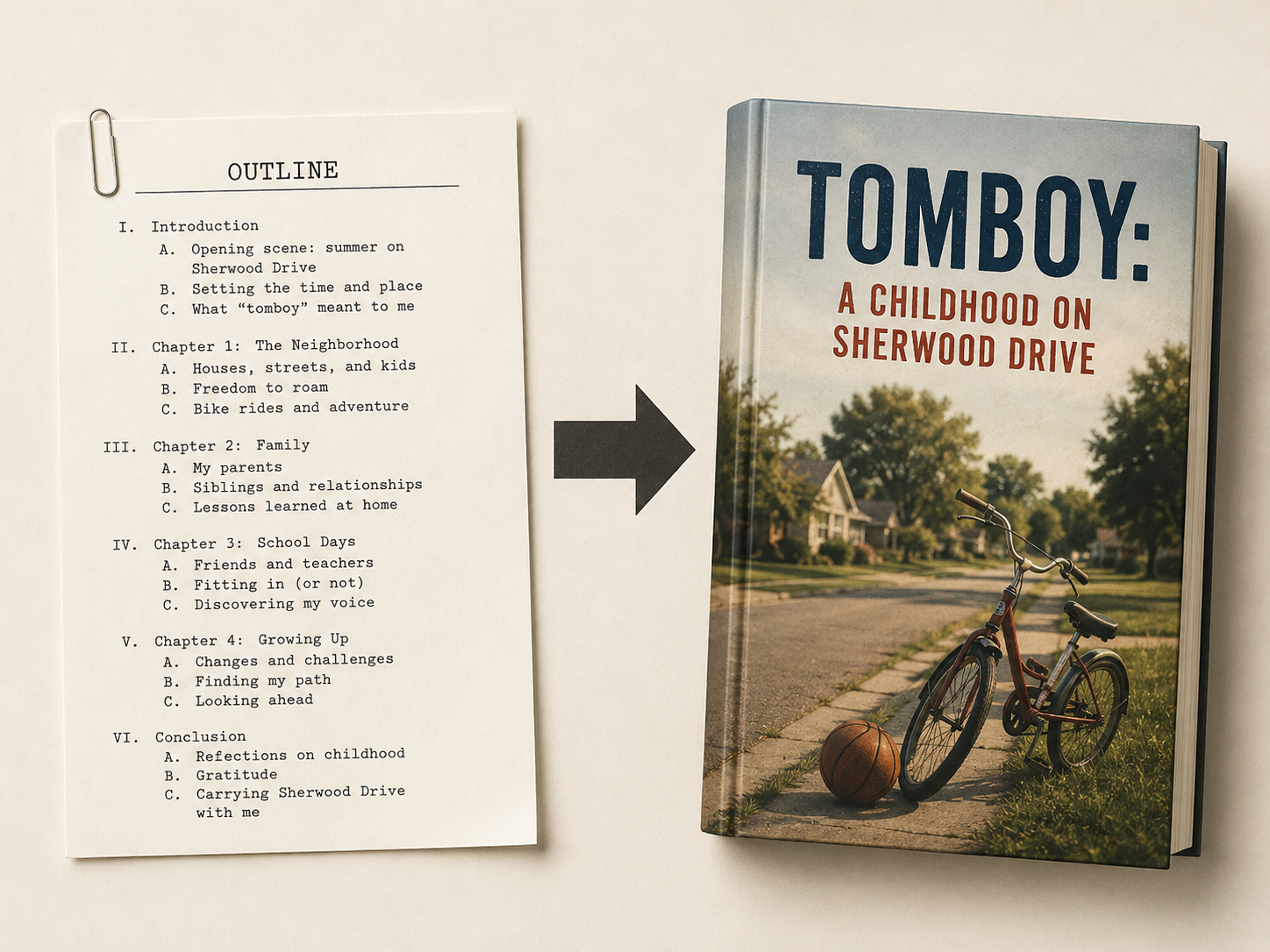
You have a book in you. Maybe you've been turning an idea over in your head for years. Maybe you finally sat down to write—and realized you have no idea where to start.
Here's the thing: sitting down to write a nonfiction book without an outline is like driving cross-country without a map. You might eventually get there, but you'll waste a lot of time, make wrong turns, and probably want to quit somewhere around Kansas.
After nearly a decade of editing nonfiction—memoirs, business books, guides, and everything in between—I've watched writers struggle with the same problem over and over. They know what they want to say. They just don't know how to organize it. A solid outline solves that problem before it derails your entire project.
Why Outlining Matters More Than You Think
An outline isn't just organizational busywork—it's your defense against writer's block, scope creep, and the dreaded abandoned manuscript. British author Tony Buzan, who popularized mind mapping techniques in the 1970s, understood that our brains don't naturally think in linear sequences. They jump from idea to idea, making connections that don't always follow a straight line. An outline helps you capture that natural creative process and then shape it into something a reader can follow.
More practically, an outline reveals structural problems before you've written 30,000 words. I've seen writers realize mid-draft that their chapter three should actually be chapter eight, or that they've accidentally written three chapters about the same concept. An outline catches these issues when they're still easy to fix.
Start With Your Core Message
Before you outline a single chapter, you need to answer one question: What is this book actually about?
I don't mean the topic. I mean the argument. What do you want readers to understand, believe, or be able to do after reading your book? Write it in one to three sentences. This becomes your North Star—every chapter should connect back to it.
For example, a book about productivity isn't really about productivity. It might be about how small daily habits compound into significant life changes. A memoir about addiction isn't just a chronicle of events—it's about resilience, identity, or the complicated nature of family. Get specific about what you're really saying.
Three Proven Outline Structures
Not every nonfiction book follows the same structure. The right framework depends on what you're writing and who you're writing it for. Here are three that work across most nonfiction genres:
Problem-Solution Structure
This framework works beautifully for self-help, business books, and how-to guides. You establish the problem your reader faces, explore why it exists, and then walk them through the solution. Most of your content lives in the solution section, broken into actionable steps or principles.
Chronological Structure
Memoirs, biographies, and historical nonfiction often benefit from a timeline-based approach. You move through events in sequence, using time as your organizing principle. That said, strict chronology isn't mandatory—many memoirs open with a pivotal moment before circling back to the beginning.
Thematic Structure
Some books organize around key themes or principles rather than time or problem-solving. Each chapter explores a different facet of your central idea. This works well for essay collections, philosophical explorations, and books that examine a topic from multiple angles.
A Simple Template to Get You Started
Here's a basic chapter outline template you can adapt for your project:
Chapter Title: [Clear, specific title that signals the chapter's focus]
Core Point: [One sentence describing what this chapter accomplishes]
Opening Hook: [How will you draw readers in? A story, question, or surprising fact?]
Key Sections: [Three to five main points or subtopics you'll cover]
Supporting Evidence: [Research, anecdotes, examples, or data you'll include]
Transition: [How does this chapter connect to the next?]
Work through this template for each chapter before you start writing. You don't need elaborate detail—bullet points are fine. The goal is to know where you're going before you set out.
The Mind Map Method
If traditional outlines feel too rigid, try mind mapping. Start with your book's central idea in the middle of a blank page. Draw branches outward for major themes or chapters. From each branch, add smaller branches for subtopics, examples, and supporting points. This visual approach lets you see connections between ideas and often reveals structural possibilities you wouldn't have noticed in a linear list.
When Your Outline Will Change (And That's Okay)
Here's something nobody tells you: your outline is a living document. It will change as you write. You'll discover that one chapter needs to become two, or that a section you planned doesn't actually serve your argument. That's not failure—that's the writing process working exactly as it should.
The outline gives you a starting point. It means you're never staring at a blank page, wondering what comes next. But it's not a contract. Give yourself permission to revise it as your book takes shape.
The Last Word
A good outline transforms the overwhelming task of writing a book into a series of manageable steps. It's the difference between building a house with blueprints and building one by guessing where the walls should go. Take the time to map out your structure before you dive into drafting. Your future self—the one who actually finishes the manuscript—will thank you.
Ready to move from outline to draft? Check out my post on "How to Start Writing a Nonfiction Book: A Clear, Practical Roadmap" for the next steps in your writing journey.
Sources
Buzan, Tony. The Mind Map Book: How to Use Radiant Thinking to Maximize Your Brain's Untapped Potential. Plume, 1996.
How to Turn Your Expertise Into a Compelling Book

“Readers want to know what’s in it for them—what they’re going to learn, or what problem you’re going to solve.”
You've spent years—maybe decades—mastering something. You've solved problems, developed frameworks, and accumulated insights that people pay you for. Clients and colleagues tell you all the time: "You should write a book."
But somewhere between the idea and the execution, you got stuck. And why wouldn’t you? What nobody tells you is that knowing your subject inside and out doesn't automatically mean you know how to write a book about it.
The good news? That's completely normal. And it's absolutely solvable.
Your Expertise Is the Starting Point, Not the Whole Story
Most professionals who want to write a book make the same assumption: since I know this material, writing about it should be straightforward. I just need to transfer all of this knowledge from my head to the page. But expertise and authorship are different skills. You might be able to explain your methodology brilliantly in a client meeting, but translating that into 50,000 words that hold a reader's attention is another challenge entirely.
“Expertise and authorship are different skills.”
Research backs this up. Cognitive scientists call it the "curse of knowledge"—a term popularized by economist Colin Camerer and colleagues in a 1989 study. Once you know something deeply, it becomes genuinely difficult to remember what it was like not to know it. You skip steps. You use jargon without realizing it. You assume context that your reader doesn't have.
This is a natural consequence of expertise. But it means that writing a book requires you to step outside your own head and meet your reader where they’re at.
Find the Story Inside Your Framework
Here's something I've learned from editing books by consultants, coaches, and executives: the ones that work are stories that have movement, tension, and payoff.
I'm currently editing a book by the founder of a digital education company. He's spent years interviewing leaders across industries, and his book looks at how effective leaders use language to shape culture, productivity, and relationships. He has tons of data and frameworks. But what makes the book compelling is how he weaves in real conversations, moments where a leader's word choice shifted the entire dynamic of a team, and meaningful anecdotes from his personal life. No doubt, the frameworks are the point of the book, but he brought them to life through narrative.
Another writer I've worked with is a psychologist who wrote about religious trauma—specifically, adults who grew up under the weight of hell indoctrination, believing they might burn for eternity if they stepped out of line. His clinical expertise gives the book credibility, but what gives it power is the way he tells his clients' stories (with their permission, of course). Readers don't just learn about trauma; they feel it, and they feel the relief of healing.
Your book needs both: the substance of what you know and the stories that make it stick.
“Your book needs the substance of what you know and the stories that make it stick.”
Start With Your Reader, Not Your Resume
One of the most common mistakes I see in expertise-driven books is leading with credentials instead of problems. The author spends the first chapter (or three) establishing why they're qualified to write this book. By the time they get to anything useful, the reader has already moved on.
Your reader picked up your book because they have a problem they want to solve or a question they want answered. They don't need your resume. They need to trust, within the first few pages, that you understand their situation and have something valuable to offer.
This doesn't mean your credentials don't matter. They do—they're part of why your perspective is worth reading. But they should emerge naturally in the course of telling your story, not dominate the opening. As author and writing instructor William Zinsser puts it, "Readers want to know what's in it for them—what they're going to learn, or what problem you're going to solve."
Structure Is Your Friend
Expertise-driven books often suffer from a lack of clear structure. The author knows so much (and cares so deeply!) that everything feels essential, and the result is a manuscript that reads like a brain dump—leaving readers lost in a forest of insights with no clear path through.
Before you write, you need to answer some fundamental questions:
What transformation are you offering your reader?
Where do they start, and where do they end up?
What are the essential steps or concepts they need to understand along the way?
Think of your book as taking the reader’s hand and guiding them on a learning journey. Each chapter should accomplish something specific and build toward the next. If you can't articulate what each chapter does and why it comes in that order, you're not ready to write yet.
Educational psychologist Richard Mayer's work on instructional design shows that learning is most effective when information is organized, sequenced logically, and connected to what the learner already knows. This is how you create a learning experience.
Write Like You Talk (Then Edit for the Page)
One of the best pieces of advice I can give: write in your own voice. The stiff, formal prose that many experts default to—thinking it sounds more "authoritative"—just sounds dry and distant. Your readers chose your book because they want access to you, not a textbook.
But you don’t want to write exactly how you speak. When I was a transcriptionist (recorded speech to text) in a previous life, you wouldn’t believe how many utterances weren’t relevant. That’s because spoken language is full of tangents, filler words, and incomplete thoughts. We want prose that feels conversational, accessible, and unmistakably yours. Write the first draft loosely, then tighten it in revision.
“Remember: We are not editing out your voice. Revision is about shaping and refining your voice without replacing it. The goal is to become the best version of yourself on the page.”
You Don't Have to Do This Alone
Let me say something I wish more writers heard early on: nobody writes a great book alone. The ones who finish—and finish well—almost always bring in help. Some bring in a developmental editor early to help shape what they're trying to say. Others work with a ghostwriter who can translate their expertise into prose that reads well. Plenty of writers tag in editors at different stages: someone to help with structure, someone to sharpen the argument, someone to polish the language before it goes out into the world.
There's no template here. The writers who succeed are the ones who can look at their manuscript honestly, name what it needs, and bring in the right help. Your knowledge is too valuable to end up in a book that's disorganized, dense, or sitting half-finished in a drafts folder.
Your Invitation
Your knowledge deserves to reach the people who need it. Let's figure out how to make that happen.
Sources
Camerer, Colin, George Loewenstein, and Martin Weber. "The Curse of Knowledge in Economic Settings: An Experimental Analysis." Journal of Political Economy, vol. 97, no. 5, 1989, pp. 1232-1254.
Mayer, Richard E. Multimedia Learning. 2nd ed., Cambridge University Press, 2009.
Zinsser, William. On Writing Well: The Classic Guide to Writing Nonfiction. Harper Perennial, 2006.

How to Start Writing a Nonfiction Book (When You Don’t Know Where to Start)

You have a book in you. Maybe it's a memoir that's been knocking around in your head for years. Maybe it's a guide built from the kind of expertise people keep asking you to share. Or maybe someone recently said, "You really should write a book about that"—and this time, you didn't laugh it off.
So you know you want to write this book. You just have no idea how to take what’s in your head—the life story, the hard-won expertise, the thing you keep meaning to put on paper—and turn it into a publishable manuscript.
I’ve spent close to a decade editing nonfiction. Memoirs, business books, self-help guides, the occasional white paper on something obscure (yes, I once edited a piece on land surveying)—and pretty much everything in between. What I’ve seen over and over is the difference between writers who finish and writers who don’t. And it comes down to this: it isn’t talent or having more time (nobody has more time). It’s having a process and being willing to follow it on the days you’d rather scrub grout.
Let’s get to work.
Get Clear on Your Why (Before You Write a Word)
Before you open a blank document, you need to answer one question: Why this book?
This isn't a fluffy exercise. Your "why" will carry you through the moments you want to quit—and trust me, those moments will come. Maybe you’re writing to share expertise that could genuinely help people. Maybe you’re trying to make sense of your own experience. Maybe it’s about establishing authority in your field or leaving something behind for your kids. There's no wrong answer here. But there needs to be an answer. A book is a serious undertaking, and vague motivation produces abandoned manuscripts.
Once you're clear on your why, get equally clear on your who. Who is your ideal reader? Not "everyone interested in this topic"—that's a non-answer, and it'll paralyze you every time you sit down to write. Get specific. Picture one person. What do they already know, and where are they stuck? What can your book give them that Google can't? Write for that person and that person alone. Everything else—what to include, what to cut, how to structure the whole thing—falls into place once you know exactly who you're talking to.
Start With Structure, Not Sentences
Here's a mistake I see constantly: writers sit down and try to write their book from the beginning, one sentence at a time, hoping it will all come together somehow. That approach seldom works for nonfiction. You end up meandering, repeating yourself, or realizing 30,000 words in, your structure doesn't hold together.
Instead, start with an outline. I know—outlining sounds tedious. But think of it as building a frame before you hang the drywall. You need to know where the load-bearing walls go.
For most nonfiction, this means pinning down your core argument or throughline, then breaking it into major sections or chapters. Each chapter should have its own mini-argument that supports the larger one. Ask yourself what your reader needs to understand first, what builds on that, and where it all naturally leads.
Your outline doesn't need to be elaborate. A list of chapter titles with a few bullet points under each is often enough to get started. You can—and will—revise it as you go. You’re not locking yourself. You’re giving yourself a map so you're not wandering in the dark.
Write the Messy First Draft
Now comes the part everyone dreads: actually writing.
Here's what I want you to internalize before you begin: your first draft is supposed to be bad. Anne Lamott calls it the "shitty first draft" in her essential book Bird by Bird, and she's being literal. The purpose of a first draft isn't to be good—it's to exist. A messy draft gives you something to work with. A blank page gives you nothing.
This is where most writers get stuck. You write a paragraph, hate it, and delete the whole thing. Or you start editing as you go—polishing sentences that might not even survive the next revision, which is its own kind of trap. Underneath all of it is perfectionism dressed up as high standards. It isn't. It's fear.
Give yourself permission to write badly. I mean it. Get the ideas out of your head and onto the page—clumsy, repetitive, wrong-word-three-times-in-one-paragraph bad. Whole sections can be placeholders. That's fine. You're not carving marble here; you're making clay. The shaping comes later.
Pick a daily word count that doesn't make you want to quit before you start. Even 300 words adds up. Then protect that writing time—don't negotiate with yourself about it. Consistency gets you further than inspiration every single time. As Stephen King puts it, the muse visits during the act of writing, not before it.
Revise With Fresh Eyes
Once you have a complete draft—and I mean complete, beginning to end, however rough—walk away from it. Seriously. A week minimum, two if you can manage it. You need distance to read what you actually wrote instead of what you think you wrote.
When you come back, read the whole thing through in one sitting if you can. Don't edit. Don't fix. Just read and take notes—where did you lose interest, where were you confused, where did something feel thin? Structural problems are almost impossible to see when you're in the weeds. This is how you get out of them.
Then start revising—and be ruthless. Cut the parts that don't serve your reader, even if you love them. Tighten the sections that ramble. Fill in the gaps you glossed over in your rush to finish. This is where good writing actually happens. First drafts are about getting it down. Revision is where the actual writing happens.
Watch for the issues that show up in nearly every nonfiction draft I edit: overwriting, vague language, weak transitions, and burying your main points under too much setup. These aren't personal failings—they're just part of the craft, and once you know to look for them, you can catch them yourself.
Know When You Need Help
At some point, you'll hit the limits of what you can see in your own work—and that's true for every writer, regardless of experience.
But here's something most writers don't realize: there are different types of editing for various stages of a manuscript. Developmental editing looks at the big picture—structure, argument, whether the book holds together as a whole. Line editing works at the sentence level, refining voice, clarity, and rhythm. Copy editing handles grammar, consistency, and mechanics. Proofreading is the final polish before publication.
Each one serves a different purpose, and hiring the wrong service at the wrong stage is one of the most common (and most expensive) mistakes I see writers make. More on that in a future post—for now, just know that getting clear on what your manuscript actually needs is the first step.
The Truth About Finishing
Here's what I've learned after close to a decade in this work: finishing a manuscript has almost nothing to do with confidence. It has everything to do with showing up when you don't have any.
Writing a nonfiction book is hard. There will be days when you're convinced the whole thing is garbage, weeks when you'd rather do literally anything else. That inner critic will get loud. Imposter syndrome will remind you that you have no business writing this book.
Those feelings are normal—I'd be more worried if you didn't have them. They're not a sign you're failing. They're a sign you care about getting it right. Hear the voice, acknowledge it, and get back to work anyway.
You’ve got everything you need. Start a new document.
Ready for the Next Step?
If you've started your manuscript and want a professional perspective on where it stands—or you're not sure what kind of editing support would move your work forward—reach out. No pressure, no judgment. Just a conversation about your writing and how to help you say exactly what you mean.