
Blog
Whether you’re outlining your first chapter or polishing your final draft, you’ll find practical guidance, editorial insight, and a steady nudge forward.
Browse by Topic
-
Editing & Revision
- Jul 28, 2026 A Realistic Timeline for Writing and Editing a Nonfiction Book Jul 28, 2026
- Jul 23, 2026 Why Great Editing Preserves Your Voice (Instead of Editing It Out) Jul 23, 2026
- Jun 27, 2026 What Is Copyediting, and When Do You Need It? Jun 27, 2026
- Jun 27, 2026 What Is Proofreading? Your Manuscript's Last Line of Defense Jun 27, 2026
- Jun 27, 2026 What Is Line Editing? The Service That Sharpens Your Voice Without Replacing It Jun 27, 2026
- Jun 20, 2026 Developmental Editing for Nonfiction: What It Is and When You Need It Jun 20, 2026
-
Editing Tips
- May 21, 2026 What Type of Editing Does Your Manuscript Need? May 21, 2026
- May 19, 2026 How to Self-Edit Your Nonfiction Manuscript May 19, 2026
-
Getting Started
- May 12, 2026 How to Outline a Nonfiction Book (With Templates and Examples) May 12, 2026
- May 8, 2026 How to Turn Your Expertise Into a Compelling Book May 8, 2026
- May 8, 2026 How to Start Writing a Nonfiction Book (When You Don’t Know Where to Start) May 8, 2026
-
Memoir/Personal Narrative
- Jun 30, 2026 How to Write a Memoir That Doesn't Read Like a Diary Jun 30, 2026
-
Reader Engagement
- Jun 25, 2026 The Psychology of Reader Engagement in Nonfiction Jun 25, 2026
- Jun 23, 2026 How to Build Credibility and Trust as a Nonfiction Author Jun 23, 2026
- Jun 9, 2026 Using Research In Your Writing Without Boring Readers Jun 9, 2026
- Jun 4, 2026 The Art of Clarity: How to Write Complex Ideas Simply Jun 4, 2026
-
Storytelling
- Jun 23, 2026 Storytelling in Nonfiction Writing Jun 23, 2026
-
Structure
- Jun 20, 2026 Developmental Editing for Nonfiction: What It Is and When You Need It Jun 20, 2026
- Jun 11, 2026 How to Craft a Strong Central Argument for Your Nonfiction Book Jun 11, 2026
- Jun 4, 2026 The Art of Clarity: How to Write Complex Ideas Simply Jun 4, 2026
- May 14, 2026 How to Structure a Nonfiction Book for Maximum Clarity and Impact May 14, 2026
- May 12, 2026 How to Outline a Nonfiction Book (With Templates and Examples) May 12, 2026
-
Writer Editor Collaboration
- Jul 21, 2026 Red Flags When Choosing a Nonfiction Editor (and What to Look For Instead) Jul 21, 2026
-
Writer-Editor Collaboration
- Jul 16, 2026 Writing Coach vs. Editor: Which One Do You Need? Jul 16, 2026
- Jul 14, 2026 Signs Your Nonfiction Manuscript Is Ready for Editing (or Not Quite Yet) Jul 14, 2026
- Jul 9, 2026 What to Expect When Working With a Nonfiction Editor Jul 9, 2026
- Jul 2, 2026 The Writer–Editor Relationship: What Collaboration Should Look Like Jul 2, 2026
-
Writing Mindset
- Jul 16, 2026 Writing Coach vs. Editor: Which One Do You Need? Jul 16, 2026
- Jul 14, 2026 Signs Your Nonfiction Manuscript Is Ready for Editing (or Not Quite Yet) Jul 14, 2026
- Jul 9, 2026 What to Expect When Working With a Nonfiction Editor Jul 9, 2026
- Jul 2, 2026 The Writer–Editor Relationship: What Collaboration Should Look Like Jul 2, 2026
- Jun 25, 2026 The Psychology of Reader Engagement in Nonfiction Jun 25, 2026
- Jun 23, 2026 The Mindset Shift Every Writer Needs Jun 23, 2026
- Jun 23, 2026 How to Build Credibility and Trust as a Nonfiction Author Jun 23, 2026
- May 28, 2026 The 7 Habits of Great Writers May 28, 2026
-
Writing Process
- Jul 28, 2026 A Realistic Timeline for Writing and Editing a Nonfiction Book Jul 28, 2026
-
Writing Tips
- Jun 23, 2026 The Mindset Shift Every Writer Needs Jun 23, 2026
- Jun 23, 2026 Storytelling in Nonfiction Writing Jun 23, 2026
- Jun 11, 2026 How to Craft a Strong Central Argument for Your Nonfiction Book Jun 11, 2026
- Jun 9, 2026 Using Research In Your Writing Without Boring Readers Jun 9, 2026
- Jun 4, 2026 The Art of Clarity: How to Write Complex Ideas Simply Jun 4, 2026
- May 28, 2026 The 7 Habits of Great Writers May 28, 2026
- May 26, 2026 The 5 Most Common Mistakes Writers Make (And the Simple Fixes) May 26, 2026
- May 14, 2026 How to Structure a Nonfiction Book for Maximum Clarity and Impact May 14, 2026
- May 12, 2026 How to Outline a Nonfiction Book (With Templates and Examples) May 12, 2026
- May 8, 2026 How to Turn Your Expertise Into a Compelling Book May 8, 2026
- May 8, 2026 How to Start Writing a Nonfiction Book (When You Don’t Know Where to Start) May 8, 2026
Writing Coach vs. Editor: Which One Do You Need?
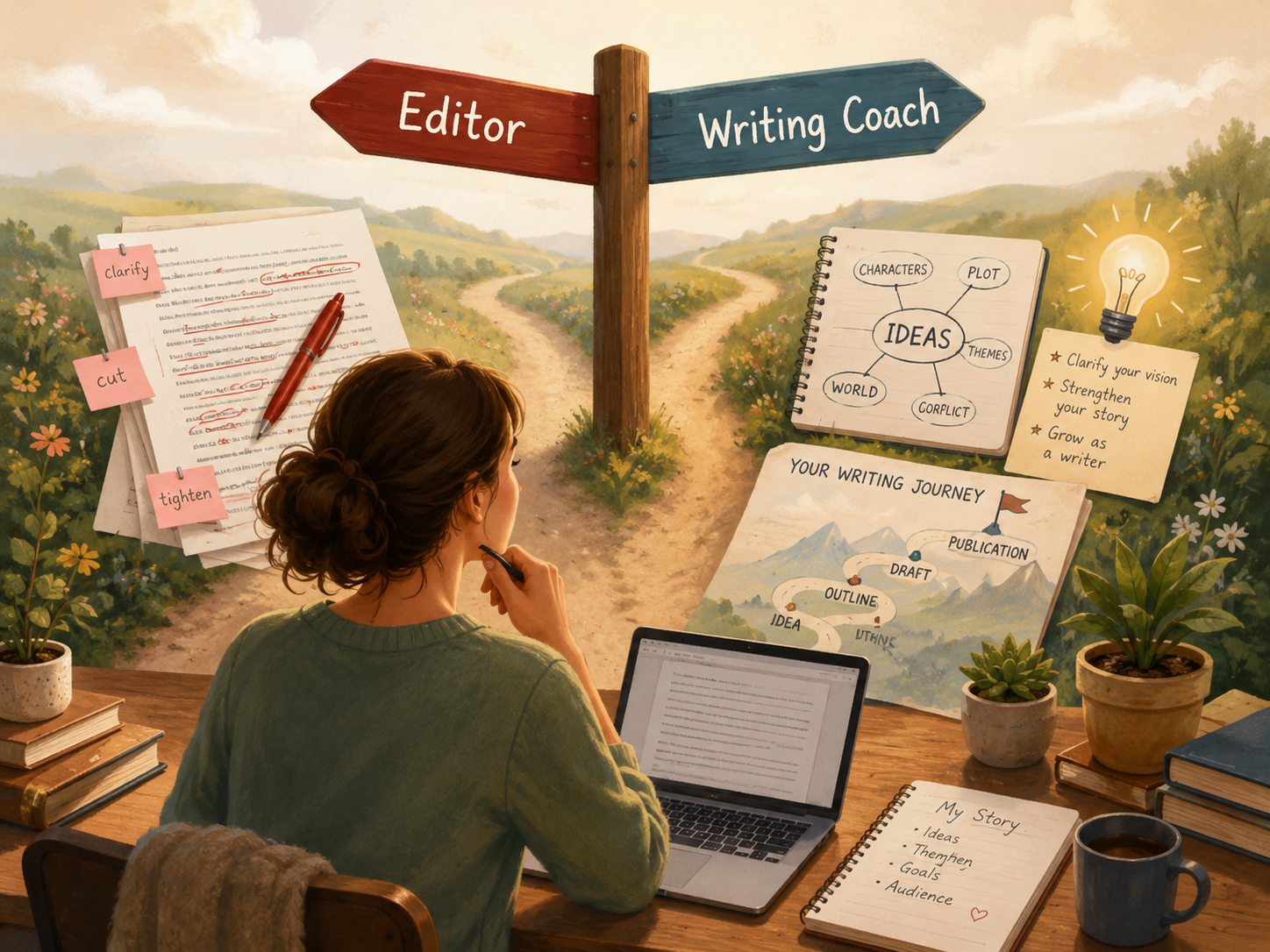
You know your nonfiction book needs help. What you're less sure about is what kind. "Writing coach" and "editor" tend to get tossed around like they're the same service, and plenty of people in the industry blur the line themselves. But a writing coach and an editor do genuinely different jobs, at different stages, for different problems. One helps you produce a manuscript. The other helps you refine one. Hiring the wrong one at the wrong time is an expensive mistake. So let's settle the writing coach vs. editor question for nonfiction writers, so your money is spent on elevating your book and moving it forward.
What a Writing Coach Does
A writing coach works with you while you're writing. You’ve got someone in your corner through the messy, uncertain middle part of a project—the stretch where most books quietly die.
Coaches help with momentum, accountability, and the day-to-day discipline of getting words on the page. A good one helps you set realistic goals, talks through structure before you've committed 40,000 words to the wrong one, and helps you troubleshoot when you're stuck. Some coaches teach craft directly. Others act more like a strategic partner who asks the right questions until you find your own way through.
What a coach generally won't do is take your finished pages and mark them up line by line. Their work is about you—your process, your habits, your confidence. The manuscript gets better as a byproduct of you getting better.
What an Editor Does
An editor works on the page, not the process. You hand over your writing, and they provide suggestions directly on the page to improve it. You can accept or reject those suggestions.
Beyond that, there are several types of editing, depending on what the manuscript needs.
Developmental editing tackles structure and argument.
Line editing works at the sentence level—voice, rhythm, flow.
Copy editing handles grammar and consistency.
Proofreading is the last polish before you publish.
But the common thread is this: editors respond to writing that already exists. They are product-focused, not process-focused. You hire an editor to elevate what you've already written.
The Real Difference: Where You Are in the Process
The cleanest way to tell these two apart is to forget the job titles and ask where you are.
If you're still writing—the draft isn't done, you keep stalling, you're not even sure the thing holds together—you're in coaching territory. A coach helps you produce the manuscript.
If you have a draft—rough is fine, but it needs to be a real, complete one—you're in editing territory. An editor helps you refine it.
Signs You Need a Writing Coach
You haven't finished a draft, and some part of you suspects you won't.
You start strong and lose steam around the middle, every single time.
You have the expertise or the story, but no idea how to shape it into a book.
You need accountability—someone expecting pages from you on a schedule.
This is your first book, and you’re overwhelmed.
If a few of those land, your money is better spent on coaching (or a structured writing program) than on editing. There's no sense paying someone to polish a manuscript that doesn't exist yet.
Signs You Need an Editor
You have a finished draft and know it needs work—you just can't always name what.
You've taken it as far as you can on your own, including self-editing, and need fresh, professional eyes.
You're getting ready to query agents or self-publish and want the writing as sharp as possible.
Beta readers keep flagging the same issues, and you want an expert read on what's really going on.
If you're nodding along, you're ready for editing. The only thing left is figuring out which type—and that hinges on whether your manuscript needs structural work or sentence-level refinement.
Where the Two Overlap
Here's where the line blurs, because it isn't always clean.
Developmental editing, in particular, shares DNA with coaching. A developmental editor diagnoses big-picture problems—structure, argument, pacing—and guides your revision without rewriting the book for you. That guiding role can feel coach-adjacent. The difference is timing and form: a developmental edit responds to a complete draft and arrives as a defined deliverable, usually an editorial letter plus margin comments. Coaching is ongoing and forward-looking. Developmental editing is a high-level assessment of the work you've already done.
Some professionals offer both, and the roles hand off naturally—a coach gets you to a finished draft, an editor helps you make it publishable. They aren't rivals. They're tools for different stages. For example, I offer both and, more often than not, incorporate a small degree of coaching into my editing services, as all of my clients turn out to be better writers by the end of our collaboration (and hopefully, have learned a thing or two they can use moving forward).
So, Which One Do You Need?
Let’s just strip it down to a single question: Do you have a complete draft?
If the answer is no, you need a coach—or build the writing habits that do a coach's job. If the answer is yes, you're ready for an editor, and the only thing left to sort out is which kind.
If you've got a draft and aren't sure what it needs—or whether it's even ready for editing yet—reach out. Sometimes a short conversation is all it takes to figure out where you are and what will actually help.
Signs Your Nonfiction Manuscript Is Ready for Editing (or Not Quite Yet)
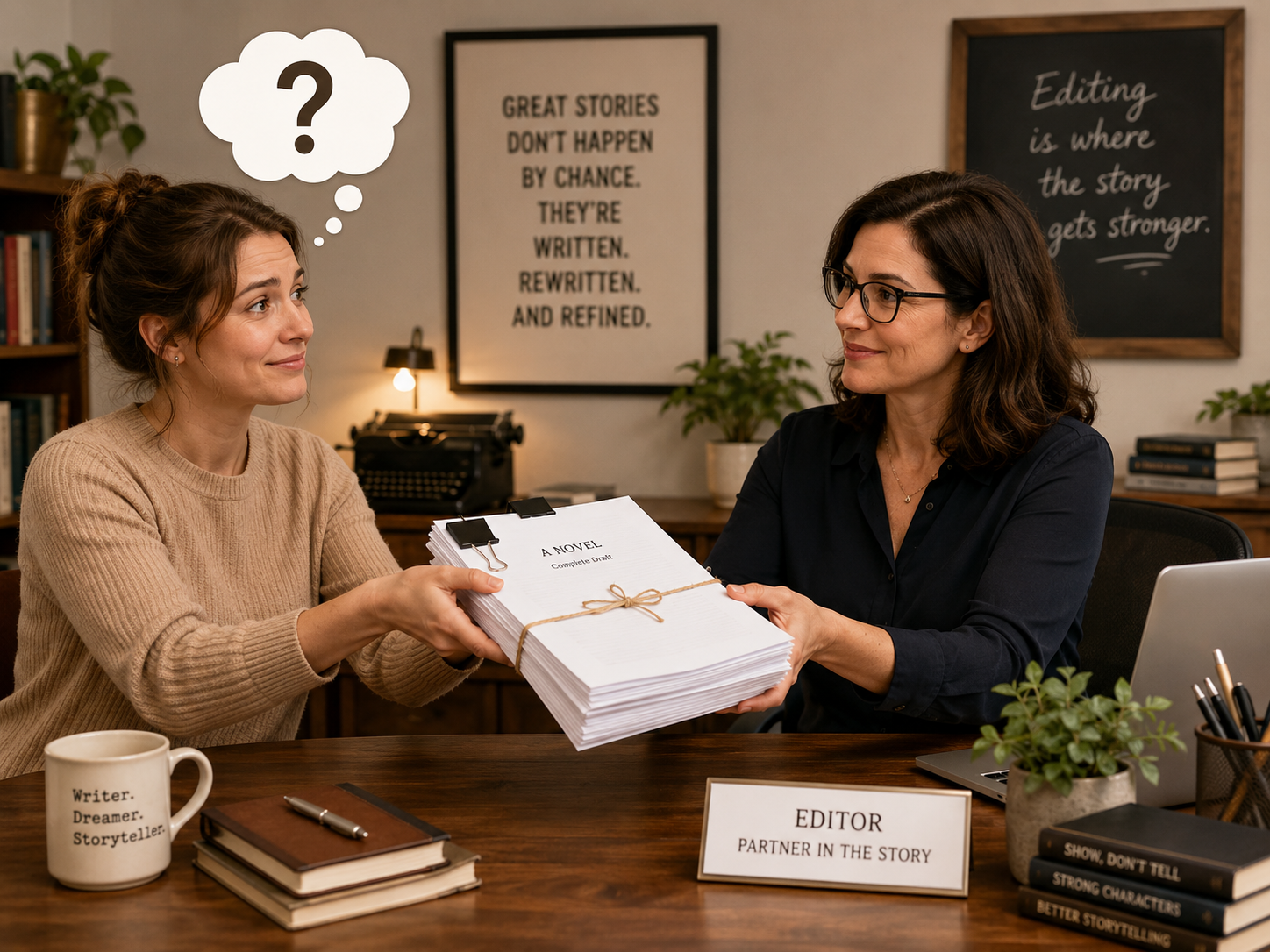
Every writer hits the same crossroads eventually. You've poured months—sometimes years—into your manuscript, and now you're staring at it, wondering whether it's time to bring in a professional or whether you'd just be handing over a draft that isn't there yet.
It's a fair question, and knowing when to hire an editor matters more than most writers realize. Bring one in too early, and you risk paying someone to point out problems you or a beta reader could have caught—or worse, paying for careful work on material you end up cutting anyway. Wait too long, and you can spend months spinning your wheels, polishing a manuscript that needs an outside set of eyes to move forward.
After years of editing nonfiction, I've gotten pretty good at reading the signals on both sides. And almost every writer I work with says the same thing afterward: they wish they'd known the signs sooner. Here's how to figure out where you stand.
You've Finished a Complete Draft
This is the big one. Before you hire an editor, you need a finished draft—beginning, middle, and end. It just has to be complete, not polished.
I can't tell you how many writers reach out when they're a third of the way in, hoping an editor can help them figure out where the book is going. I understand the impulse. But editing a partial manuscript is like asking a contractor to inspect a house with no roof and half the walls still missing. There's not enough there to assess. Finish the draft first, however rough it turns out. A messy, complete manuscript gives an editor something real to work with.
If you are absolutely stuck in the last third of your book but you are clear on its trajectory, then you would need a writing coach—not an editor—to help you get to the end.
You've Already Revised at Least Once
A first draft fresh off the keyboard is not going to be ready for professional editing—unless you’re Stephen King. Countless successful writers say that writing is revision, revision, revision. I just took David Sedaris’s MasterClass, and he said he will rewrite the opening of a short story 14 times before he is convinced he has the right version. Sedaris is a prolific, seasoned writer. You’d think it would come to him, maybe by the third try. But 14 times! In the class, he showed some of the opening rewrites that didn’t make the cut, and even though they were beautifully written, they didn’t create the setup that he was going for. That’s why writing is truly a craft.
If you’re feeling urgency, this next thing may be hard to do, but it works. Step away from the manuscript for a week or two, then come back and revise with fresh eyes. That distance lets you catch the rambling sections, the point you accidentally made twice, the place where you buried your real insight under three paragraphs of throat-clearing.
And if you haven't done a self-editing pass yet, that's your next move, not hiring an editor. (I walk through exactly how to approach this in my post on self-editing your manuscript). Handing over a draft you've already tightened means you're paying for refinement instead of cleanup.
You've Taken It As Far As You Can
You've read the manuscript so many times, you can no longer tell what's working. You've revised it, reorganized it, gone back and tinkered some more, and now you're just moving commas around. Something feels off, but you can't name it.
You’ve just hit the wall of self-editing. You know your material so well that you've lost the ability to read it as a stranger would, which is exactly the perspective a book needs before it goes out into the world. When you hit that wall, it's a strong sign you're ready for an outside reader.
You Know What You're Asking For—Or You're Ready to Find Out What You Need
You don't need to walk in with a perfect diagnosis. But it helps to have a sense of whether you're after big-picture structural feedback, sentence-level polish, or a final proofread. These are different services at different price points, and matching the right one to your manuscript's actual stage saves you real money. If you're unsure which you need, that's a conversation worth having before any work begins. (My breakdown of the different editing types is a good place to start sorting that out.)
So those are the green lights. Now for the other side.
You're Still Making Major Changes
If you're rethinking your structure, cutting whole chapters, or debating what the book is even about, you're not ready—and that's completely fine. Questions like these are worth resolving before line-level work begins, because there's no sense in perfecting prose that might not survive the next round of revision. Sometimes a developmental editor is the right partner for this stage. But if you're still in the process of shaping the book, give yourself room to do that work first.
You're Looking for Reassurance More Than Feedback
Be honest with yourself here. Are you hiring an editor because your manuscript needs sharpening, or because you want someone to tell you it's good? I say that with affection, because every writer feels the pull. Editing is a process of making your work better, which means it involves hearing what isn't landing yet. If you're not in a headspace to receive that, a little more time might serve you better than a little more money.
You're Hoping the Editor Will Do the Hard Part
A good editor diagnoses and guides. They don't write your book for you. If part of you is hoping to hand off a thin draft and get back a finished manuscript, that expectation will disappoint everyone involved. The revision is yours. An editor helps you see it more clearly so you can do it well.
When You're Somewhere in Between
Most writers don't land cleanly in one camp. You've finished a draft and revised it once, but you're still uneasy about the structure. You've taken it as far as you can, but you're not sure it's far enough. That uncertainty is common, and it's exactly where a conversation helps to clarify where you are and what you need. You don't have to figure that out alone.
Not Sure Where You Stand?
If you've read this far and you're still uncertain whether your manuscript is ready for editing, that uncertainty is worth talking through. Reach out, and let's figure out where you are in the process and what kind of support would move your work forward.
What to Expect When Working With a Nonfiction Editor

Handing your manuscript to an editor for the first time feels a little like handing someone your journal and asking them to mark it up in red pen. You've lived with these pages for months, maybe years. You know every soft spot, every paragraph you wrestled with at 2 a.m. and never quite fixed. And now a stranger is going to read all of it.
I get it. As an editor, I've watched plenty of writers approach that first handoff with their shoulders up around their ears. I don’t blame them. It’s an incredibly brave thing to do.
But let me pull back the curtain for a minute. Most of the anxiety around the nonfiction editing process comes from not knowing what happens once you hit "send." When you understand what goes on during the editing process, that anxiety dissipates quite a bit. Here's a behind-the-scenes look at what working with an editor looks like, from first contact to final file.
Conversation First
Before a single word is edited, a professional editor wants to understand your vision. What triggered you to write the book? Where are you in the process? Who are your readers? What's keeping you up at night about it?
That first conversation is about determining what kind of editing service your manuscript needs. Sometimes a writer asks me for a line edit when their manuscript has a structural problem that has to be solved first. Catching that early saves you money and spares you the frustration of polishing sentences that may be cut.
Many editors will also do a short sample edit of a few manuscript pages so you can see how they work before you commit. It also helps determine whether you and the editor will be a good fit. Some editors charge for an editing sample; others don’t. Either way, it’s a valuable test drive that will either reassure you as you move forward or help to refine what you do and don’t want in an editor.
The Writer-Editor Relationship: A Strategic Partnership
Savvy editors are not teachers who are going to mark up your manuscript in red to get you to comply with their agenda. We don’t judge the quality of your writing. And good editors do not rewrite your prose to sound more like they think you should sound. A nonfiction editor's job is to help you sound like the clearest, sharpest version of yourself on the page.
The best editing is invisible. When it works, readers don't notice the edits—they just feel like the writing flows, the argument holds, and the story lands. But the only way to achieve that is to have a meeting of the minds. You articulate high-level goals for your book. And that vision informs how the editor applies best practices, experience, and a style guide.
I once worked with an author who'd recorded dozens of videos for his audience before he ever wrote a word of his book. I watched them, read his social posts, listened to how he actually talked. The point wasn't to impose a style—he had that in spades, bowtie and all. The point was to honor and protect his voice so that it remained intact throughout the edits. That's the spirit of the writer-editor collaboration: your editor is in your corner, working to realize the book you intended.
What You'll Actually Receive
This part varies by the type of editing and editor, but the deliverables are more concrete than you may think. Here’s what I provide:
Developmental editing.
An editorial letter that walks through what's working, what isn't, and how to strengthen the structure and argument. It's a chapter-by-chapter roadmap for your revision, not a list of failures.
You’ll also get comments on the manuscript itself, referring to suggested high-level changes. These comments may point to redundant/repetitive content, inconsistencies, or a gap in logic.
As of this writing, I just did a developmental edit where I also included a “Heading Map” by chapter, so the writer could more easily understand the content included in each chapter. This heading map was needed because the edit required a complete overhaul of the original manuscript.
Line, copy editing, and proofreading.
Your manuscript typically comes back as a tracked-changes document. You'll see every suggested edit right in the text, alongside margin comments that explain the reasoning.
You'll also get queries: questions only you can answer. "You mention this study in Chapter Two, but a different figure here—which is correct?"
I also provide insights that may help with clarity or make the prose more compelling.
You Are in the Driver's Seat
Tracked changes can look alarming when you first open the file. A page lit up with revisions feels like a verdict. It isn't.
Every single change is a suggestion you can accept, reject, or modify. The manuscript is still yours, and so is the final call on every comma. A good editor expects pushback and welcomes it, because the back-and-forth is where the real refinement happens. If a suggested edit changes your meaning or flattens a line you love, say so. You won't hurt anyone's feelings. You'll make the book better.
This is what people mean when they call editing a partnership rather than a service. You bring the expertise and the vision. Your editor brings the outside eyes and the craft. Neither of you could produce the finished book alone.
Timelines, Cost, and Communication
Editing takes time, and the deeper the edit, the longer it runs. Developmental work on a full manuscript can take several weeks; a proofread of a finished, formatted file moves much faster. Your editor should give you a clear timeline up front, along with how they prefer to communicate along the way—email check-ins, a mid-project call, or a single handoff at the end.
Cost tracks with depth, too. Developmental and line editing are more labor-intensive and priced accordingly, while proofreading sits at the lighter end. Reputable editors base their rates on industry benchmarks rather than pulling numbers from thin air, so don't be shy about asking how a quote was built. Clarity here protects both of you.
One thing worth knowing: the cleaner your draft is going in, the less time an editor spends untangling basics, and the more of your budget goes toward elevating your prose. Self-editing before you hire pays for itself.
The Last Word
Working with an editor is not about handing over custody of your manuscript. You are always in control. You gain a strategic collaborator whose entire job is to help your words land exactly the way you meant them to.
The Writer–Editor Relationship: What Collaboration Should Look Like
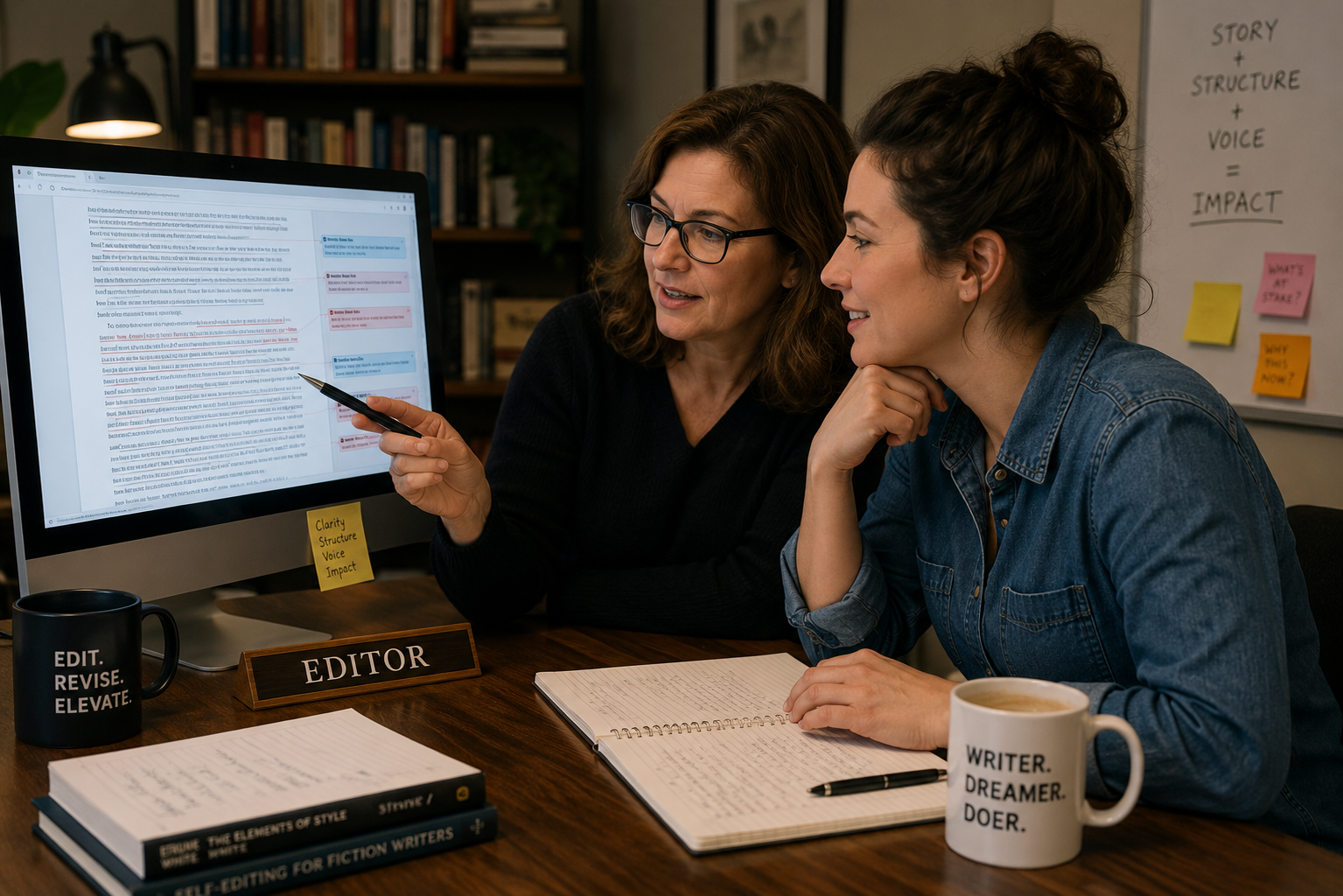
The first time you hand your manuscript to an editor, it can feel like handing over a child. You've lived with these words for months, maybe years. And now some stranger is going to mark them up, point out the flaws, and—you secretly fear—tell you the whole thing was a mistake.
I get it. I've watched that fear show up in writers who've published before and writers who've never put a word out in public. So let me put one worry to rest right away: working with an editor isn't about someone taking a red pen to your work and handing it back covered in corrections you're expected to obey. At least, that's not how I do it, and it's not how good editing works.
What actually happens is closer to a partnership. And the writers who get the most out of the process are the ones who expect that going in.
It Starts With Your Voice, Not My Preferences
Before I change a single sentence, my job is to understand how you sound. Everyone has a natural rhythm on the page—the words you reach for, the way you build an argument, the jokes you can't help making. That's your voice, and it's the most valuable thing in your manuscript.
A while back, I was tasked with taking a bunch of blog posts and papers written by my client and structuring all that content into a book. He also had a website and a YouTube presence, which I studied. We may have Zoomed one time, but we did a lot of messaging back and forth and shared a couple of relevant personal details. Throughout the process, I not only had a grasp of his voice, but I also understood how he thought. When we were wrapping up, he said that it felt like I was in his head.
That's the heart of writer-editor collaboration. A good editor doesn't impose a house style on you. They learn your voice well enough to help you sound more like yourself, not less.
You're Still the Author
Here's something that surprises a lot of first-time clients: when I send back a line edit, every change is a suggestion. You can accept it, reject it, or rewrite it your own way. The tracked-changes document isn't a verdict—it's a starting point for a conversation.
I'll often leave comments explaining why I suggested something: "this paragraph repeats the point you made two pages back," or "I think you're burying your strongest line at the bottom here." But you know things about your book that I don't. You know what you're trying to say, who you're saying it to, and what you're willing to cut. When a writer pushes back on an edit with a good reason, that's the process working exactly as it should.
The authority stays with you. I'm there to give you the clearest possible picture of how your words land so that you can make better decisions about them.
The Back-and-Forth Is the Point
People sometimes imagine editing as a single hand-off: you send the file, I fix it, you publish. Real collaboration is messier and a lot more useful than that.
A developmental edit, for instance, usually comes back as an editorial letter—a few pages walking through what's working, what isn't, and why. Then you sit with it. You decide what to change. You might reorganize chapters, cut a section you loved, or write something new to fill a gap I flagged. After that, we often talk it through. Questions come up. You explain what you were going for, and suddenly the fix becomes obvious to both of us.
One client I worked with on a business book had reorganized his chapters more times than he could count and still wasn't confident. He didn't need me to rewrite anything. He needed a fresh set of eyes to tell him which version actually served his reader. We figured it out together, and he finished ahead of his deadline—on a book he'd called me, a little panicked, to ask whether he even had a book.
What I Need From You
Collaboration runs both directions, so here's my side of the bargain and yours.
Be honest about where you are and what you want. Maybe you're querying agents. Maybe you're self-publishing, or writing something for a narrow professional audience. You could be writing a book that you’ll use more like a business card and a marketing tool to establish credibility and attract clients.
Do you know what kind of editing you need? Deep structural feedback? A final polish before it goes out the door? The more I understand your goals, the more useful my edits become. I'd rather you tell me up front that you're attached to a certain chapter than spend hours suggesting you cut it.
Most writers don't expect how much I lean on context. The history matters—if an editor took your manuscript partway and then walked, that alone tells me a lot about the seams I'm noticing. But so does everything surrounding the writing itself: how long you've been carrying this book, what your experience on the page has been, even how the people in your life feel about you spending your evenings on it. None of that is small talk to me. It all informs the work.
I need access to you. That means when I have a question during the editing process, your answer may inform my edits on subsequent material. I’ve found the most successful collaborations have a real-time feel with solid momentum.
Why So Demanding?
The reason I'm so particular about all of this is simple: the relationship determines the result.
I've had writers tell me, after the fact, about editors who flattened their personality or rewrote them into someone else—who handed back a marked-up file with no explanation and no conversation. They felt managed, not helped. A few of them nearly gave up on their books because of it. One client was convinced that the editor ran her manuscript through an AI platform that marked it up. She had paid professional rates.
That's the opposite of what editing should be. When the collaboration works, you don't come away feeling like your book was taken from you and returned in someone else's handwriting. You come away with a manuscript that's unmistakably yours, just sharper and more assured than the version you handed over.
That's the whole goal. Not to make you sound like me—to help you say exactly what you mean.
The Last Word
If you're thinking about working with an editor and you're not sure what the process would actually look like for your project, reach out. I'm always happy to talk through where you are, what you're trying to accomplish, and whether we'd be a good fit. No pressure, no judgment—just a conversation about your writing.