The 5 Most Common Mistakes Writers Make (And the Simple Fixes)
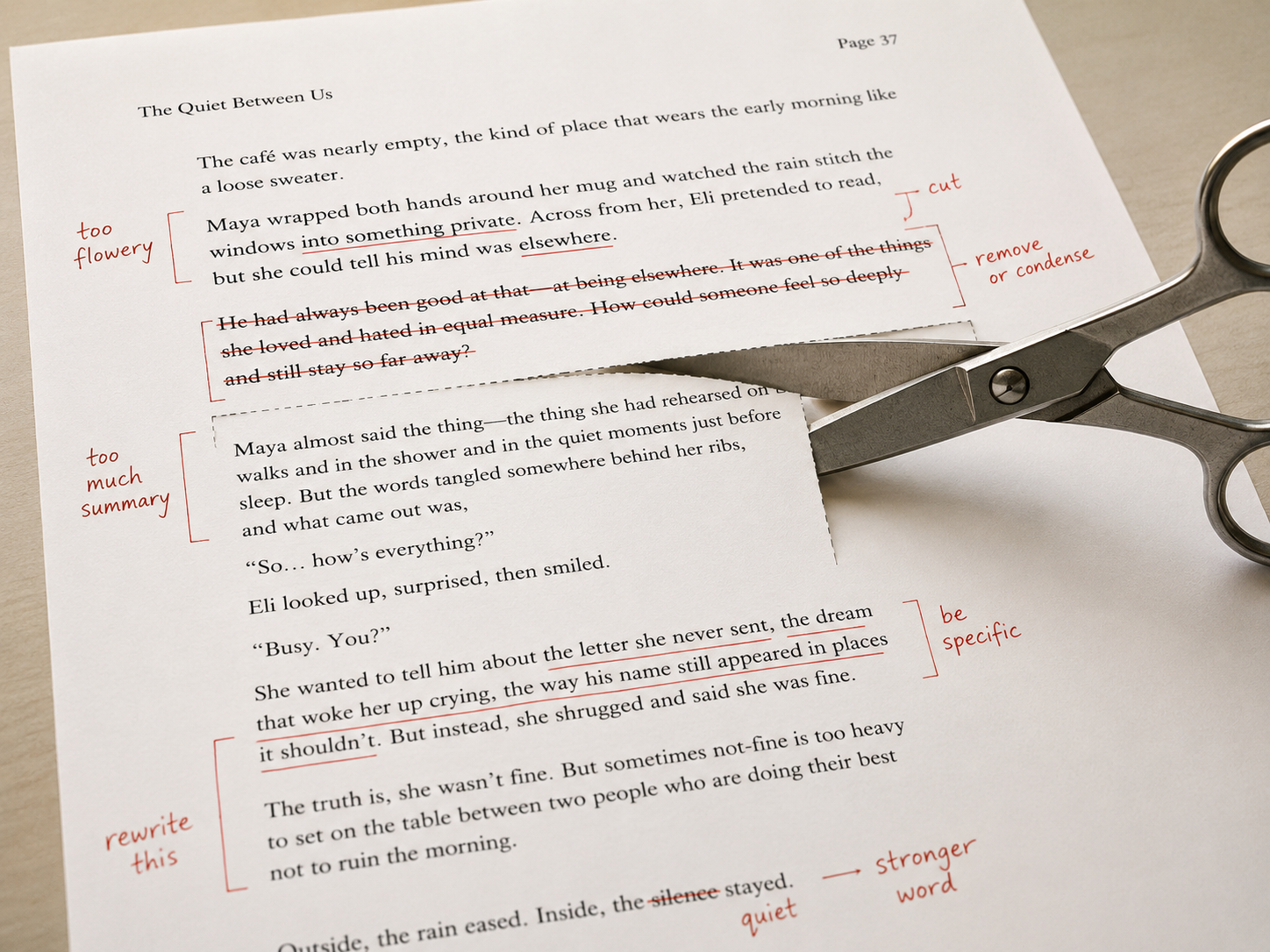
After nearly a decade of editing content on Upwork, I've seen just about everything. I've worked with debut novelists and seasoned authors. I edited a memoir dictated by a writer with unmanaged ADHD and dyslexia who couldn't type her own story but could tell it beautifully. I've worked on content ranging from a white paper about the intricacies of land surveying to a hysterical mob crime novel. Despite the diversity of writers and subject matter, a common truth always surfaces: good writing is good writing.
But what also pops up are consistent mistakes that seem to be both subject- and writer-agnostic.
I don't say that to discourage you. Actually, it's the opposite. If nearly every writer struggles with the same handful of issues, that means these aren't personal failings—they're just part of the craft. They're learnable. Fixable. And once you know what to look for, you can start catching them yourself.
So let's walk through the five mistakes I see most often and talk about how to address them.
1. Overwriting
If I had to pick a single issue that shows up in nearly every project I touch, it's overwriting—using more words than necessary to say what needs to be said.
Overwriting takes many forms. Sometimes it's purple prose: elaborate descriptions that call attention to themselves rather than serving the content. Sometimes it's redundancy: saying the same thing twice in slightly different ways, as if the reader didn't catch it the first time. Sometimes it's over-explaining: not trusting your audience to understand what you're communicating, so you spell it out in exhausting detail.
Here's the thing: more words don't equal more clarity or greater impact. Often, it's the reverse. Toni Morrison once said, "I have been more impressed with myself when I can say more with less." She understood that economy of language creates power. Every word has to earn its place on the page. In other words, you can often say more with fewer words. I once read that Stephen King despises adverbs. He said adverbs are indicative of lazy writing because you can create the same effect with a stronger verb.
The fix: After you've finished a draft, go back through with one question in mind: What can I cut? Look for places where you've said the same thing twice. Look for adjectives and adverbs that aren't doing real work. Look for explanations that follow points you've already made clearly. Trust your reader to meet you halfway.
2. Vague Language
This one is sneaky because it often feels like writing. You've put words on the page. They form sentences. The sentences form paragraphs. But when I read them, I'm left asking: What are you really trying to say here?
Vague language shows up as abstractions without examples, generalizations without specifics, and descriptions that gesture toward something without landing on it. "It was an interesting experience." "The results were significant." "She had a difficult childhood." These sentences tell the reader almost nothing. They're placeholders where concrete details should live.
Strong writing is specific. It gives readers something to see, to hold onto, to understand. Researcher and educator Peter Elbow calls this "rendering" versus "explaining"—the difference between showing your reader the thing itself and merely pointing in its general direction. It’s akin to the adage about writing, “Show, don’t tell.”
The fix: When you revise, hunt for vague words like "interesting," "significant," "very," "really," and "things." Each time you find one, ask yourself: Can I replace this with something concrete? Instead of "she had a difficult childhood," what specifically happened? Instead of "the results were significant," what were the numbers? Specificity builds credibility and keeps your reader engaged.
3. Weak Transitions
I’ll come across this one on every writing project. The thing is that you’ll have these very well-written paragraphs and sections that don't connect in any way. The reader finishes one thought, moves to the next, and feels a small jolt of confusion. Wait—how did we get here?
Transitions are the connective tissue of your writing. They tell your reader how one idea relates to the next. Are you building on the previous point? Contradicting it? Shifting to a new topic entirely? Without clear signals, readers have to work harder than they should to follow your logic.
This is especially common in narrative nonfiction and memoir, where writers sometimes organize their material in ways that make perfect sense to them—because they know the full story—but leave readers disoriented. The path that feels obvious to you isn't always obvious on the page.
The fix: Read your draft specifically for flow. Read the last sentence of a paragraph and the first sentence of the next. And ask, Is there a bridge between these two sentences? Sometimes a single word ("However," "Meanwhile," "Later") does the work. Sometimes you need a sentence that explicitly bridges two ideas. You aren’t overexplaining. You’re guiding your reader smoothly from one point to the next.
4. Burying the Lead
Burying the lead is when you hide your main point under layers of setup, context, or throat-clearing. By the time you get to your thesis, your reader has already checked out.
It shows up everywhere. Opening paragraphs that spend too long setting the scene before anything happens. Chapters that take five pages to arrive at the insight they're building toward. Even individual sentences that back into their meaning instead of leading with it.
Sometimes this happens because writers are warming up on the page, finding their way into what they want to say. That's fine in a first draft—but it shouldn't stay in the final version. Other times, writers worry that stating something directly will seem abrupt, so they cushion it with context. But readers don't need as much cushion as you think. They'd rather you get to the point.
The fix: Look at your opening paragraphs—for the whole piece and for each section. Where does the actual content begin? Often, you can cut the first few sentences (or the first few paragraphs) entirely and lose nothing. Start where things get interesting. You can always weave in necessary context later.
5. Losing Your Voice
Every writer has a voice. It's the rhythm of your sentences, the words you naturally reach for, the personality that comes through on the page. When your voice is present, your writing feels alive and distinctly yours. When it disappears, your writing goes flat.
Voice gets lost for a few reasons. Sometimes writers try to sound "more professional" or "more literary" than they naturally are, and the result feels stiff and borrowed. Sometimes they've been editing so long that they've sanded away all the texture. Sometimes they're writing about a topic that intimidates them, and their natural confidence vanishes.
The writer who dictated her memoir? Her voice was phenomenal—funny, raw, and completely hers. She wasn't worried about sounding like a "real writer." She was just telling her story. That's what voice sounds like when it's left alone.
The fix: Read your draft aloud. Does it sound like you? Are there places where the prose suddenly feels stiff or unnatural? Those are the spots where your voice has slipped. Sometimes the fix is as simple as asking: How would I say this if I were talking to a friend? Write that down. It's probably better. A really cool piece of technology I discovered recently is a text-to-voice app called Speechify (I’m sure there are plenty of others) that reads the text I’m editing in a chosen voice and at a desired speed. I’m amazed at how a sentence can read fine on paper but come across unnaturally when spoken. And it’s kind of cool to have President Obama or Gwyneth Paltrow read your writing!
Why This Matters Beyond the Writing
Here's something worth knowing: the cleaner your manuscript, the less time an editor needs to spend on it. That translates directly into cost and turnaround time. If I'm spending hours untangling vague language or flagging sections that need stronger transitions, that's hours you're paying for. But if you've already addressed these common issues, we can focus on refining your voice and elevating your prose—the work that makes good writing great.
I'm not saying you need to hand over a perfect draft. That's not realistic, and it's not the point. Editing exists because every writer benefits from a second set of eyes. But understanding these patterns helps you become a stronger self-editor. By the time you work with an editor like me, your writing will be elevated, making our work together more productive—and more satisfying for both of us.
The Last Word
These five mistakes are not writing failures. They’re signs that you are writing—doing the hard, necessary work of getting ideas onto the page. Every writer I've worked with, regardless of genre or experience level, has grappled with at least one of these issues. Most have grappled with all of them at some point.
The goal at this point is awareness. Once you know what to look for, you can start making intentional choices about your prose. And that's where the real growth happens.
Not sure where your manuscript stands? Sometimes it helps to have a professional take a look. Reach out and let's talk about what kind of editing support might move your work forward.
Sources
Elbow, Peter. Writing With Power: Techniques for Mastering the Writing Process. Oxford University Press, 1998.
Zinsser, William. On Writing Well: The Classic Guide to Writing Nonfiction. Harper Perennial, 2006.