
Blog
Whether you’re outlining your first chapter or polishing your final draft, you’ll find practical guidance, editorial insight, and a steady nudge forward.
Browse by Topic
-
Editing & Revision
- Jul 28, 2026 A Realistic Timeline for Writing and Editing a Nonfiction Book Jul 28, 2026
- Jul 23, 2026 Why Great Editing Preserves Your Voice (Instead of Editing It Out) Jul 23, 2026
- Jun 27, 2026 What Is Copyediting, and When Do You Need It? Jun 27, 2026
- Jun 27, 2026 What Is Proofreading? Your Manuscript's Last Line of Defense Jun 27, 2026
- Jun 27, 2026 What Is Line Editing? The Service That Sharpens Your Voice Without Replacing It Jun 27, 2026
- Jun 20, 2026 Developmental Editing for Nonfiction: What It Is and When You Need It Jun 20, 2026
-
Editing Tips
- May 21, 2026 What Type of Editing Does Your Manuscript Need? May 21, 2026
- May 19, 2026 How to Self-Edit Your Nonfiction Manuscript May 19, 2026
-
Getting Started
- May 12, 2026 How to Outline a Nonfiction Book (With Templates and Examples) May 12, 2026
- May 8, 2026 How to Turn Your Expertise Into a Compelling Book May 8, 2026
- May 8, 2026 How to Start Writing a Nonfiction Book (When You Don’t Know Where to Start) May 8, 2026
-
Memoir/Personal Narrative
- Jun 30, 2026 How to Write a Memoir That Doesn't Read Like a Diary Jun 30, 2026
-
Reader Engagement
- Jun 25, 2026 The Psychology of Reader Engagement in Nonfiction Jun 25, 2026
- Jun 23, 2026 How to Build Credibility and Trust as a Nonfiction Author Jun 23, 2026
- Jun 9, 2026 Using Research In Your Writing Without Boring Readers Jun 9, 2026
- Jun 4, 2026 The Art of Clarity: How to Write Complex Ideas Simply Jun 4, 2026
-
Storytelling
- Jun 23, 2026 Storytelling in Nonfiction Writing Jun 23, 2026
-
Structure
- Jun 20, 2026 Developmental Editing for Nonfiction: What It Is and When You Need It Jun 20, 2026
- Jun 11, 2026 How to Craft a Strong Central Argument for Your Nonfiction Book Jun 11, 2026
- Jun 4, 2026 The Art of Clarity: How to Write Complex Ideas Simply Jun 4, 2026
- May 14, 2026 How to Structure a Nonfiction Book for Maximum Clarity and Impact May 14, 2026
- May 12, 2026 How to Outline a Nonfiction Book (With Templates and Examples) May 12, 2026
-
Writer Editor Collaboration
- Jul 21, 2026 Red Flags When Choosing a Nonfiction Editor (and What to Look For Instead) Jul 21, 2026
-
Writer-Editor Collaboration
- Jul 16, 2026 Writing Coach vs. Editor: Which One Do You Need? Jul 16, 2026
- Jul 14, 2026 Signs Your Nonfiction Manuscript Is Ready for Editing (or Not Quite Yet) Jul 14, 2026
- Jul 9, 2026 What to Expect When Working With a Nonfiction Editor Jul 9, 2026
- Jul 2, 2026 The Writer–Editor Relationship: What Collaboration Should Look Like Jul 2, 2026
-
Writing Mindset
- Jul 16, 2026 Writing Coach vs. Editor: Which One Do You Need? Jul 16, 2026
- Jul 14, 2026 Signs Your Nonfiction Manuscript Is Ready for Editing (or Not Quite Yet) Jul 14, 2026
- Jul 9, 2026 What to Expect When Working With a Nonfiction Editor Jul 9, 2026
- Jul 2, 2026 The Writer–Editor Relationship: What Collaboration Should Look Like Jul 2, 2026
- Jun 25, 2026 The Psychology of Reader Engagement in Nonfiction Jun 25, 2026
- Jun 23, 2026 The Mindset Shift Every Writer Needs Jun 23, 2026
- Jun 23, 2026 How to Build Credibility and Trust as a Nonfiction Author Jun 23, 2026
- May 28, 2026 The 7 Habits of Great Writers May 28, 2026
-
Writing Process
- Jul 28, 2026 A Realistic Timeline for Writing and Editing a Nonfiction Book Jul 28, 2026
-
Writing Tips
- Jun 23, 2026 The Mindset Shift Every Writer Needs Jun 23, 2026
- Jun 23, 2026 Storytelling in Nonfiction Writing Jun 23, 2026
- Jun 11, 2026 How to Craft a Strong Central Argument for Your Nonfiction Book Jun 11, 2026
- Jun 9, 2026 Using Research In Your Writing Without Boring Readers Jun 9, 2026
- Jun 4, 2026 The Art of Clarity: How to Write Complex Ideas Simply Jun 4, 2026
- May 28, 2026 The 7 Habits of Great Writers May 28, 2026
- May 26, 2026 The 5 Most Common Mistakes Writers Make (And the Simple Fixes) May 26, 2026
- May 14, 2026 How to Structure a Nonfiction Book for Maximum Clarity and Impact May 14, 2026
- May 12, 2026 How to Outline a Nonfiction Book (With Templates and Examples) May 12, 2026
- May 8, 2026 How to Turn Your Expertise Into a Compelling Book May 8, 2026
- May 8, 2026 How to Start Writing a Nonfiction Book (When You Don’t Know Where to Start) May 8, 2026
The Mindset Shift Every Writer Needs
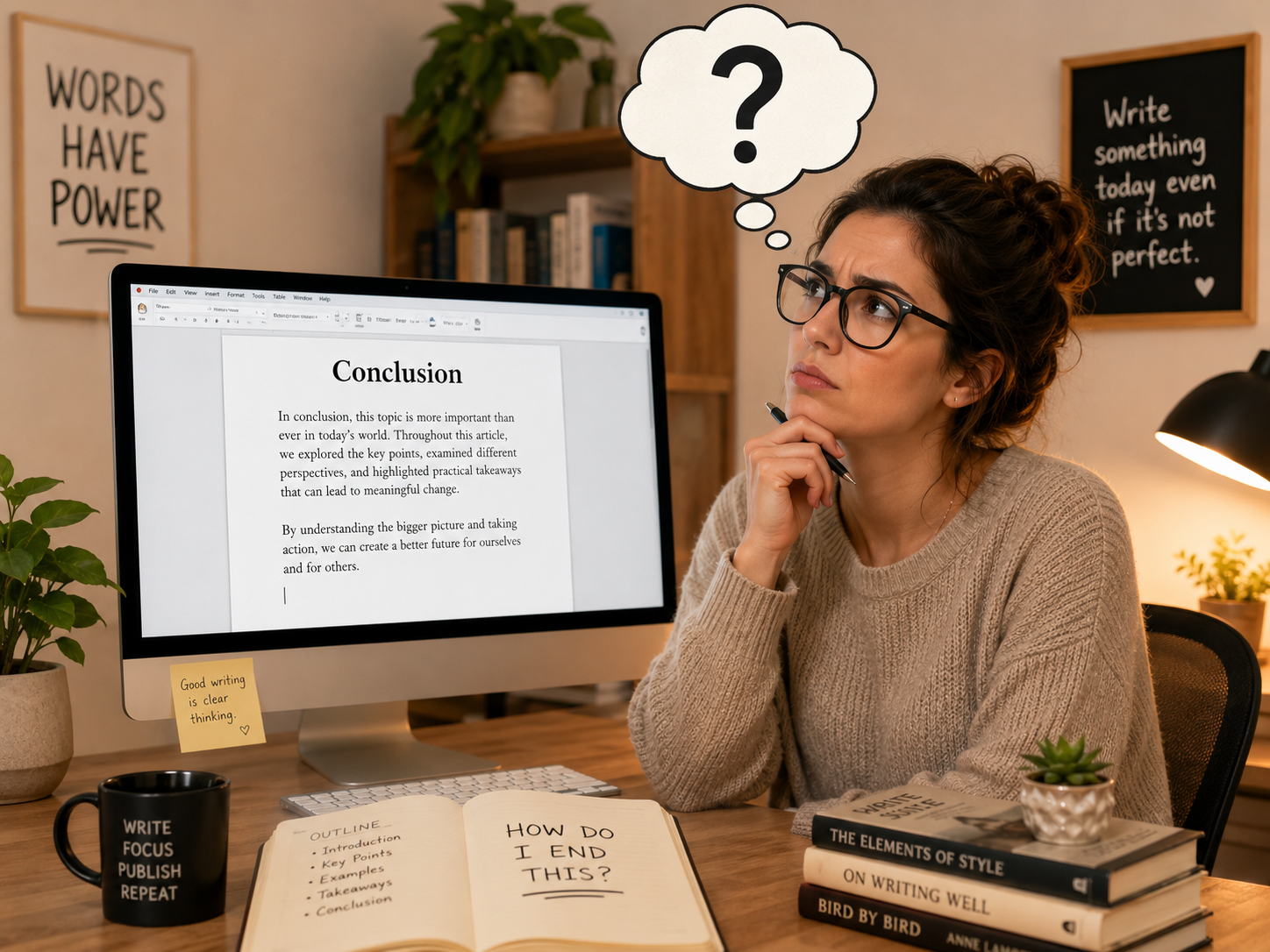
You're stuck.
Maybe you're three chapters from the end and suddenly convinced the whole thing is garbage. Maybe you haven't opened your manuscript in weeks because the thought of facing it makes your stomach clench. Or maybe you keep finding "urgent" tasks—laundry, emails, reorganizing your sock drawer—anything to avoid sitting down with your words.
I feel you. And I have some news that might surprise you: this is completely, frustratingly normal.
The Lie Your Brain Keeps Telling You
Here's what I've learned after years of working with writers: almost everyone, at some point in their manuscript, becomes convinced they're uniquely terrible at this. That they're the only ones struggling while everyone else sails through their drafts with coffee in hand and inspiration flowing like an open faucet.
Psychologists have a name for this feeling. It's called imposter phenomenon, first described by researchers Pauline Rose Clance and Suzanne Imes in 1978. It's that persistent sense of being a fraud—of waiting for someone to discover you have no idea what you're doing—despite evidence that you're actually capable. Research shows that about 70% of professionals experience this at some point in their lives, and writers are certainly no exception.
The cruel irony? The more you care about your work, the more vulnerable you are to this kind of self-doubt. Your inner critic isn't a sign that you're failing. It's a sign that you're invested.
The Mindset That Changes Everything
Stanford psychologist Carol Dweck's research on mindset has revolutionized how we understand achievement and struggle. Her work shows that people tend to operate from one of two belief systems. Some people believe their abilities are fixed—you either have talent or you don't, and no amount of effort will change that. Others believe their abilities can be developed through practice, feedback, and persistence.
That second belief? That's a growth mindset. Along with persistence, it's one of the most important things you can cultivate as a writer.
When you operate from a growth mindset, failure stops being a statement about who you are. It becomes information about what to try next. Dweck's research found that people with a growth mindset are more likely to embrace challenges, persist through setbacks, and ultimately achieve at higher levels—not because they're more talented, but because they're more willing to keep going.
Think about what this means for your manuscript. That chapter that isn't working is in no way proof that you can't write. It's a puzzle to solve. That critical voice that taunts you when you sit down to write has zero credibility. Remember—that inner critic is merely composed of thoughts, which means you can choose not to let them run the show. They’re not the boss of you. You got the wheel here.
Practical Reframes for the Stuck Writer
Let's get specific and get to work. Here are some mindset shifts that can actually get you back to the page.
Replace "I can't do this" with "I haven't figured this out yet." That single word, “yet,” is magic. It acknowledges the struggle without making it permanent. You're not a writer who can't finish. You're a writer in the middle of learning how. It’s true.
Understand that your first draft is just about getting it all down, nothing more. Anne Lamott gave us permission decades ago to write what she calls "shitty first drafts." The purpose of a first draft is to exist. In fact, celebrate that you now have something to work with. You can fix garbage. You cannot fix nothing. (I explore this more in my piece on The 7 Habits of Great Writers—it's habit number three, and it might just save your creative life.)
Separate your identity from your output. A bad writing day doesn't make you a bad writer. A messy chapter doesn't mean you don't have what it takes. Your worth as a creative person isn't determined by how smoothly the words come.
Remember that everyone's process looks different. Some writers draft quickly and revise slowly. Others labor over every sentence. Some write linearly; others jump around. There's no correct way to finish a manuscript—there's only your way.
The Surprising Power of Being Kind to Yourself
Here's something that might feel counterintuitive: being gentle with yourself isn't weakness. It's a sound strategy.
Kristin Neff, a psychologist at the University of Texas, has spent over two decades researching self-compassion. Her findings consistently show that self-compassion is actually a more effective motivator than self-criticism. When we beat ourselves up, we activate the threat-defense system in our brains. We become anxious, avoidant, and less creative. But when we treat ourselves with kindness—the same kindness we'd show a friend in the same situation—we create the psychological safety needed to take risks and keep going.
Neff identifies three core components of self-compassion: kindness toward yourself instead of harsh judgment, recognition that struggle is part of the shared human experience rather than something isolating, and mindful awareness of your emotions without drowning in them.
Applied to writing, this might look like acknowledging that the work is hard today without making it mean something terrible about you. Don’t fall into the trap of thinking a bad writing day means you’re just no good at this, and then chewing on that thought like caramel. Let it go. It’s just a bad session. It might look like remembering that every author whose book you love has sat exactly where you're sitting, wondering if they could pull it off. It might look like noticing your frustration or fear without letting it drive you away from the work.
The Truth About Finishing
Here's what I know to be true after working with hundreds of manuscripts: the writers who finish aren't the ones who never doubt themselves. They're the ones who doubt themselves and keep going anyway. Listen, as of this writing, my writer has before him a completed manuscript (ahead of deadline) ready to be sent to the publisher. But it was only a couple of months ago when he wanted to Zoom to ask me if he really had a book. And he’s already published in a big way. Obviously, we kept going, and here we are with a “real” book.
It’s okay to be filled with uncertainty about your manuscript. But it’s not okay to let your inner critic prevent you from putting butt in chair and writing something, even if it’s terrible. Take it from an editor who knows—terrible can be revised. Nothing cannot.
You may never be able to fully silence the inner critic, but you can change how you meet that voice. Instead of treating it as the final authority on your abilities, treat it as background noise. You can hear it, acknowledge it, and then get back to work.
Your Invitation
If doubt has rendered you too anxious to write—I want to offer you this: you are not broken, and you are not alone. You are experiencing the hard work of writing. That struggle is a sign that you’re a writer, and knowing that is how you move forward.
So close your browser tabs. Silence your phone. Open your manuscript.
And remember: the only way out is through.
Stuck on where to go next with your draft? Sometimes a fresh set of eyes can help you see what's working—and what's keeping you from the finish line. Reach out to me here to talk about how editing support might help you get unstuck.
Sources
Bravata, D. M., et al. "Prevalence, Predictors, and Treatment of Imposter Syndrome: A Systematic Review." Journal of General Internal Medicine, vol. 35, no. 4, 2020, pp. 1252-1275.
Clance, P. R., and S. Imes. "The Imposter Phenomenon in High Achieving Women: Dynamics and Therapeutic Intervention." Psychotherapy: Theory, Research & Practice, vol. 15, no. 3, 1978, pp. 241-247.
Dweck, C. S. Mindset: The New Psychology of Success. Ballantine Books, 2006.
Dweck, C. S., and D. S. Yeager. "Mindsets: A View From Two Eras." Perspectives on Psychological Science, vol. 14, no. 3, 2019, pp. 481-496.
Neff, K. D. "Self-Compassion: Theory, Method, Research, and Intervention." Annual Review of Psychology, vol. 74, 2023, pp. 193-218.
Neff, K. D., et al. "Self-Compassion and Its Link to Adaptive Psychological Functioning." Journal of Research in Personality, vol. 41, no. 1, 2007, pp. 139-154.
Workplace Strategies for Mental Health. "Self-Doubt and Impostor Syndrome." Centre for Applied Research in Mental Health and Addiction, 2022.
Storytelling in Nonfiction Writing

Since you’re writing nonfiction, you might be thinking that storytelling belongs to novelists. That if you're writing a memoir, a business book, a self-help guide, or a deeply reported piece of journalism, your job is to deliver information clearly and let the narrative prose stay out of the way.
It makes sense where this nonfiction writing myth comes from. Nonfiction is supposed to be true, and "story" can feel synonymous with "made up." But here's the reality after nearly a decade of editing memoirs, business books, white papers, and everything in between: the nonfiction that lands with readers—the kind people finish, recommend, and return to—uses the same techniques novelists use. Scene. Character. Tension. Voice. Specificity.
Information alone doesn't move people. Story does. And the good news is that storytelling in nonfiction isn't about inventing anything. It's about shaping what's already true so a reader can feel it.
Let's get into how you can make that happen.
Trade Summary for Scene
A big shift happens when you stop telling readers what happened and start putting them inside what happened. Here’s what I mean. Telling or summary sounds like "My dad and I had an almost nonexistent relationship throughout my childhood." Scene sounds like "My father was reading the newspaper in his recliner, a cigarette between his print-smudged fingers, when I told him I was moving to California with my boyfriend. He lowered the paper, narrowed his eyes, and took a hard pull on his cigarette, then snapped the paper back up. Smoke drifted from behind it.
Both versions are accurate, but only one of them lets the reader feel the weight of the moment.
Known as the godfather of creative nonfiction, Lee Gutkind built a framework around a "scene-by-scene construction" of nonfiction. His point is simple: scenes are the basic building blocks of a story, and nonfiction writers who lean on summary are essentially writing reports. Readers don’t just want to be informed. They wanted to be transported.
But that doesn’t mean you never summarize. Transitions, context, and reflection all require a summary. What you don’t want to do is string together a series of summarized events bound by analysis. Your manuscript is going to read like a textbook.
Treat Real People Like Characters
Your subjects—including yourself, if you're writing memoir—are characters in your book. That means rendering them with the same care a novelist gives to a protagonist, which means specificity. We’re not talking about eye color, height, and weight. What does this person look like when they're nervous? What's their tell? When do they laugh, and when do they refuse to? What's the contradiction at the heart of them—the thing that makes them three-dimensional?
Without these details, even real people in your manuscript will come across as generic people. "My mother was a hardworking woman who valued discipline” doesn’t set the writer’s mother apart from mine. It tells me nothing. "My mother woke up before everybody else and made German pancakes or southern biscuits every single morning of my childhood. She served my father coffee the moment he sank into his chair—even on the days she had one of her debilitating migraines" tells me everything about her standards, her commitment, and maybe something about her self-care.
The same applies if you're writing business or expert nonfiction. The CEO you're profiling, the client whose case study illustrates your method, the historical figure you're tracing—they're characters, too. Find the detail that brings them to life. Skip the resume, find the human.
Use Sensory Detail (And Be Ruthless About Specificity)
Vague language is the enemy of story. I've written about this elsewhere, but it bears repeating in this context: when you describe something in general terms, your reader's imagination has nothing to grip. Make it sticky.
"The restaurant was busy" is a sentence. "Every table was full, and a couple at the bar was arguing in Spanish over a single plate of fries" is a scene.
Sensory detail is what turns abstract prose into something a reader can actually feel. What did the room smell like? What sound was coming from the next apartment? What was the texture of the chair you couldn't stop noticing because you didn't want to be in that meeting? These details are the evidence that you were really there—or that your subject was. They're how you earn the reader's trust.
Build Tension, Even When the Outcome Is Known
Here's a question I hear constantly from memoirists: "How do I create suspense when my reader already knows I survived?"
The answer is that tension in nonfiction doesn't come from wondering what will happen. It comes from wondering how it will happen and what it will cost. Readers don't pick up a memoir about addiction recovery to find out whether the author got sober. They pick it up to understand what it took.
Jon Franklin, who won the Pulitzer Prize for his narrative journalism, argued in Writing for Story that every nonfiction story worth telling has the same essential structure: a complication and a resolution, with a series of developments in between that build pressure on the protagonist. The reader's engagement comes from watching that pressure build.
Practically, this means you have to identify what's at stake in every section of your manuscript. Not just the global stakes ("Will I survive this?") but the local stakes ("Will I make it through this dinner without telling my sister the truth?"). When you articulate what your subject—or you—stands to lose or gain in any given scene, you have tension. When you don’t, you have a summary.
Find the Structure That Serves the Story
Chronological order is the obvious choice, but it isn't always the right one. Some of the most effective nonfiction opens in the middle of the action—a technique novelists call in medias res—and then circles back to fill in context. Some braid multiple timelines together. Some organize around theme rather than time.
The structure you choose should be in service of the experience you want the reader to have. If the most powerful moment in your story is the day you walked out, maybe that's where the book opens, and we spend the rest of the manuscript understanding how you got there. If your business book makes its strongest argument through contrast, maybe each chapter pairs a failure with a success.
This is bigger than the scope of a single post (I get into book structure more deeply in my piece on outlining nonfiction), but the point is that storytelling structure is a choice, not a default. Make it intentionally.
Trust Your Voice
Narrative nonfiction techniques can sound technical, but they only work when they're filtered through a voice that feels like yours. The minute your prose starts sounding like what you think a "real writer" would sound like, you’re not using your voice.
Think of voice as the difference between writing that informs and writing that connects. It's the rhythm of your sentences, the words that naturally surface, the moments when you’re funny or angry or uncertain on the page. Mary Karr puts it bluntly in The Art of Memoir: a memoir without voice is just a chronology. The same is true of any nonfiction.
So as you bring these techniques into your work—scene, character, sensory detail, tension, structure—don't lose yourself in the process. The goal is to use the tools of story to tell your truth in a way readers can feel.
The Last Word
Nonfiction lives or dies on storytelling. You can have the research, the credentials, the lived experience—but if you can't tell a story with it, your reader checks out. The writers who break through are the ones who know how to make a reader lean in.
Want a professional read on whether your storytelling is landing the way you intend? That's exactly the kind of work I do in a line edit. Reach out and let's talk about where your manuscript is and what kind of support might move it forward.
Sources
Franklin, Jon. Writing for Story: Craft Secrets of Dramatic Nonfiction. Plume, 1994.
Gutkind, Lee. You Can't Make This Stuff Up: The Complete Guide to Writing Creative Nonfiction—from Memoir to Literary Journalism and Everything in Between. Da Capo Lifelong Books, 2012.
Karr, Mary. The Art of Memoir. Harper Perennial, 2016.
How to Craft a Strong Central Argument for Your Nonfiction Book
Something's off with your manuscript, and you can't quite name it.
The chapters are solid on their own. The writing is decent. But when you read the whole thing through, it feels scattered—like a collection of related essays rather than a single, building case. You've reorganized it twice and it still doesn't cohere. You suspect the problem is structural, but every time you go looking for it, you end up rearranging chapters and hoping it sticks.
When a book feels structurally broken, many times the problem isn't the structure at all. It's that there's no clear central argument holding the structure together. You can't organize chapters around a throughline that doesn't exist yet.
Get the argument right, and the structure tends to fall into place on its own. Let's get to it.
The Real Source of Mushy Structure
Most structural problems are about purpose.
When writers come to me convinced their chapters are in the wrong sequence, many times, I find that the chapters don't agree on what the book is saying. Each one is pulling in a slightly different direction. Chapter three is making one case, chapter six is making a subtly different one, and the reader feels the drift even if they can't put their finger on it.
This can be a death sentence for author credibility. Readers don't consciously think "this book lacks a unifying argument." They just feel less convinced as they go, and they trust the author a little less with each chapter that doesn't connect. Structural confusion reads as muddled thinking, even when your thinking is perfectly sound. You just haven't pinned it down yet.
So before you move yet another chapter, don’t worry about structure right now. Ask yourself: What’s this book’s argument?
Topic vs. Argument
Okay—you’re going to read this distinction and say, “Julie, I know that already.” But what feels off with your book may be explained by the difference between a topic and an argument. A topic is what your book is about. An argument is what your book says.
"Productivity" is a topic. "Sustainable productivity comes from managing energy, not time" is an argument. The first gives you no way to decide what belongs in the book. The second tells you instantly: a chapter on energy management belongs; a chapter that drifts into general time-hacking does not, however interesting it is.
That's why this matters for structure. An argument is a filter. Once you can state in a single sentence what your book is claiming, every chapter becomes easy to evaluate—it either advances that claim or it doesn't. Without that filter, you're left organizing by instinct, which is exactly why you keep reshuffling without ever feeling settled.
Before you do anything else to your manuscript, finish this sentence:
By the end of this book, the reader will understand that ______.
If you can't fill that blank with something specific, that's your real problem—not the chapter order.
Make the Argument Carry Weight
A central argument that's too safe won't hold a book together. "Communication matters in relationships" is true, but it's so universally agreed upon that it gives your chapters nothing to build toward. There's no tension, no momentum, no push and pull.
A strong argument takes a position—this, not that. It makes a claim specific enough that someone could reasonably disagree. That specificity is what gives your book a spine. Each chapter’s job is to advance the claim, address an objection to it, or supply the evidence it needs. The argument creates the work, and the work creates the structure.
Nonfiction authority is not about how much you know—it’s about the clarity with which you make and defend a specific case. A sharp central argument, supported chapter by chapter, demonstrates rigorous thinking. That demonstration is what earns the reader's trust, and it's impossible without a claim worth defending in the first place.
Use the Argument to Diagnose Your Structure
Only now do you have a tool to fix the structure.
Here’s what you do:
Go through your manuscript chapter by chapter and ask one question of each: How does this advance my central argument?
Write the answer in a single sentence.
This is the most clarifying exercise I know, and it surfaces problems immediately:
If you can't write that sentence for a chapter, that’s great! You’ve just determined that the chapter isn't earning its place. Cut it or rewrite it to serve the argument.
If two chapters produce nearly identical sentences, you're making the same point twice and probably need to merge them.
If the sentences don't build on one another—if Chapter Five doesn't depend on anything Chapter Four established—your sequence is arbitrary, and you have just identified your ordering problem.
When I wear my developmental editor hat, your book is the house, the central argument is the load-bearing wall. Every chapter either supports it or it's just taking up space. Through that lens, once you can see which chapters carry weight and which ones merely sit nearby, the right structure stops being a guessing game.
Stop Rearranging, Start Arguing
If your manuscript feels scattered, resist the urge to keep rearranging. Shuffling chapters is treating a symptom. The cure is upstream: a central argument clear and specific enough that every chapter knows its job.
Do that work first, and the structure that frustrated you starts to take root. Chapters that don't belong become obvious. The right order reveals itself because order follows logic and logic follows the argument. And a clearly argued book reads like clear thinking, which fosters your credibility.
Figure out what you're really trying to say. Then let that argument tell you where everything goes.
Still can't see why your structure isn't working? That's exactly what a developmental edit is for—an outside set of eyes to find the throughline you're too close to see. Let's talk about the throughline you're trying to land—and how to get every chapter working toward it.
Using Research In Your Writing Without Boring Readers

You've done the due diligence. You've read the studies, interviewed the experts, filled a document with quotes, statistics, and citations you're proud of. Now comes the part you’re not going to be happy about: most of it can't go in the book.
That's the paradox of research in nonfiction writing. The more you gather, the harder it becomes to use well. I've watched skilled writers undermine strong arguments by burying them under data. No doubt, the information was relevant, but there was too much of it, and all of it was given equal weight, so the reader didn’t know where to focus.
You’re the expert with the research in hand. Finding it is not the problem. The bigger challenge is knowing what to leave out and how to weave in what stays so it enhances your message and serves the reader.
Let's get to work.
Research Is the Seasoning, Not the Meal
Here's the reframe that changes everything: your research exists to support your argument, not to be the argument.
When you've spent months immersed in a subject, every fact feels essential. You know the provenance of each statistic, the nuance behind each study, and the reason that one obscure source matters. But your reader doesn't share your investment, and they don't need to. They need just enough evidence to trust you and the information you’re providing—and to follow your thinking.
A good cook doesn’t use the salt so you can taste it in and of itself. The salt is used to enhance the taste of everything else. When readers notice your research as research—when they feel the seams, the data dumps, the parade of citations—you've over-salted. The evidence has lost its purpose and has started to detract from your prose. This is really just overwriting wearing a lab coat. Toni Morrison's line applies as much to evidence as to prose: "I have been more impressed with myself when I can say more with less." One well-chosen study lands harder than five mediocre ones.
The Litmus Test for Every Source
Before any piece of research earns its place, make it pass a single question: Does this change what the reader believes or does?
If a statistic confirms something you've already established, cut it. If a second study says the same thing as the first, you don't need both—you need the stronger one. If a quote is interesting but tangential, it belongs in your notes, not your manuscript.
While cutting it may feel like a waste, unused research isn't wasted—it helped to build a foundation that lets you write with authority even on the pages where it never appears. The reader feels the depth of your knowledge precisely because you're not dumping all of it on them.
These nonfiction research tips come down to a discipline of subtraction. The expertise that makes you a credible author is the same expertise that should make you ruthless about what stays.
Integrate, Don't Interrupt
Even the most compelling research can muddle up an otherwise excellent point if you’re not strategic about how and where to include it. The most common failure I see in manuscripts is the research interruption—a smooth passage of the author's own thinking that suddenly stops cold for a block quote, a string of figures, or a three-sentence study summary, then resumes as if nothing happened.
The reader feels that jolt. In this context, jolts are not a good thing. It's the same disorientation a weak transition creates: Wait—how did we get here?
The fix is to make your evidence move at the speed of your prose. A few techniques can help make that happen.
Paraphrase more than you quote. Direct quotes should be rare—reserved for language so precise or so memorable that rewording would diminish it. Most of the time, restating a finding in your own voice keeps the rhythm intact and keeps the reader inside your argument rather than someone else's phrasing.
Lead with your point, then support it. Don't open a paragraph with "A 2019 study found ..." and make the reader wait to learn why they should care. State your claim, then bring in the evidence that backs it. The research arrives as reinforcement, not a detour.
Attribute in passing, not in ceremony. "Researchers have found that ..." or "One study of remote teams showed ..." carries enough authority for most readers. Save the full citation for your sources section. You're writing a book, not defending a dissertation.
Trust the Reader to Connect the Dots
Expert writers often over-explain their evidence because they're afraid of being misunderstood. You present a statistic, then spend a paragraph telling the reader exactly what to conclude from it. But readers are smarter than we give them credit for, and spelling out every implication drains the life from the work.
This is where economy of language and respect for your audience meet. Present the evidence cleanly, point it in the right direction, and let the reader arrive at the conclusion themselves. That act of arrival—the small click of oh, I see—is what makes an argument stick. When you do the thinking for them, you rob them of it.
Restraint, here, is a form of confidence. You're trusting your research to do its job and your reader to meet you halfway.
The Last Word
Bringing research into your writing so that it enhances your point, your credibility, and the reader’s understanding is about how much you can leave out while keeping your argument airtight. The studies, the data, the quotes—they're in service to the reader's understanding, never to your need to prove you did the homework.
So when you revise, go through your evidence the way you'd go through your prose: asking what can be cut, what can be tightened, what's earning its place. Most of your research should stay invisible—beneath confident, clean writing rather than the clutter on top of it.
That's the difference between a manuscript that informs and one that overwhelms. And it's usually the last thing standing between a good nonfiction book and a great one.
Wrestling with whether your evidence is serving your argument or burying it? That's exactly the kind of thing a fresh set of professional eyes can spot. Reach out and let's talk about where your manuscript stands.
The Art of Clarity: How to Write Complex Ideas Simply

If you've ever read a business book or thought leadership piece and thought, I have no clue what I just read, you're not alone. And if you've ever written about a topic in depth that still came across as convoluted, you're definitely not alone.
I live in a town full of engineers and rocket scientists. At one point, Huntsville, Alabama, had the most PhDs per capita in the country. Here's a truth that you’ve likely experienced yourself: When people with deep subject expertise talk about it, they often forget that the listener doesn’t share that default knowledge. The same thing happens with their writing. It's not that they're bad writers. It's that the material is second-nature to them and they assume the reader is on the same level. These experts often live and breathe their subject and love to delve into nuance, and don’t want to be seen as simplistic. So they overcomplicate. They hedge. They reach for jargon when plain words would do. And that’s fine as long as they’re writing for their colleagues, and not a mainstream audience.
The result is writing that is clearly authoritative but doesn't reach the reader. And in business writing—where you're trying to build trust, establish expertise, or move someone to action—that's a problem.
Writing clearly doesn’t mean dumbing down your subject. You’re meeting the reader where they’re at. Let's talk about how to achieve it.
Clarity Is Not the Same as Simplicity
Before we go any further, let's clear up a misconception. When I tell writers that we need to work on clarity, some of them hear, “We’re going to make it less sophisticated." That's not what I mean.
Clear writing can address the most complex ideas in the world. The difference is that the complexity lives in the idea, not in the prose. Your job as a writer is to be the bridge between what you understand and what your reader needs to understand. The harder the concept, the more important it is that your sentences carry the reader across that bridge rather than letting them flounder in that understanding gap.
One way to do that is to get rid of unessential content—clutter. William Zinsser, in On Writing Well, called clutter "the disease of American writing." He was talking about prose that functions as filler and leaves no space for the idea to land.
Know Exactly What You're Trying to Say
Most unclear writing stems from a thinking problem.
When writers haven't fully worked out their thesis statement, their prose gets fuzzy. They circle the idea instead of stating it and use abstract language because it doesn't require commitment.
You address this before you write the first word. Ask yourself: If I had to explain this idea to one person, in one sentence, what would I say?
That sentence becomes your anchor. Everything else either supports it or gets cut. If you can't write that sentence, you're not ready to write the piece yet. Sit with the idea longer and talk it through. Once you can say it clearly out loud, you can write it clearly on the page.
Use Plain Words
There's a persistent belief in business writing that sophisticated ideas require sophisticated vocabulary. The opposite is true. The most respected thinkers in any field tend to write in remarkably plain language—because they understand their material well enough to translate it.
Compare these two sentences:
"To maximize organizational efficiency, leadership is focused on streamlining communication workflows and enhancing cross-departmental visibility to reduce friction points.”
"Leaders want teams to communicate more clearly and share information more easily so work doesn’t get slowed down."
The second sentence is not only clearer but also reflects how people (who aren’t using business lingo) really talk.
Jargon often functions as a kind of insider signaling—a way of saying I belong here. But your reader is more interested in whether you can help them understand something. Think of it like this: Every time you reach for a five-syllable word when a one-syllable word would do, you're choosing your ego over your reader.
But do use technical terms when appropriate. A neurosurgeon writing for other neurosurgeons should use the language of the field. But the moment your audience widens, your language has to widen with it.
Cut the Throat-Clearing
Open most business writing, and you'll find the first paragraph (or two, or three) doing nothing. Setting up. Contextualizing. Easing in. Throat-clearing.
Readers don't need a warm-up. They need to know why they should keep reading.
How many of your opening sentences say something like "In today's dynamic business landscape..." or "Now more than ever..." or "It's important to consider..."? These are placeholders, not ideas. Cut them. Start with the actual point. You can contextualize later, after you've earned the reader's attention.
The same applies to sentences inside the piece. Watch for phrases like "It is important to note that..." or "What is interesting here is that..." Just say the thing.
Use Concrete Examples
Abstract ideas are slick, but examples make them stick.
If you're explaining a concept—a framework, a principle, a methodology—stop and ask: Have I shown the reader what this looks like in practice? If not, find an example. A client story. A scenario. A specific case where the principle played out.
Many SMEs explain the theory beautifully but never show it in action. The reader nods along, then closes the book, having retained almost nothing. Examples are what convert understanding into memory.
This is also where storytelling techniques do their work in business writing. A two-sentence anecdote about a specific person facing a specific problem is worth ten sentences of abstract principle. You don't need to write narrative nonfiction to use a scene. You just need to give your reader something to hold onto.
Read for Rhythm
Clear prose has rhythm. Sentences vary in length. Short sentences punch. Longer sentences develop ideas, build context, and give the reader room to think. When every sentence runs the same length—particularly when they all run long—the reader's brain starts to slide off the page.
Read your work aloud. If reading a sentence makes you run out of breath, it’s too long. When the rhythm flattens, you've stacked too many similar structures. Break it up. Let some sentences be six words. Let others be twenty-five. Variation keeps the reader engaged.
Trust Your Reader
A lot of unclear writing comes from a place of anxiety—the writer worried that the reader won't get it, so they over-explain, over-qualify, over-justify. The irony is that this almost always makes the writing harder to follow, not easier.
Your reader is smart, so trust them to meet you halfway. One explanation for an idea—not three—will suffice. You don’t have to spell out every implication. And what I see so much of these days is this pattern of presenting counterarguments at the sentence level.
Say it once, clearly, and move on. If you've done your job, they'll get it.
This is one of the hardest shifts for thought leaders, specifically, because expertise comes with a deep awareness of nuance. You know all the exceptions. You know all the ways a sophisticated reader might push back. The temptation is to address every one of them in the body of your argument. Don't. Acknowledge nuance where it matters, then keep moving. Footnotes and appendices exist for a reason.
The One-Question Test
When you’ve completed your first draft, ask Would a smart person outside my field understand what I'm saying?
Someone capable, curious, and willing to read carefully—but without your specialized knowledge. If the answer is yes, your writing is doing its job. If the answer is no, you've got revision ahead of you.
Even better, give it to that person. Watch where they pause, where they reread, where they ask what you meant. Those are the spots where your clarity broke down. Fix them.
The Last Word
Writing clearly about complex ideas is harder than writing about them in dense, jargon-filled prose. It takes more thinking, more revision, and more willingness to be understood.
Wondering if your writing is landing the way you intend? A professional line edit catches the places where complexity is obscuring your message instead of communicating it. Reach out, and let's talk about your project.
Sources
Zinsser, William. On Writing Well: The Classic Guide to Writing Nonfiction. Harper Perennial, 2006.
The 7 Habits of Great Writers
They say imitation is the sincerest form of flattery. And why reinvent the wheel if someone else has already figured out the thing you want to do?
So, I thought it might be helpful (and fun) to pinpoint what separates published authors from people who dream about writing and being published "someday."
Spoiler: it's not talent.
What I’ve discovered about successful writers over the years is that many of them have this love/hate relationship with writing because good writing is hard. And it’s not like the words form in their head, and all they have to do is get them on paper. There’s nothing more daunting than a blank screen and a blinking cursor, and all you can think about is running downstairs and throwing your wet clothes into the dryer. You know you should write anything, even if it’s gibberish, but you can’t even come up with gibberish. I mean, if you do that and continue it, doesn’t that gibberish just snowball into an avalanche of gibberish?
The point is, yes, you can just sit there and see if anything happens. Or you can develop habits and strategies that will keep you planted in your seat and writing. To give you a jumpstart, this guide provides several (surprising) routines shared by the most prolific authors in history. We’ll walk through seven of these habits from these literary legends—and show how each translates into better writing.
Let's look at what the greats actually did (and still do) to produce work that endures.
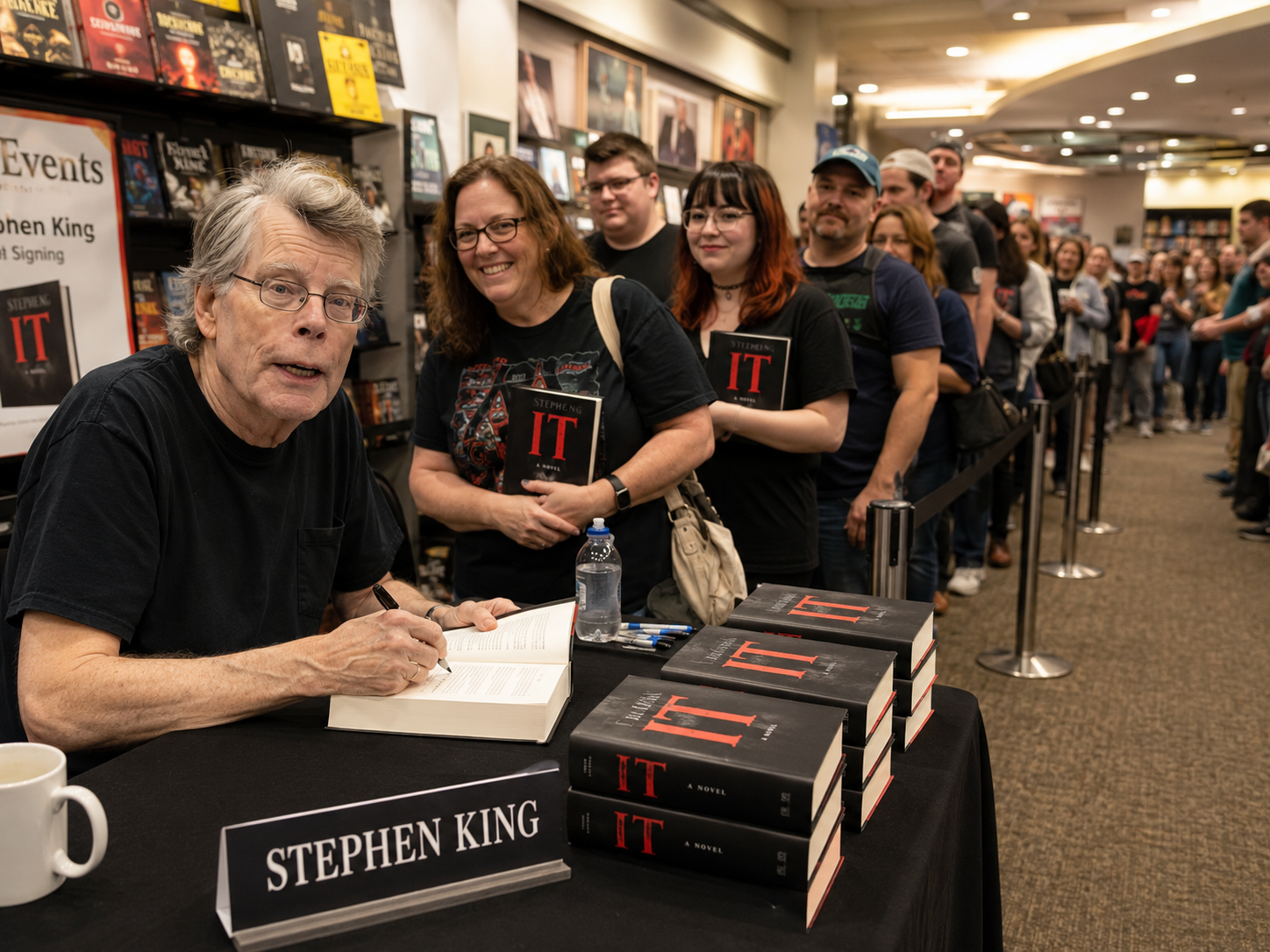
1. Write Every Day Without Exception — Stephen King
The habit:
Even with his colossal success, King writes 2,000 words every day without exception and, yes, even on holidays. It may sound boring, but he sits down at the same time every single morning and goes through the same ritual: tea or coffee, a vitamin pill, music, same seat, papers arranged identically. He describes this routine as "a way of saying to the mind, you're going to be dreaming soon.”
Why it translates into good writing:
We just mentioned momentum, which is created by consistency. The more you write, the easier it becomes. But waiting and hoping for inspiration is a trap because you need to train your writing muscle by showing up and writing every day. And those 2000 words? Yeah, that’s a lot. But volume matters because it’s so much easier to manage a jumble of words than it is to deal with a blank page. In King’s experience, it is only when he is in the process of writing that he experiences visits from his muse.
How to use it:
Set a daily word count that feels realistic to you (even as small as 300 words). The goal here is to show up and making it achievable and fun.
2. Stop While You Still Know What Comes Next — Ernest Hemingway
The habit:
Hemingway was a disciplined writer, getting up every morning and writing “as soon after first light as possible,” which meant typically from 6 a.m. until noon. You may have heard of his famous rule: you write until you come to a place where you still have momentum and know exactly what follows. Hemingway would stop writing mid-sentence or mid-scene—but always knew what was going to happen next. That may seem counterintuitive because, like an athlete, you’re in a flow. But, this is Ernest Hemingway!
Why it translates into good writing:
In knowing exactly where to start the next day, Hemingway eliminated the terrifying "blank page" problem. You’re also stopping before you are completely drained, which prevents burnout. You’re also building anticipation and a creative energy that carries you back to the desk. Because you’re holding what you’re going to write between sessions, it keeps your content “alive in your subconscious between sessions.
How to use it:
End your writing session mid-thought. Leave yourself a breadcrumb trail. You’ll be thankful tomorrow.
3. Embrace the "Shitty First Draft" — Anne Lamott
The habit:
Lamott gave writers permission to write terrible first drafts in her book Bird by Bird. She tells her readers to “just get it down on paper” without judgment, then revise ruthlessly. When I do this, I actually have to take off my editor hat and give myself permission over and over again. It sounds much easier than it is in practice. She describes the first draft as "the child's draft"—emotional, messy, and uninhibited. Well, let’s be real—there are a lot of adults who fit that description!
Why it translates into good writing:
Perfectionism is the enemy of progress because it paralyzes writers before they begin. I don’t stand a chance with writing when I’m in editing mode. Bad drafts become good second drafts, which become terrific third drafts. You’ve created the raw material to then start the real writing, which is in the revision. Lamott’s process frees your creative voice from your inner critic.
How to use it:
Give yourself permission to write garbage. You can fix garbage. You can't fix nothing.
4. Create a Distraction-Free Sanctuary — Maya Angelou
The habit:
Angelou rented hotel rooms in every city she lived in—specifically to write. She stripped the rooms bare: "I insist that all things are taken off the walls. I don't want anything in there." Armed with only a Bible, dictionary, thesaurus, yellow legal pads, and a bottle of sherry, she wrote lying across the bed from around 6:30 a.m. until early afternoon, every single day.
Why it translates into good writing:
Environment shapes output. Distractions don't just slow you down—they dilute your creative focus entirely. A dedicated writing space signals to your brain that it's time to work, and physical separation from daily life creates mental separation from daily worries. As Angelou put it: "I go into the room, and I feel as if all my beliefs are suspended. Nothing holds me to anything."
How to use it:
You don't need a hotel room. You need a room—or a corner, a coffee shop, a library. Protect your writing space fiercely.
5. Read Voraciously and Constantly — Ray Bradbury
The habit:
Bradbury's advice was deceptively simple: "Just write every day of your life. Read intensely. Then see what happens." But he practiced what he preached with almost obsessive dedication. He recommended reading one short story, one essay, and one poem every night—for a thousand nights. Before he ever published seriously, he spent ten years educating himself in public libraries. "At the end of ten years," he said, "I had read every book in the library and I'd written a thousand stories."
Why it translates into good writing:
Reading fills your creative well, and you can't pour from an empty cup. Exposure to different styles, voices, and structures expands your toolkit in ways you don't even notice until you need them. Great writers absorb rhythm, pacing, and language through osmosis—it seeps into their prose whether they intend it to or not. Bradbury captured this beautifully: "You must lurk in libraries and climb the stacks like ladders to sniff books like perfumes."
How to use it:
Read widely and without apology. Read in your genre. Read outside your genre. Read what challenges you.
6. Warm Up Before the Real Work — John Steinbeck
The habit:
Every day before writing East of Eden, Steinbeck wrote a "letter" to his editor in his journal. These warm-up pages helped him rev his mind like an engine—he'd discuss his mood, his doubts, the day ahead. He also sharpened anywhere from 24 to 100 pencils each morning as part of his ritual. It sounds almost comically meticulous, but for Steinbeck, these small acts were the on-ramp to deeper work.
Why it translates into good writing:
Warm-ups ease you into creative mode without the pressure of producing "real" writing. Journaling clears mental clutter so you can arrive at the manuscript with a quieter mind. But more than that, the ritual itself becomes a signal—a way of telling your brain it's time to create. As Steinbeck put it: "In writing, habit seems to be a much stronger force than either willpower or inspiration."
How to use it:
Try writing a one-page "letter" to anyone (real or imagined) before diving into your project. Let yourself meander. Then get to work.
7. Trust the Power of Saying Less — Toni Morrison
The habit:
Morrison was as deliberate about what she left out as what she put in. She believed in relying on "the reader's own emotions and intelligence" rather than over-explaining, and she worked early mornings when she was "clearer-headed, more confident, and generally more intelligent." Her philosophy was refreshingly direct: "I have been more impressed with myself when I can say more with less."
Why it translates into good writing:
Economy of language creates impact—every word has to earn its place on the page. Trusting your readers makes them active participants rather than passive consumers, and that trust pays dividends. Over-writing dilutes emotional punch; restraint amplifies it. Morrison said it best: "It is what you don't write that frequently gives what you do write its power."
How to use it:
After your draft is complete, ask: What can I cut? Where am I explaining too much? Trust your reader to meet you halfway.
The Bottom Line
These seven habits aren't magic—they're choices, made daily. The writers who "make it" aren't necessarily more talented than the rest of us; they're more consistent. And every habit here is something you can start today, not someday. But here's the thing about habits: they get you to "good enough." And "good enough" is exactly where the real magic begins.
The Last Word
So you've built the habits. You've shown up day after day. You've written the shitty first draft, revised it, tightened it, and now you're holding a manuscript that feels... ready.
Here's my question: Ready for what?
Because "good enough" is the starting line, not the finish. That's where someone like me comes in—a fresh set of professional eyes to help you see what you're too close to notice. Whether you need developmental guidance, a thorough line edit, or a final polish before submission, I'm here to help your words land exactly the way you intended.
Let's get your work where it deserves to be.
Sources
Angelou, Maya. Interview by George Plimpton. "Maya Angelou, The Art of Fiction No. 119." The Paris Review, 1990.
Bradbury, Ray. "Zen in the Art of Writing: Essays on Creativity." Joshua Odell Editions, 1990.
Hemingway, Ernest. Interview by George Plimpton. "Ernest Hemingway, The Art of Fiction No. 21." The Paris Review, 1958.
King, Stephen. "On Writing: A Memoir of the Craft." Scribner, 2000.
Lamott, Anne. "Bird by Bird: Some Instructions on Writing and Life." Anchor Books, 1994.
Morrison, Toni. Interview by Elissa Schappell. "Toni Morrison, The Art of Fiction No. 134." The Paris Review, 1993.
Morrison, Toni. "Toni Morrison on Creative Failure." National Endowment for the Arts, 2014.
Steinbeck, John. "Journal of a Novel: The East of Eden Letters." Viking Press, 1969.
The 5 Most Common Mistakes Writers Make (And the Simple Fixes)
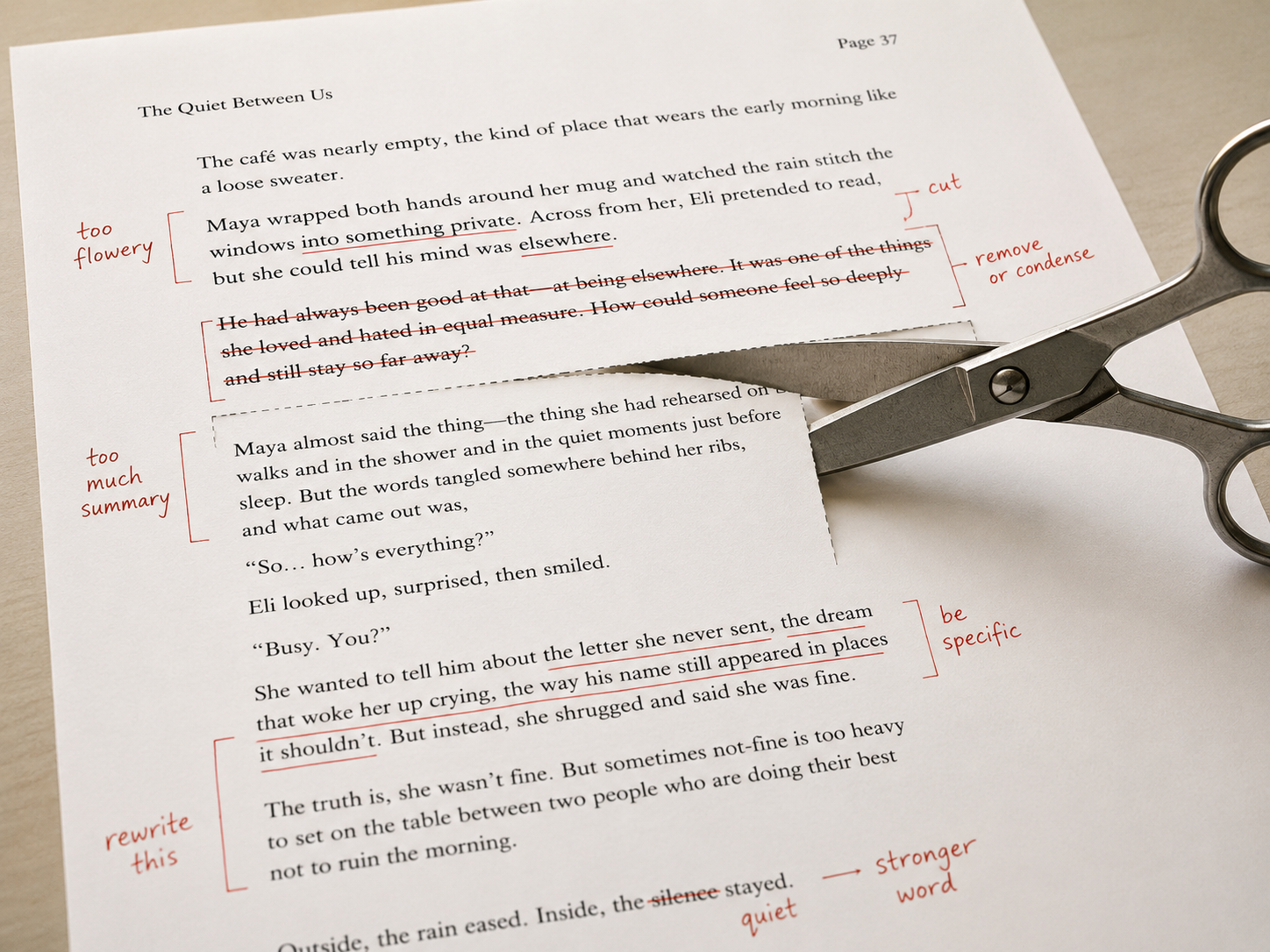
After nearly a decade of editing content on Upwork, I've seen just about everything. I've worked with debut novelists and seasoned authors. I edited a memoir dictated by a writer with unmanaged ADHD and dyslexia who couldn't type her own story but could tell it beautifully. I've worked on content ranging from a white paper about the intricacies of land surveying to a hysterical mob crime novel. Despite the diversity of writers and subject matter, a common truth always surfaces: good writing is good writing.
But what also pops up are consistent mistakes that seem to be both subject- and writer-agnostic.
I don't say that to discourage you. Actually, it's the opposite. If nearly every writer struggles with the same handful of issues, that means these aren't personal failings—they're just part of the craft. They're learnable. Fixable. And once you know what to look for, you can start catching them yourself.
So let's walk through the five mistakes I see most often and talk about how to address them.
1. Overwriting
If I had to pick a single issue that shows up in nearly every project I touch, it's overwriting—using more words than necessary to say what needs to be said.
Overwriting takes many forms. Sometimes it's purple prose: elaborate descriptions that call attention to themselves rather than serving the content. Sometimes it's redundancy: saying the same thing twice in slightly different ways, as if the reader didn't catch it the first time. Sometimes it's over-explaining: not trusting your audience to understand what you're communicating, so you spell it out in exhausting detail.
Here's the thing: more words don't equal more clarity or greater impact. Often, it's the reverse. Toni Morrison once said, "I have been more impressed with myself when I can say more with less." She understood that economy of language creates power. Every word has to earn its place on the page. In other words, you can often say more with fewer words. I once read that Stephen King despises adverbs. He said adverbs are indicative of lazy writing because you can create the same effect with a stronger verb.
The fix: After you've finished a draft, go back through with one question in mind: What can I cut? Look for places where you've said the same thing twice. Look for adjectives and adverbs that aren't doing real work. Look for explanations that follow points you've already made clearly. Trust your reader to meet you halfway.
2. Vague Language
This one is sneaky because it often feels like writing. You've put words on the page. They form sentences. The sentences form paragraphs. But when I read them, I'm left asking: What are you really trying to say here?
Vague language shows up as abstractions without examples, generalizations without specifics, and descriptions that gesture toward something without landing on it. "It was an interesting experience." "The results were significant." "She had a difficult childhood." These sentences tell the reader almost nothing. They're placeholders where concrete details should live.
Strong writing is specific. It gives readers something to see, to hold onto, to understand. Researcher and educator Peter Elbow calls this "rendering" versus "explaining"—the difference between showing your reader the thing itself and merely pointing in its general direction. It’s akin to the adage about writing, “Show, don’t tell.”
The fix: When you revise, hunt for vague words like "interesting," "significant," "very," "really," and "things." Each time you find one, ask yourself: Can I replace this with something concrete? Instead of "she had a difficult childhood," what specifically happened? Instead of "the results were significant," what were the numbers? Specificity builds credibility and keeps your reader engaged.
3. Weak Transitions
I’ll come across this one on every writing project. The thing is that you’ll have these very well-written paragraphs and sections that don't connect in any way. The reader finishes one thought, moves to the next, and feels a small jolt of confusion. Wait—how did we get here?
Transitions are the connective tissue of your writing. They tell your reader how one idea relates to the next. Are you building on the previous point? Contradicting it? Shifting to a new topic entirely? Without clear signals, readers have to work harder than they should to follow your logic.
This is especially common in narrative nonfiction and memoir, where writers sometimes organize their material in ways that make perfect sense to them—because they know the full story—but leave readers disoriented. The path that feels obvious to you isn't always obvious on the page.
The fix: Read your draft specifically for flow. Read the last sentence of a paragraph and the first sentence of the next. And ask, Is there a bridge between these two sentences? Sometimes a single word ("However," "Meanwhile," "Later") does the work. Sometimes you need a sentence that explicitly bridges two ideas. You aren’t overexplaining. You’re guiding your reader smoothly from one point to the next.
4. Burying the Lead
Burying the lead is when you hide your main point under layers of setup, context, or throat-clearing. By the time you get to your thesis, your reader has already checked out.
It shows up everywhere. Opening paragraphs that spend too long setting the scene before anything happens. Chapters that take five pages to arrive at the insight they're building toward. Even individual sentences that back into their meaning instead of leading with it.
Sometimes this happens because writers are warming up on the page, finding their way into what they want to say. That's fine in a first draft—but it shouldn't stay in the final version. Other times, writers worry that stating something directly will seem abrupt, so they cushion it with context. But readers don't need as much cushion as you think. They'd rather you get to the point.
The fix: Look at your opening paragraphs—for the whole piece and for each section. Where does the actual content begin? Often, you can cut the first few sentences (or the first few paragraphs) entirely and lose nothing. Start where things get interesting. You can always weave in necessary context later.
5. Losing Your Voice
Every writer has a voice. It's the rhythm of your sentences, the words you naturally reach for, the personality that comes through on the page. When your voice is present, your writing feels alive and distinctly yours. When it disappears, your writing goes flat.
Voice gets lost for a few reasons. Sometimes writers try to sound "more professional" or "more literary" than they naturally are, and the result feels stiff and borrowed. Sometimes they've been editing so long that they've sanded away all the texture. Sometimes they're writing about a topic that intimidates them, and their natural confidence vanishes.
The writer who dictated her memoir? Her voice was phenomenal—funny, raw, and completely hers. She wasn't worried about sounding like a "real writer." She was just telling her story. That's what voice sounds like when it's left alone.
The fix: Read your draft aloud. Does it sound like you? Are there places where the prose suddenly feels stiff or unnatural? Those are the spots where your voice has slipped. Sometimes the fix is as simple as asking: How would I say this if I were talking to a friend? Write that down. It's probably better. A really cool piece of technology I discovered recently is a text-to-voice app called Speechify (I’m sure there are plenty of others) that reads the text I’m editing in a chosen voice and at a desired speed. I’m amazed at how a sentence can read fine on paper but come across unnaturally when spoken. And it’s kind of cool to have President Obama or Gwyneth Paltrow read your writing!
Why This Matters Beyond the Writing
Here's something worth knowing: the cleaner your manuscript, the less time an editor needs to spend on it. That translates directly into cost and turnaround time. If I'm spending hours untangling vague language or flagging sections that need stronger transitions, that's hours you're paying for. But if you've already addressed these common issues, we can focus on refining your voice and elevating your prose—the work that makes good writing great.
I'm not saying you need to hand over a perfect draft. That's not realistic, and it's not the point. Editing exists because every writer benefits from a second set of eyes. But understanding these patterns helps you become a stronger self-editor. By the time you work with an editor like me, your writing will be elevated, making our work together more productive—and more satisfying for both of us.
The Last Word
These five mistakes are not writing failures. They’re signs that you are writing—doing the hard, necessary work of getting ideas onto the page. Every writer I've worked with, regardless of genre or experience level, has grappled with at least one of these issues. Most have grappled with all of them at some point.
The goal at this point is awareness. Once you know what to look for, you can start making intentional choices about your prose. And that's where the real growth happens.
Not sure where your manuscript stands? Sometimes it helps to have a professional take a look. Reach out and let's talk about what kind of editing support might move your work forward.
Sources
Elbow, Peter. Writing With Power: Techniques for Mastering the Writing Process. Oxford University Press, 1998.
Zinsser, William. On Writing Well: The Classic Guide to Writing Nonfiction. Harper Perennial, 2006.
How to Structure a Nonfiction Book for Maximum Clarity and Impact
You're in the thick of it now. You've got chapters written, ideas scattered across multiple documents, and that nagging feeling that something isn't quite clicking. The words are there, but when you step back and look at the whole thing, it feels... muddled. Like the pieces of a puzzle that should fit together but don't.
If this sounds familiar, you're not alone. After nearly a decade of editing nonfiction, I can tell you that structural issues are among the most common problems I encounter in mid-draft manuscripts. Writers know what they want to say. They've done the research, lived the experiences, and developed the expertise. But organizing all of that into a shape that carries a reader from beginning to end is where things typically fall apart.
Here's the good news: structure is fixable. And understanding how to organize nonfiction writing effectively can transform a meandering manuscript into a memorable reading journey.
Why Structure Matters More Than You Think
When readers pick up a nonfiction book, they're making an implicit deal with you. They're giving you their time and attention, and in return, they expect you to guide them somewhere meaningful. A well-structured book honors that deal. It says: I know where we're going, and I'm going to get you there in a way that makes sense.
Poor structure breaks that promise. It leaves readers confused about how ideas connect, frustrated by repetition, or worse—they put the book down entirely. I've seen beautifully written manuscripts fail to find publishers or readers simply because the organization worked against the content instead of supporting it.
The truth is, structure isn't separate from your ideas. It is how your ideas make sense. British author Tony Buzan, who pioneered mind mapping techniques, recognized that our brains don't naturally think in linear sequences—they make leaps and connections that don't always follow a straight path (Buzan, 1996). Your job as a nonfiction writer is to take those organic connections and shape them into something a reader can follow without getting lost.
Diagnose Your Structural Problems
Before you can fix your structure, you need to identify what's broken. Step away from the sentence-level work and look at your manuscript from a distance. You can use ChatGPT to do this or just do it manually: create a one-pager for all of your chapters, listing your chapter titles and one-sentence summaries. Spread them on a table or tape them to a wall. Now ask yourself some hard questions.
Does each chapter have a clear purpose that supports your book's central argument? Can you articulate what each chapter accomplishes in a single sentence? If you can't, the chapter might be trying to do too much—or too little.
Is there a logical progression from one chapter to the next? Your reader should feel carried forward, not jerked around. If Chapter Four could swap places with Chapter Seven without anyone noticing, you have a structural problem.
Are you repeating yourself? This is incredibly common, especially in books that grew organically from blog posts, talks, or years of accumulated thinking. You might be making the same point in three different chapters without realizing it.
Where do you lose momentum? Be honest. Is there a section where even you get bored rereading? That's a signal that either the content doesn't belong or it's not positioned correctly in the arc of your book.
Three Frameworks That Create Clarity
Once you've diagnosed the issues, you need a framework to rebuild. Most nonfiction books organize around one of three structures, and understanding which one serves your material best can clarify everything.
The problem-solution structure works beautifully for prescriptive nonfiction—books that teach readers how to do something or solve a challenge they're facing. You establish the problem, explore why it exists and why conventional approaches fail, then walk readers through your solution. The bulk of your content lives in that solution section, broken into principles, steps, or strategies that build on each other.
The chronological structure serves memoir, biography, and narrative nonfiction well. Time becomes your organizing principle, and events unfold in sequence. But here's the nuance: strict chronology isn't mandatory. Many successful memoirs open with a pivotal moment that hooks the reader before circling back to the beginning. The key is that your reader always knows where they are in time and how events connect.
The thematic structure is organized around ideas rather than time or problems. Each chapter explores a different facet of your central argument. This works for essay collections, philosophical explorations, and books examining a topic from multiple angles. The challenge here is making sure your themes build toward something rather than simply sitting side by side.
The Throughline Test
Whatever structure you choose, every chapter needs to pass what I call the throughline test. Your book has a central argument—or maybe you’ve heard it referred to as a thesis. This is the one core thing you want readers to understand, believe, or be able to do by the end. Every single chapter should connect to that throughline. If a chapter doesn't serve your book's central purpose, it doesn't belong in your book, no matter how well-written it is.
This is exactly where I see mid-draft writers struggle the most. They've written chapters they love, chapters that represent real work and real insight, but those chapters don't actually support the book they're writing. Cutting them feels like failure. It's not. It's discernment. It's the difference between a focused book that delivers on its promise and a scattered one that loses readers along the way.
Transitions Are Your Secret Weapon
Let me tell you something. Listen closely to this because if you do the following in your manuscript, you are going to be miles ahead of most other writers, and you’ll surely save time and money on editing.
What’s tricky is that you can have a super-solid structure, but if you don’t have effective transitions, your manuscript will not only sound choppy but it’ll lack any sense of cohesion. That’s because transitions are the connective tissue that holds your chapters and sections together. They tell readers how one idea relates to the next and why it matters that these ideas appear in this order.
You’ll want to look at the endings of your chapters. Are they creating momentum or setting up for what’s coming next? At no point in your book should a reader feel that jolt of confusion: ”Wait, how did we get here?” That signals a missing bridge. Sometimes a single sentence does the work. Sometimes you need a paragraph that explicitly connects two ideas. Either way, never assume the connection is obvious to the reader just because it's obvious to you.
The Last Word
Structure isn't about imposing rigid rules on your creativity. It's about making your ideas accessible to readers who don't live inside your head. A well-structured nonfiction book feels effortless to read precisely because the writer did the hard work of organization behind the scenes.
If your mid-draft manuscript feels stuck, the problem might not be your writing. It might be your architecture. Step back, diagnose the structural issues, and don't be afraid to move things around—or cut them entirely. Your book will be stronger for it.
Struggling to see your manuscript's structure clearly? Sometimes a fresh set of professional eyes can help you identify what's working and what needs to shift. Reach out and let's talk about where your book stands and what kind of support might help you get it where it needs to go.
Sources
Buzan, Tony. The Mind Map Book: How to Use Radiant Thinking to Maximize Your Brain's Untapped Potential. Plume, 1996.
How to Outline a Nonfiction Book (With Templates and Examples)
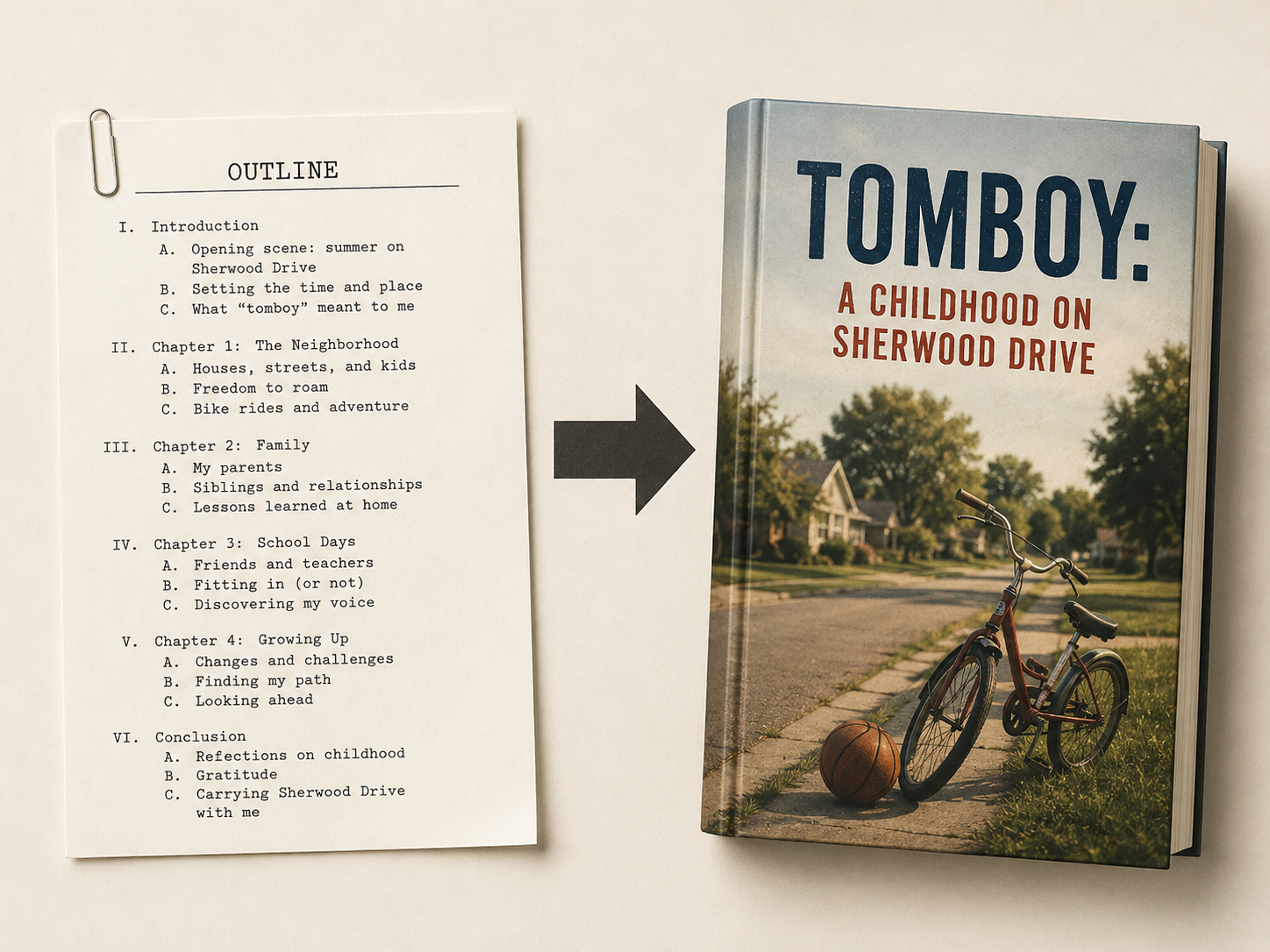
You have a book in you. Maybe you've been turning an idea over in your head for years. Maybe you finally sat down to write—and realized you have no idea where to start.
Here's the thing: sitting down to write a nonfiction book without an outline is like driving cross-country without a map. You might eventually get there, but you'll waste a lot of time, make wrong turns, and probably want to quit somewhere around Kansas.
After nearly a decade of editing nonfiction—memoirs, business books, guides, and everything in between—I've watched writers struggle with the same problem over and over. They know what they want to say. They just don't know how to organize it. A solid outline solves that problem before it derails your entire project.
Why Outlining Matters More Than You Think
An outline isn't just organizational busywork—it's your defense against writer's block, scope creep, and the dreaded abandoned manuscript. British author Tony Buzan, who popularized mind mapping techniques in the 1970s, understood that our brains don't naturally think in linear sequences. They jump from idea to idea, making connections that don't always follow a straight line. An outline helps you capture that natural creative process and then shape it into something a reader can follow.
More practically, an outline reveals structural problems before you've written 30,000 words. I've seen writers realize mid-draft that their chapter three should actually be chapter eight, or that they've accidentally written three chapters about the same concept. An outline catches these issues when they're still easy to fix.
Start With Your Core Message
Before you outline a single chapter, you need to answer one question: What is this book actually about?
I don't mean the topic. I mean the argument. What do you want readers to understand, believe, or be able to do after reading your book? Write it in one to three sentences. This becomes your North Star—every chapter should connect back to it.
For example, a book about productivity isn't really about productivity. It might be about how small daily habits compound into significant life changes. A memoir about addiction isn't just a chronicle of events—it's about resilience, identity, or the complicated nature of family. Get specific about what you're really saying.
Three Proven Outline Structures
Not every nonfiction book follows the same structure. The right framework depends on what you're writing and who you're writing it for. Here are three that work across most nonfiction genres:
Problem-Solution Structure
This framework works beautifully for self-help, business books, and how-to guides. You establish the problem your reader faces, explore why it exists, and then walk them through the solution. Most of your content lives in the solution section, broken into actionable steps or principles.
Chronological Structure
Memoirs, biographies, and historical nonfiction often benefit from a timeline-based approach. You move through events in sequence, using time as your organizing principle. That said, strict chronology isn't mandatory—many memoirs open with a pivotal moment before circling back to the beginning.
Thematic Structure
Some books organize around key themes or principles rather than time or problem-solving. Each chapter explores a different facet of your central idea. This works well for essay collections, philosophical explorations, and books that examine a topic from multiple angles.
A Simple Template to Get You Started
Here's a basic chapter outline template you can adapt for your project:
Chapter Title: [Clear, specific title that signals the chapter's focus]
Core Point: [One sentence describing what this chapter accomplishes]
Opening Hook: [How will you draw readers in? A story, question, or surprising fact?]
Key Sections: [Three to five main points or subtopics you'll cover]
Supporting Evidence: [Research, anecdotes, examples, or data you'll include]
Transition: [How does this chapter connect to the next?]
Work through this template for each chapter before you start writing. You don't need elaborate detail—bullet points are fine. The goal is to know where you're going before you set out.
The Mind Map Method
If traditional outlines feel too rigid, try mind mapping. Start with your book's central idea in the middle of a blank page. Draw branches outward for major themes or chapters. From each branch, add smaller branches for subtopics, examples, and supporting points. This visual approach lets you see connections between ideas and often reveals structural possibilities you wouldn't have noticed in a linear list.
When Your Outline Will Change (And That's Okay)
Here's something nobody tells you: your outline is a living document. It will change as you write. You'll discover that one chapter needs to become two, or that a section you planned doesn't actually serve your argument. That's not failure—that's the writing process working exactly as it should.
The outline gives you a starting point. It means you're never staring at a blank page, wondering what comes next. But it's not a contract. Give yourself permission to revise it as your book takes shape.
The Last Word
A good outline transforms the overwhelming task of writing a book into a series of manageable steps. It's the difference between building a house with blueprints and building one by guessing where the walls should go. Take the time to map out your structure before you dive into drafting. Your future self—the one who actually finishes the manuscript—will thank you.
Ready to move from outline to draft? Check out my post on "How to Start Writing a Nonfiction Book: A Clear, Practical Roadmap" for the next steps in your writing journey.
Sources
Buzan, Tony. The Mind Map Book: How to Use Radiant Thinking to Maximize Your Brain's Untapped Potential. Plume, 1996.
How to Turn Your Expertise Into a Compelling Book

“Readers want to know what’s in it for them—what they’re going to learn, or what problem you’re going to solve.”
You've spent years—maybe decades—mastering something. You've solved problems, developed frameworks, and accumulated insights that people pay you for. Clients and colleagues tell you all the time: "You should write a book."
But somewhere between the idea and the execution, you got stuck. And why wouldn’t you? What nobody tells you is that knowing your subject inside and out doesn't automatically mean you know how to write a book about it.
The good news? That's completely normal. And it's absolutely solvable.
Your Expertise Is the Starting Point, Not the Whole Story
Most professionals who want to write a book make the same assumption: since I know this material, writing about it should be straightforward. I just need to transfer all of this knowledge from my head to the page. But expertise and authorship are different skills. You might be able to explain your methodology brilliantly in a client meeting, but translating that into 50,000 words that hold a reader's attention is another challenge entirely.
“Expertise and authorship are different skills.”
Research backs this up. Cognitive scientists call it the "curse of knowledge"—a term popularized by economist Colin Camerer and colleagues in a 1989 study. Once you know something deeply, it becomes genuinely difficult to remember what it was like not to know it. You skip steps. You use jargon without realizing it. You assume context that your reader doesn't have.
This is a natural consequence of expertise. But it means that writing a book requires you to step outside your own head and meet your reader where they’re at.
Find the Story Inside Your Framework
Here's something I've learned from editing books by consultants, coaches, and executives: the ones that work are stories that have movement, tension, and payoff.
I'm currently editing a book by the founder of a digital education company. He's spent years interviewing leaders across industries, and his book looks at how effective leaders use language to shape culture, productivity, and relationships. He has tons of data and frameworks. But what makes the book compelling is how he weaves in real conversations, moments where a leader's word choice shifted the entire dynamic of a team, and meaningful anecdotes from his personal life. No doubt, the frameworks are the point of the book, but he brought them to life through narrative.
Another writer I've worked with is a psychologist who wrote about religious trauma—specifically, adults who grew up under the weight of hell indoctrination, believing they might burn for eternity if they stepped out of line. His clinical expertise gives the book credibility, but what gives it power is the way he tells his clients' stories (with their permission, of course). Readers don't just learn about trauma; they feel it, and they feel the relief of healing.
Your book needs both: the substance of what you know and the stories that make it stick.
“Your book needs the substance of what you know and the stories that make it stick.”
Start With Your Reader, Not Your Resume
One of the most common mistakes I see in expertise-driven books is leading with credentials instead of problems. The author spends the first chapter (or three) establishing why they're qualified to write this book. By the time they get to anything useful, the reader has already moved on.
Your reader picked up your book because they have a problem they want to solve or a question they want answered. They don't need your resume. They need to trust, within the first few pages, that you understand their situation and have something valuable to offer.
This doesn't mean your credentials don't matter. They do—they're part of why your perspective is worth reading. But they should emerge naturally in the course of telling your story, not dominate the opening. As author and writing instructor William Zinsser puts it, "Readers want to know what's in it for them—what they're going to learn, or what problem you're going to solve."
Structure Is Your Friend
Expertise-driven books often suffer from a lack of clear structure. The author knows so much (and cares so deeply!) that everything feels essential, and the result is a manuscript that reads like a brain dump—leaving readers lost in a forest of insights with no clear path through.
Before you write, you need to answer some fundamental questions:
What transformation are you offering your reader?
Where do they start, and where do they end up?
What are the essential steps or concepts they need to understand along the way?
Think of your book as taking the reader’s hand and guiding them on a learning journey. Each chapter should accomplish something specific and build toward the next. If you can't articulate what each chapter does and why it comes in that order, you're not ready to write yet.
Educational psychologist Richard Mayer's work on instructional design shows that learning is most effective when information is organized, sequenced logically, and connected to what the learner already knows. This is how you create a learning experience.
Write Like You Talk (Then Edit for the Page)
One of the best pieces of advice I can give: write in your own voice. The stiff, formal prose that many experts default to—thinking it sounds more "authoritative"—just sounds dry and distant. Your readers chose your book because they want access to you, not a textbook.
But you don’t want to write exactly how you speak. When I was a transcriptionist (recorded speech to text) in a previous life, you wouldn’t believe how many utterances weren’t relevant. That’s because spoken language is full of tangents, filler words, and incomplete thoughts. We want prose that feels conversational, accessible, and unmistakably yours. Write the first draft loosely, then tighten it in revision.
“Remember: We are not editing out your voice. Revision is about shaping and refining your voice without replacing it. The goal is to become the best version of yourself on the page.”
You Don't Have to Do This Alone
Let me say something I wish more writers heard early on: nobody writes a great book alone. The ones who finish—and finish well—almost always bring in help. Some bring in a developmental editor early to help shape what they're trying to say. Others work with a ghostwriter who can translate their expertise into prose that reads well. Plenty of writers tag in editors at different stages: someone to help with structure, someone to sharpen the argument, someone to polish the language before it goes out into the world.
There's no template here. The writers who succeed are the ones who can look at their manuscript honestly, name what it needs, and bring in the right help. Your knowledge is too valuable to end up in a book that's disorganized, dense, or sitting half-finished in a drafts folder.
Your Invitation
Your knowledge deserves to reach the people who need it. Let's figure out how to make that happen.
Sources
Camerer, Colin, George Loewenstein, and Martin Weber. "The Curse of Knowledge in Economic Settings: An Experimental Analysis." Journal of Political Economy, vol. 97, no. 5, 1989, pp. 1232-1254.
Mayer, Richard E. Multimedia Learning. 2nd ed., Cambridge University Press, 2009.
Zinsser, William. On Writing Well: The Classic Guide to Writing Nonfiction. Harper Perennial, 2006.

How to Start Writing a Nonfiction Book (When You Don’t Know Where to Start)

You have a book in you. Maybe it's a memoir that's been knocking around in your head for years. Maybe it's a guide built from the kind of expertise people keep asking you to share. Or maybe someone recently said, "You really should write a book about that"—and this time, you didn't laugh it off.
So you know you want to write this book. You just have no idea how to take what’s in your head—the life story, the hard-won expertise, the thing you keep meaning to put on paper—and turn it into a publishable manuscript.
I’ve spent close to a decade editing nonfiction. Memoirs, business books, self-help guides, the occasional white paper on something obscure (yes, I once edited a piece on land surveying)—and pretty much everything in between. What I’ve seen over and over is the difference between writers who finish and writers who don’t. And it comes down to this: it isn’t talent or having more time (nobody has more time). It’s having a process and being willing to follow it on the days you’d rather scrub grout.
Let’s get to work.
Get Clear on Your Why (Before You Write a Word)
Before you open a blank document, you need to answer one question: Why this book?
This isn't a fluffy exercise. Your "why" will carry you through the moments you want to quit—and trust me, those moments will come. Maybe you’re writing to share expertise that could genuinely help people. Maybe you’re trying to make sense of your own experience. Maybe it’s about establishing authority in your field or leaving something behind for your kids. There's no wrong answer here. But there needs to be an answer. A book is a serious undertaking, and vague motivation produces abandoned manuscripts.
Once you're clear on your why, get equally clear on your who. Who is your ideal reader? Not "everyone interested in this topic"—that's a non-answer, and it'll paralyze you every time you sit down to write. Get specific. Picture one person. What do they already know, and where are they stuck? What can your book give them that Google can't? Write for that person and that person alone. Everything else—what to include, what to cut, how to structure the whole thing—falls into place once you know exactly who you're talking to.
Start With Structure, Not Sentences
Here's a mistake I see constantly: writers sit down and try to write their book from the beginning, one sentence at a time, hoping it will all come together somehow. That approach seldom works for nonfiction. You end up meandering, repeating yourself, or realizing 30,000 words in, your structure doesn't hold together.
Instead, start with an outline. I know—outlining sounds tedious. But think of it as building a frame before you hang the drywall. You need to know where the load-bearing walls go.
For most nonfiction, this means pinning down your core argument or throughline, then breaking it into major sections or chapters. Each chapter should have its own mini-argument that supports the larger one. Ask yourself what your reader needs to understand first, what builds on that, and where it all naturally leads.
Your outline doesn't need to be elaborate. A list of chapter titles with a few bullet points under each is often enough to get started. You can—and will—revise it as you go. You’re not locking yourself. You’re giving yourself a map so you're not wandering in the dark.
Write the Messy First Draft
Now comes the part everyone dreads: actually writing.
Here's what I want you to internalize before you begin: your first draft is supposed to be bad. Anne Lamott calls it the "shitty first draft" in her essential book Bird by Bird, and she's being literal. The purpose of a first draft isn't to be good—it's to exist. A messy draft gives you something to work with. A blank page gives you nothing.
This is where most writers get stuck. You write a paragraph, hate it, and delete the whole thing. Or you start editing as you go—polishing sentences that might not even survive the next revision, which is its own kind of trap. Underneath all of it is perfectionism dressed up as high standards. It isn't. It's fear.
Give yourself permission to write badly. I mean it. Get the ideas out of your head and onto the page—clumsy, repetitive, wrong-word-three-times-in-one-paragraph bad. Whole sections can be placeholders. That's fine. You're not carving marble here; you're making clay. The shaping comes later.
Pick a daily word count that doesn't make you want to quit before you start. Even 300 words adds up. Then protect that writing time—don't negotiate with yourself about it. Consistency gets you further than inspiration every single time. As Stephen King puts it, the muse visits during the act of writing, not before it.
Revise With Fresh Eyes
Once you have a complete draft—and I mean complete, beginning to end, however rough—walk away from it. Seriously. A week minimum, two if you can manage it. You need distance to read what you actually wrote instead of what you think you wrote.
When you come back, read the whole thing through in one sitting if you can. Don't edit. Don't fix. Just read and take notes—where did you lose interest, where were you confused, where did something feel thin? Structural problems are almost impossible to see when you're in the weeds. This is how you get out of them.
Then start revising—and be ruthless. Cut the parts that don't serve your reader, even if you love them. Tighten the sections that ramble. Fill in the gaps you glossed over in your rush to finish. This is where good writing actually happens. First drafts are about getting it down. Revision is where the actual writing happens.
Watch for the issues that show up in nearly every nonfiction draft I edit: overwriting, vague language, weak transitions, and burying your main points under too much setup. These aren't personal failings—they're just part of the craft, and once you know to look for them, you can catch them yourself.
Know When You Need Help
At some point, you'll hit the limits of what you can see in your own work—and that's true for every writer, regardless of experience.
But here's something most writers don't realize: there are different types of editing for various stages of a manuscript. Developmental editing looks at the big picture—structure, argument, whether the book holds together as a whole. Line editing works at the sentence level, refining voice, clarity, and rhythm. Copy editing handles grammar, consistency, and mechanics. Proofreading is the final polish before publication.
Each one serves a different purpose, and hiring the wrong service at the wrong stage is one of the most common (and most expensive) mistakes I see writers make. More on that in a future post—for now, just know that getting clear on what your manuscript actually needs is the first step.
The Truth About Finishing
Here's what I've learned after close to a decade in this work: finishing a manuscript has almost nothing to do with confidence. It has everything to do with showing up when you don't have any.
Writing a nonfiction book is hard. There will be days when you're convinced the whole thing is garbage, weeks when you'd rather do literally anything else. That inner critic will get loud. Imposter syndrome will remind you that you have no business writing this book.
Those feelings are normal—I'd be more worried if you didn't have them. They're not a sign you're failing. They're a sign you care about getting it right. Hear the voice, acknowledge it, and get back to work anyway.
You’ve got everything you need. Start a new document.
Ready for the Next Step?
If you've started your manuscript and want a professional perspective on where it stands—or you're not sure what kind of editing support would move your work forward—reach out. No pressure, no judgment. Just a conversation about your writing and how to help you say exactly what you mean.