Writing Coach vs. Editor: Which One Do You Need?
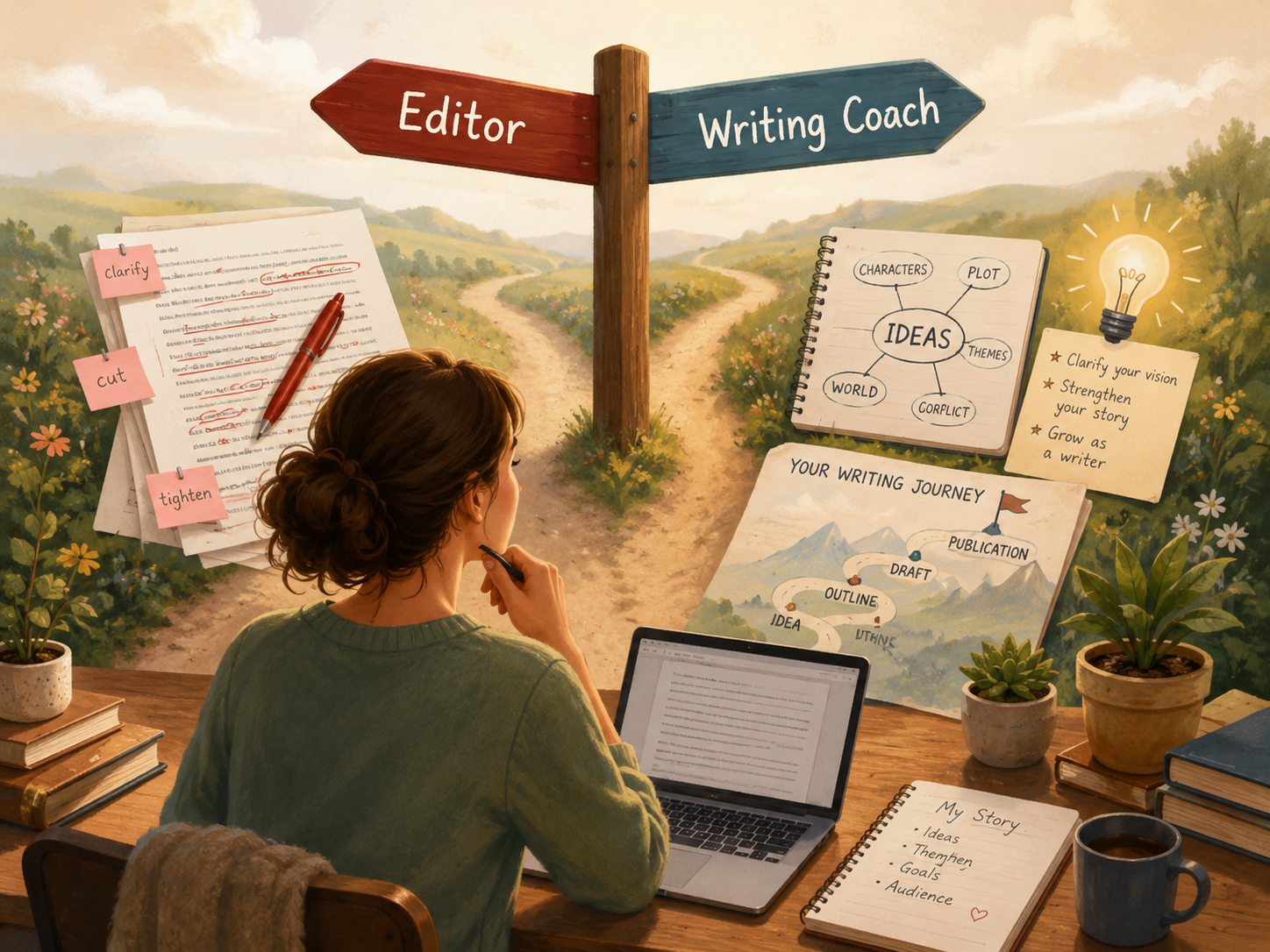
You know your nonfiction book needs help. What you're less sure about is what kind. "Writing coach" and "editor" tend to get tossed around like they're the same service, and plenty of people in the industry blur the line themselves. But a writing coach and an editor do genuinely different jobs, at different stages, for different problems. One helps you produce a manuscript. The other helps you refine one. Hiring the wrong one at the wrong time is an expensive mistake. So let's settle the writing coach vs. editor question for nonfiction writers, so your money is spent on elevating your book and moving it forward.
What a Writing Coach Does
A writing coach works with you while you're writing. You’ve got someone in your corner through the messy, uncertain middle part of a project—the stretch where most books quietly die.
Coaches help with momentum, accountability, and the day-to-day discipline of getting words on the page. A good one helps you set realistic goals, talks through structure before you've committed 40,000 words to the wrong one, and helps you troubleshoot when you're stuck. Some coaches teach craft directly. Others act more like a strategic partner who asks the right questions until you find your own way through.
What a coach generally won't do is take your finished pages and mark them up line by line. Their work is about you—your process, your habits, your confidence. The manuscript gets better as a byproduct of you getting better.
What an Editor Does
An editor works on the page, not the process. You hand over your writing, and they provide suggestions directly on the page to improve it. You can accept or reject those suggestions.
Beyond that, there are several types of editing, depending on what the manuscript needs.
Developmental editing tackles structure and argument.
Line editing works at the sentence level—voice, rhythm, flow.
Copy editing handles grammar and consistency.
Proofreading is the last polish before you publish.
But the common thread is this: editors respond to writing that already exists. They are product-focused, not process-focused. You hire an editor to elevate what you've already written.
The Real Difference: Where You Are in the Process
The cleanest way to tell these two apart is to forget the job titles and ask where you are.
If you're still writing—the draft isn't done, you keep stalling, you're not even sure the thing holds together—you're in coaching territory. A coach helps you produce the manuscript.
If you have a draft—rough is fine, but it needs to be a real, complete one—you're in editing territory. An editor helps you refine it.
Signs You Need a Writing Coach
You haven't finished a draft, and some part of you suspects you won't.
You start strong and lose steam around the middle, every single time.
You have the expertise or the story, but no idea how to shape it into a book.
You need accountability—someone expecting pages from you on a schedule.
This is your first book, and you’re overwhelmed.
If a few of those land, your money is better spent on coaching (or a structured writing program) than on editing. There's no sense paying someone to polish a manuscript that doesn't exist yet.
Signs You Need an Editor
You have a finished draft and know it needs work—you just can't always name what.
You've taken it as far as you can on your own, including self-editing, and need fresh, professional eyes.
You're getting ready to query agents or self-publish and want the writing as sharp as possible.
Beta readers keep flagging the same issues, and you want an expert read on what's really going on.
If you're nodding along, you're ready for editing. The only thing left is figuring out which type—and that hinges on whether your manuscript needs structural work or sentence-level refinement.
Where the Two Overlap
Here's where the line blurs, because it isn't always clean.
Developmental editing, in particular, shares DNA with coaching. A developmental editor diagnoses big-picture problems—structure, argument, pacing—and guides your revision without rewriting the book for you. That guiding role can feel coach-adjacent. The difference is timing and form: a developmental edit responds to a complete draft and arrives as a defined deliverable, usually an editorial letter plus margin comments. Coaching is ongoing and forward-looking. Developmental editing is a high-level assessment of the work you've already done.
Some professionals offer both, and the roles hand off naturally—a coach gets you to a finished draft, an editor helps you make it publishable. They aren't rivals. They're tools for different stages. For example, I offer both and, more often than not, incorporate a small degree of coaching into my editing services, as all of my clients turn out to be better writers by the end of our collaboration (and hopefully, have learned a thing or two they can use moving forward).
So, Which One Do You Need?
Let’s just strip it down to a single question: Do you have a complete draft?
If the answer is no, you need a coach—or build the writing habits that do a coach's job. If the answer is yes, you're ready for an editor, and the only thing left to sort out is which kind.
If you've got a draft and aren't sure what it needs—or whether it's even ready for editing yet—reach out. Sometimes a short conversation is all it takes to figure out where you are and what will actually help.