Red Flags When Choosing a Nonfiction Editor (and What to Look For Instead)
You’ve put everything you have into completing your nonfiction manuscript. Your colleagues and friends have given it a thumbs-up, and many of them reinforced what you already know: you need an editor to get it publish-ready. Unless you’ve written a book and have gone through the publishing process before—and even if you have—this is a vulnerable time for writers. Choosing a nonfiction editor means handing a near-stranger months or years of your work, and not every editor deserves that trust.
Pre-pandemic, I wouldn’t have written an entire blog post on this. But throughout the pandemic era through today, I can say with confidence that freelancers who have little to no editing experience are labeling themselves as such and charging below market rates. Just know that it takes years of hands-on experience with many different writers to hone one’s editing skills.
What I’m about to share with you does not make me rub my hands together in glee. But writers have found me after having had bad experiences with so-called editors”
Editors who suddenly go silent mid-project.
An editor delivered line edits as comments in the margins.
Several editors obviously let AI edit the manuscript.
An editor who thought development editing was prompting the writer to add more content to the manuscript.
A big-name publishing house editor line-edited my client’s voice out of his first book.
Those editing disasters are completely avoidable when you know what to look for before agreeing to anything.
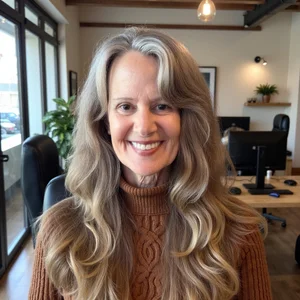
Let's get started by walking through the editor behaviors that should raise a red flag—and the signs you're looking at a good one. (Like when you look at my photo!)
Raise the Red Flag When:
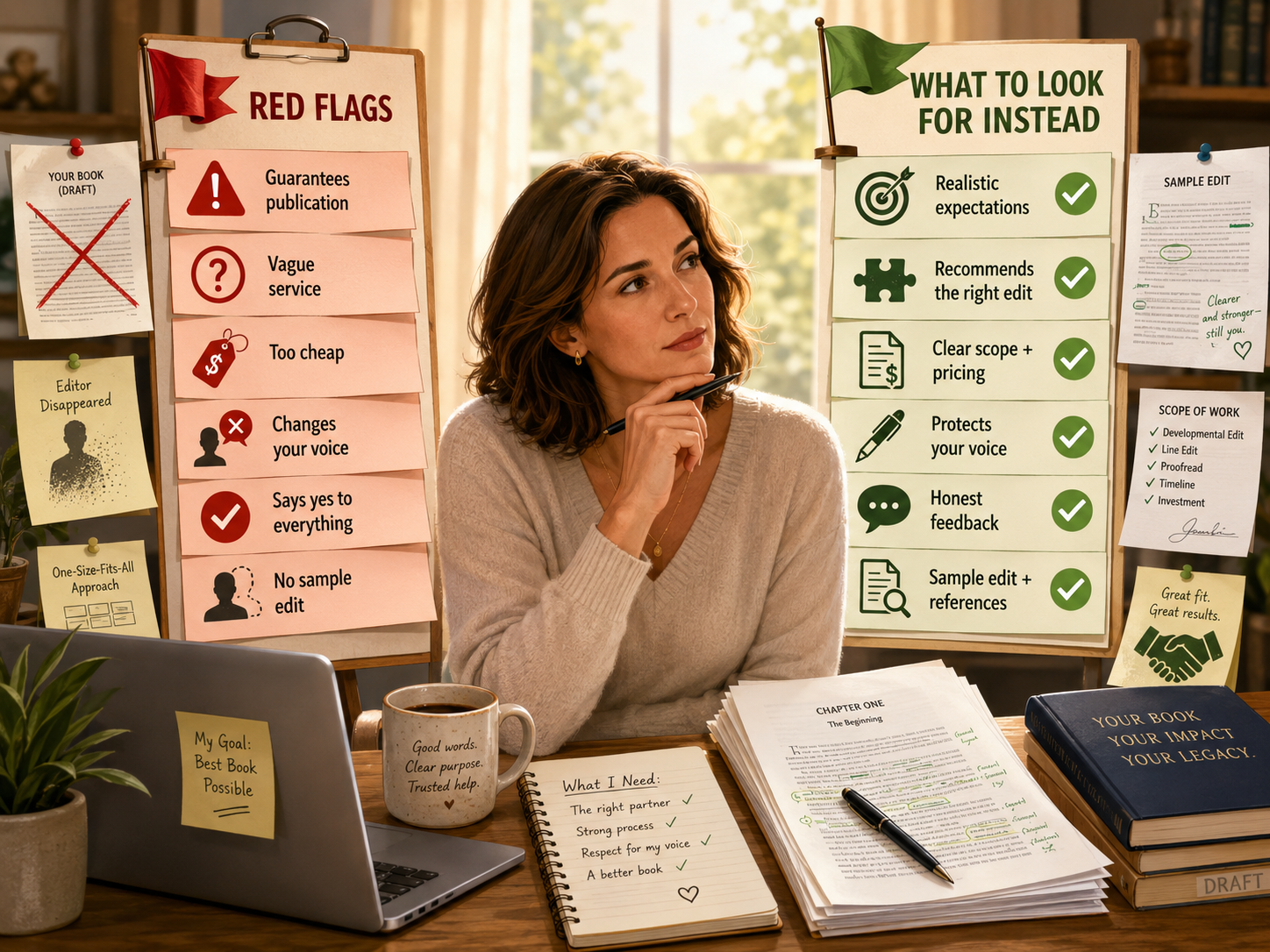
They guarantee you'll get published
Red Flag: We’re starting with the big one. If an editor promises their work will land you an agent, a book deal, or a spot on a list, walk away.
No honest editor can promise that. Publishing depends on the market, timing, your platform, and a long list of things no editor controls. An editor's job is to make your manuscript as strong as it can be, not to sell you a fantasy. When someone leads with guarantees, they're really selling hope—and hope tends to be overpriced.
Green Flag: Look for an editor who's candid about what editing can and can't do. The good ones set realistic expectations and are upfront about the limits of the work.
They can't tell you what kind of editing you need
Red Flag: A nonfiction manuscript might need developmental editing, line editing, copy editing, or proofreading. Those are genuinely different services at genuinely different price points. (I break it all down in my post on what type of editing your manuscript actually needs.)
A warning sign is the editor who lumps it all into one fuzzy package, or who quotes a "full edit" without asking where you are in the process. Worse is the one who happily agrees to a copy edit when your book has structural problems that no amount of comma-fixing will solve.
Green Flag: What you want instead is someone who asks questions before quoting. A good editor wants to know whether you've finished revising, what feedback you've gotten so far, and what you're trying to accomplish. Often, they'll point you toward the service you actually need—even when it costs less than the one you asked for.
The price feels too good to be true
Red Flag: We all want a deal. But editing is skilled, labor-intensive work, and rates that fall dramatically below the norm usually signal inexperience or a rushed job. The Editorial Freelancers Association publishes rate ranges that give you a realistic feel for the market. If a quote comes in at a small fraction of that, it's worth asking why.
The flip side is its own red flag. An editor who's vague about money—who won't put scope, price, and timeline in writing—is one you can't hold to anything later.
Green Flag: Look for clear, written terms: a real scope-of-work document that spells out:
What you're getting
What it doesn’t include (like if you add more content during the process)
When you’re getting it
What it costs
They want to make your book sound like them
Red Flag: This is the one that genuinely bothers me, because it's so hard to undo. Some editors, often well-meaning ones, revise until your voice disappears and theirs takes over. You get back clean, competent prose that no longer sounds like you wrote it.
In nonfiction, especially, your voice is the reason readers trust you. It's what makes a memoir feel intimate and a business book feel like real advice from a real person. Many of these subject matter experts appear online in videos. Imagine a major mismatch between their authentic voice and how they sound on the page. There’s a real risk of losing credibility, like maybe the SME really didn’t write it. An editor who edits out a writer’s voice is doing damage, even when every individual sentence is technically improved.
Green Flag: A prospective editor will proactively tell you how they handle voice. The answer is some version of this: my job is to make you sound more like yourself, not more like me. That distinction is the whole game.
They say yes to everything
Red Flag: Here's a counterintuitive one. An editor who never pushes back, never tells you anything you don't want to hear, and agrees with everything you say has zero editing prowess.
Green Flag: I've declined projects that weren't the right fit, and I've told writers their manuscript needed another revision pass before I could be useful to them. That isn't rejection—it's respect, both for the work and for their budget. Honest pushback during a sample edit or a first conversation is one of the better signs you're dealing with a professional who has standards rather than just an open calendar.
They can't show you anything
Red Flag: Before you commit, you should be able to see how an editor works and get a sense of what it’s like to collaborate with them. A short sample edit shows you their judgment on your actual pages, not a generic pitch. Testimonials and references tell you whether they deliver what they say they will. Why would you let someone have access to your manuscript who gives you nothing to earn your trust?
Green Flag: A willingness to do a brief paid sample edit is a green flag worth paying attention to. So is a roster of clients who'll vouch for the experience, not just the result.
Indicators of a Good Editor
Pull these threads together, and the same picture keeps emerging.
Signs of a good editor:
Curious about your book
Honest about the work
Protective of your voice
Ask more than they promise.
Undersells and over-delivers
Treats the collaboration as a partnership
If you're trying to choose a nonfiction editor and you're not sure who to trust, I'd be glad to talk it through. No pressure, no pitch. Reach out and tell me where you are with your book. The right fit matters far more than any number on a price sheet.